Lesson Plan: Matter Changes (3rd Grade Science)
Objective: Students will be able to construct an argument with evidence that some changes caused by heating or cooling can be reversed and some cannot [S.2.PS.1.4].
Duration: 50 minutes
I. Introduction (10 minutes)
-
Engage: Begin by asking students about their favorite foods that change when heated or cooled. For example, "Who likes ice cream? What happens when it sits out in the sun?" or "What happens when we cook eggs?".
-
Explain: Introduce the concept of matter and how it can change. Matter is anything that takes up space and has weight. Explain that changes to matter can be reversible or irreversible.
II. Exploring Reversible Changes (15 minutes)
-
Demonstration:
-
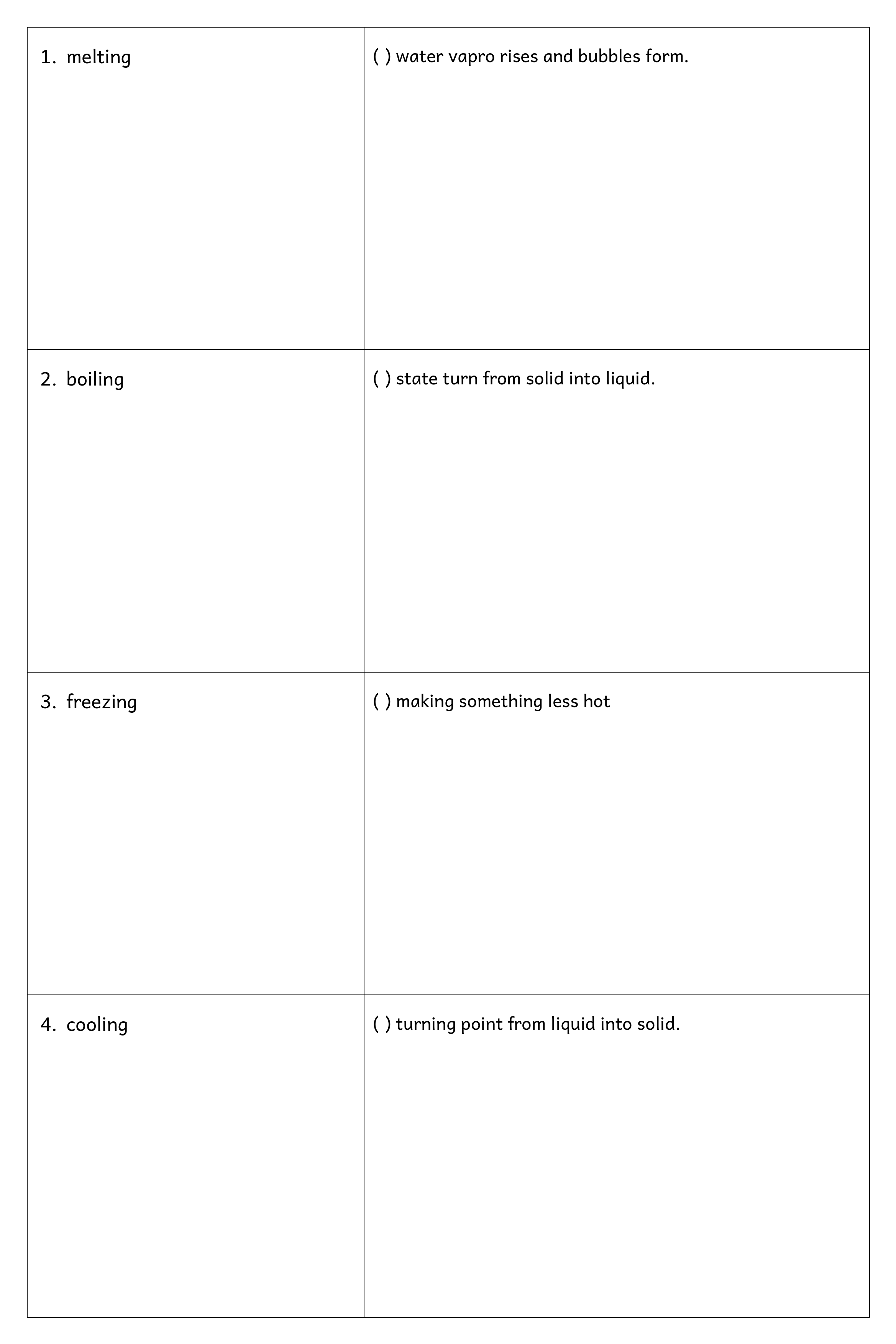
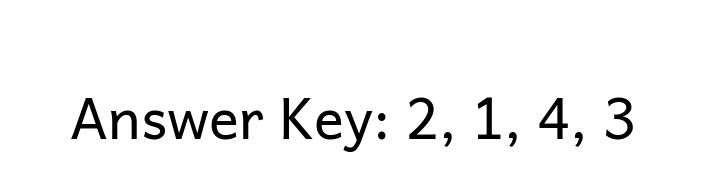
Melting and Freezing: Show students an ice cube. Ask them what will happen if it's left out [i.e., it will melt]. Explain that melting is a change from solid to liquid due to heating. Then, refreeze the water and explain that freezing is a change from liquid to solid due to cooling.
-
Boiling and Condensation: Boil water in a clear kettle or pot, allowing students to observe the steam. Explain that boiling is a change from liquid to gas due to heating. Then, show how the steam condenses back into water on a cool surface, explaining that condensation is a change from gas to liquid due to cooling.
-
-
Activity:
- Reversible Change Experiment: Provide each student (or group) with a small cup of butter or chocolate chips. Have them place the cup in their hands or a warm place to observe it melting. Then, place the cup in a cooler place to observe it solidifying again. Discuss how the butter/chocolate can return to its original state.
III. Exploring Irreversible Changes (15 minutes)
-
Demonstration:
-
Burning Paper: Carefully burn a small piece of paper in a controlled environment (with proper safety precautions). Explain that burning is an irreversible change because you cannot turn the ash back into paper.

-
Cooking an Egg: Show students a raw egg and then cook it (scramble or fry). Explain that cooking an egg is an irreversible change because you cannot uncook it.
-
-
Activity:
- Irreversible Change Discussion: Discuss examples of irreversible changes that students are familiar with, such as baking a cake, rusting metal, or leaves changing color in the fall. Ask them to explain why they think these changes are irreversible.
IV. Technical Application: Connecting to Careers (5 minutes)
-
Real-World Example: Discuss how understanding reversible and irreversible changes is important in various careers. For example:
-
Chef: Understands how cooking (often irreversible) and chilling (sometimes reversible) affects ingredients.
-
Metallurgist: Works with metals, understanding how heating and cooling can change their properties, sometimes reversibly (like annealing) and sometimes irreversibly (like hardening steel).
-
Environmental Scientist: Studies how pollutants change in the environment, some changes being reversible (like diluting a contaminant) and some irreversible (like certain chemical reactions).
-
-
Challenging Activity:
- Ask students to imagine they are developing a new type of snack. They need to decide whether changes during production should be reversible or irreversible. For example, should the snack change color when heated (reversible) or should it stay the same (irreversible)? Have them present their ideas, justifying their choices.
V. Conclusion (5 minutes)
-
Review: Recap the key concepts of reversible and irreversible changes.
-
Assessment: Ask students to provide their own examples of reversible and irreversible changes, explaining why they are classified as such.
-
Wrap-up: Encourage students to observe changes in matter around them and think about whether those changes are reversible or irreversible.
Change
Reversible?
Explanation
Melting Ice
Yes
Water can be refrozen.
Burning Wood
No
Ash cannot be turned back into wood.
Dissolving Sugar in Water
Yes
Water can be evaporated to recover the sugar.
Cooking an Egg
No
A cooked egg cannot be turned back into a raw egg.