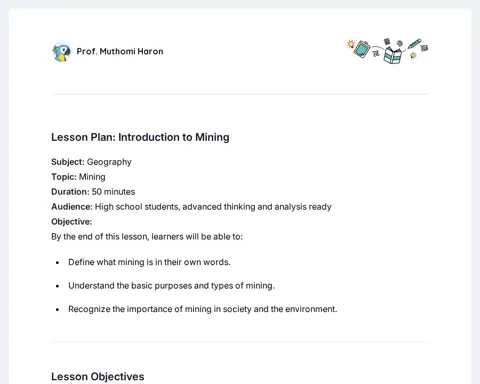
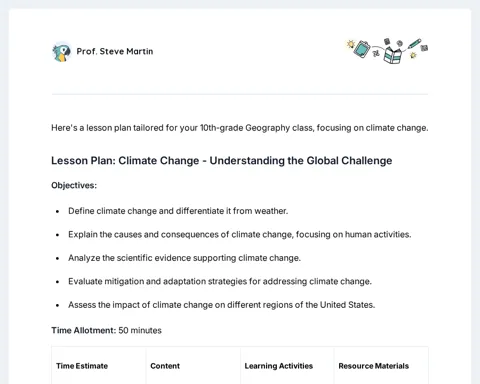
Geography Lesson Plan: Natural and Cultural Processes
Grade Level: 12th Grade
Duration: 60 minutes
Objectives:
-
Understand the Earth's landforms and relief features.
-
Analyze the causes and impacts of natural hazards (plate tectonics, volcanoes, earthquakes, tropical cyclones, tsunamis, floods, and droughts).
-
Examine the global distribution and utilization of natural resources.
-
Explore population growth patterns, distribution, and consequences.
-
Investigate urbanization processes, planning, and management strategies.
-
Assess the effects of tourism and its planning and management.
Materials:
-
Textbooks
-
World map
-
Computer/Projector
-
Internet access
-
Worksheets
-
Markers/Colored pencils
Lesson Activities:
-
Introduction (5 minutes)
-
Begin by reviewing key concepts related to geography and natural processes.
-
Engage students with a brief discussion about their understanding of the Earth's dynamic nature.
-
Present the lesson objectives.
-
-
Earth’s Landforms and Relief (10 minutes)
-
Explain different types of landforms (mountains, plains, plateaus) and relief features.
-
Use a world map to identify examples of various landforms and relief features.
-
Discuss the processes that create and shape these landforms (erosion, weathering, tectonic activity).
-
-
Living with Natural Hazards (15 minutes)
-
Plate Tectonics, Volcanoes, and Earthquakes:
-
Detail the theory of plate tectonics and its relationship to volcanoes and earthquakes.
-
Discuss the causes and effects of volcanic eruptions and earthquakes.
-
Show examples of areas prone to these hazards.
-
-
Tropical Cyclones, Tsunamis, Floods, and Droughts:
-
Explain the formation and characteristics of tropical cyclones, tsunamis, floods, and droughts.
-
Discuss the impacts of these hazards on human populations and the environment.
-
Share case studies of areas affected by these natural disasters.
-
-
-
Global Distribution and Utilization of Natural Resources (5 minutes)
-
Discuss the types and distribution of natural resources around the world.
-
Explain how natural resources are utilized and their importance to economies.
-
Engage students in a discussion about sustainable resource management.
-
-
Cultural Processes: Population Growth (5 minutes)
-
Explore population growth patterns and distribution across the globe.
-
Discuss the consequences of population growth, including environmental and social impacts.
-
-
Cultural Processes: Urbanization (5 minutes)
-
Explain the process of urbanization and its effects on cities and surrounding areas.
-
Discuss the challenges of urban planning and management, such as infrastructure, housing, and transportation.
-
-
Cultural Processes: Tourism (5 minutes)
-
Discuss the effects of tourism (positive and negative) on local communities and the environment.
-
Explain the importance of tourism planning and management to maximize benefits and minimize negative impacts.
-
-
Activity: Group Discussion (5 minutes)
-
Divide the class into small groups.
-
Assign each group a specific natural process or cultural process to discuss.
-
Have each group share their findings with the class.
-
Assessment:
-
Observe student participation in discussions.
-
Collect and review completed worksheets.
-
Assign a short essay on a chosen natural or cultural process.
Differentiation:
-
Provide additional support and resources for struggling learners.
-
Challenge advanced learners with extension activities.
National Curriculum of Vanuatu Standards Addressed:
-
Understand the Earth's landforms and relief features.
-
Analyze the causes and impacts of natural hazards.
-
Examine the global distribution and utilization of natural resources.
-
Explore population growth patterns, distribution, and consequences.
-
Investigate urbanization processes, planning, and management strategies.
-
Assess the effects of tourism and its planning and management.