5E Lesson Plan: Order of Operations
Objectives:
-
Students will identify and understand the order of operations in mathematical expressions.
-
Students will apply the correct order of operations to solve mathematical problems.
Engage (20 minutes)
-
Introduction: Begin by presenting a math problem with multiple operations but without parentheses, such as .
-
Ask students to solve the problem individually. You’ll likely get different answers.
-
Discuss the different answers and ask students to explain their methods. This will highlight the need for a standard order of operations.
Explore (30 minutes)
-
Group Activity: "Operation Scramble"
-
Divide the class into small groups.
-
Give each group a set of cards with numbers and operation symbols (+, -, ×, ÷, ( )).
-
Challenge them to create different mathematical expressions using the cards and solve them.
-
Encourage them to experiment with different groupings and operations to see how the placement of parentheses changes the outcome.
-
Have groups share some of the expressions they created and the different results they obtained.
Explain (30 minutes)
-
Introduce the Order of Operations (PEMDAS/BODMAS):
-
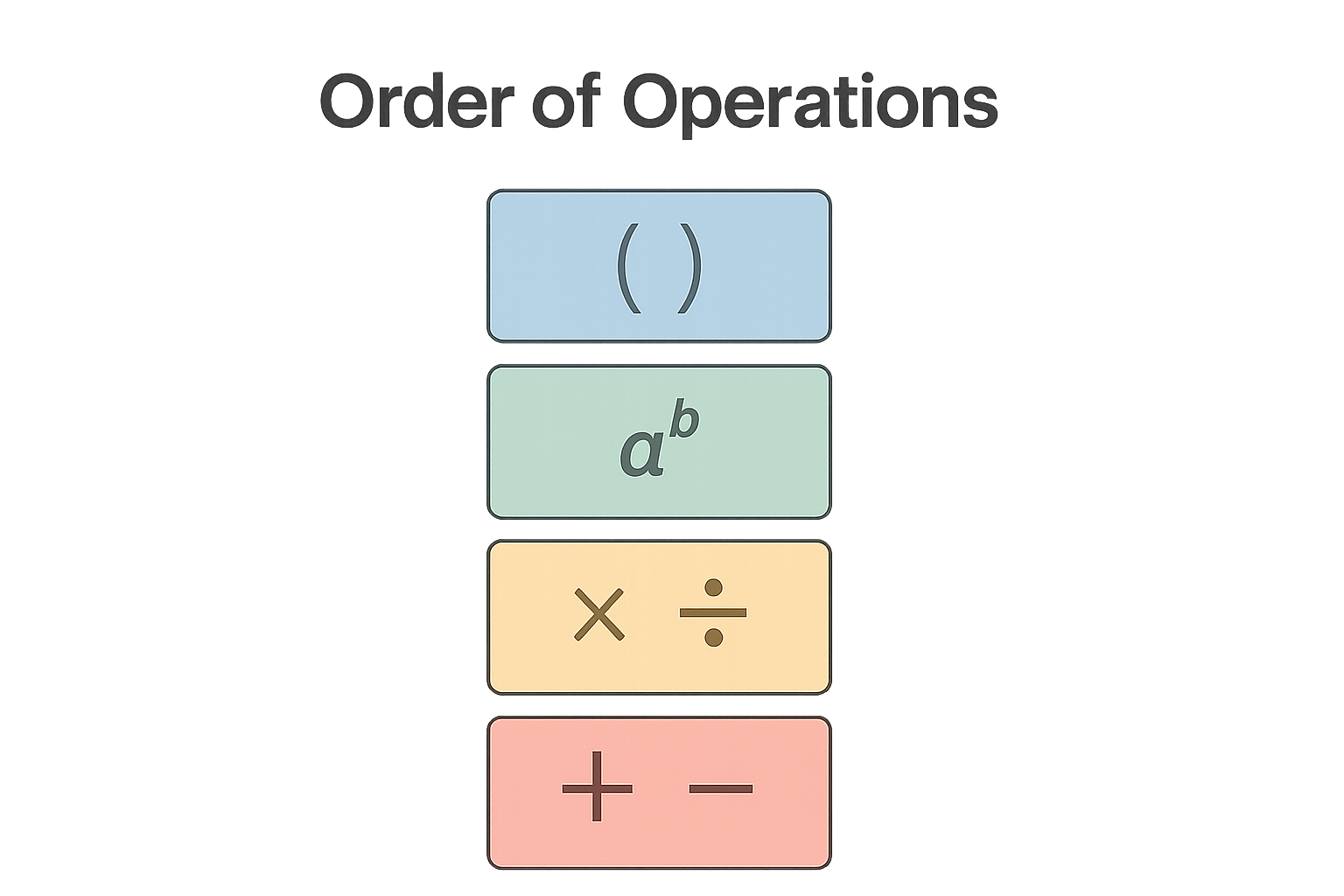
Explain the acronym PEMDAS (Parentheses, Exponents, Multiplication and Division, Addition and Subtraction) or BODMAS (Brackets, Orders, Division and Multiplication, Addition and Subtraction).
-
Detail that it provides a standard order for solving mathematical expressions.
-
Use examples to illustrate each step. For instance:
-
Parentheses:
-
Exponents:
-
Multiplication and Division: (from left to right)
-
Addition and Subtraction: (from left to right)
-
Interactive Whiteboard Session:
-
Work through several example problems on the interactive whiteboard, step-by-step, involving the whole class in determining the correct order of operations.
-
For example:
-
Elaborate (25 minutes)
-
Real-World Problem Solving:
-
Present word problems that require the use of order of operations to solve. For example:
-
"Sarah bought 3 notebooks for 1.50 each. How much did she spend in total?"
-
Translate the word problem into a mathematical expression:
.
-
Guide students to solve the problem using the correct order of operations.
-
Digital Tool Integration:
-
Use online math games or interactive tools that focus on order of operations. These games often provide immediate feedback and can make practice more engaging.
Evaluate (15 minutes)
-
Quick Quiz:
-
Administer a short quiz with problems that require the application of the order of operations. Include a mix of straightforward calculations and word problems.
-
Example Questions:
-
Solve:
-
Solve:
-
Word Problem: "John has 2 each and a drink for $3. How much money does he have left?"
-
Class Discussion:
-
Review the quiz answers together, discussing common errors and reinforcing the correct procedures.
By the end of this lesson, your students should have a solid understanding of the order of operations and be able to apply it confidently to solve mathematical problems!