OK! Here is your requested lesson plan.
Unit 9: Subtraction as Difference - 1st Grade
Unit Overview: In this unit, your students will explore subtraction as finding the difference between two numbers or amounts. They will use objects and number lines to visualize and solve subtraction problems.
Lesson 1: Finding the Difference (40 minutes)
Objective: Students will be able to use objects to find the difference between two amounts.
Materials:
- Ten interlocking cubes per student
- Sheet of paper
- Ten stickers or paper cut-out shapes and a glue stick per student
- Set of 1-5 number cards from Resource sheet 1: 0-20 number cards
Procedure:
-
Introduction (15 minutes):
- Begin by discussing the picture in the Student's Book (page 38), asking, "How many books are in each pile? How could you work out how many more books are in the larger pile?"
- Explain that today, we will learn how to find the difference between two amounts. Explain that 'finding the difference' means finding how many more there are in one amount than the other.
-
Main Activity (15 minutes):
- Have students choose two number cards. They make a line from their stickers to match each amount.
- Ensure that students position the two lines of stickers one above the other so that differences between the amounts of stickers are obvious.
- They count the extra stickers on the longer line to find the difference between the two amounts and write the answer at the bottom of the paper.

-
Wrap-up (5 minutes):
- Ask: "If my starting number was zero and my finishing number was four, what is the difference?"
- Demonstrate to students that the problem with using objects to find the difference between 0 and another number is that you cannot make a line or tower of zero objects because zero means none.
- Make a tower of four cubes and show students, then hold out an imaginary tower and say: "This is a tower of zero cubes." Demonstrate counting the difference between them by counting all four cubes in the tower of four and say: "The difference between zero and four is four."
- Repeat with 0 and other numbers less than 10 to reinforce that the difference between 0 and any number/amount will always be the same as the other number.
-
Assessment for Learning (5 minutes):
- What is the difference between 8 and 10?
- How could you use cubes to find the difference?
- Why must we line up our objects carefully when we compare them to find the difference?
Lesson 2: Subtracting by Finding the Difference (40 minutes)
Objective: Students will be able to solve subtraction problems by finding the difference.
Materials:
- 20 building blocks (per class)
- Paper (per student)
- Dishes of red and blue paint (per group)
Procedure:
-
Introduction (15 minutes):
- Direct students to the picture in the Student's Book (page 39). Ask: "Can you find the difference between the amounts of windows that are lit up on the towers?"
- Work through the problem with students, counting the extra windows that are lit up on one of the towers to find the answer. Explain that when you are asked to find the difference between two amounts, you are being asked to subtract the smaller amount from the larger amount.
-
Main Activity (15 minutes):
- Give students paper and two dishes of paint, one blue and one red.
- Students solve the subtractions on the slide by making fingerprint lines to match the minuend and the subtrahend using one color of paint.
- They go over the top of the extra prints in the longer line with the other color of paint to find the difference and write the answer next to the lines.

-
Wrap-up (5 minutes):
- Build a tower of nine blocks and a tower of six blocks.
- Ask: "What number sentence would match these towers if we wanted to find the difference between the amounts in each tower?" Encourage students to use the terms 'minuend', 'subtrahend', 'subtract', 'difference' and 'equals'.
-
Assessment for Learning (5 minutes):
- How would you find the answer to by finding the difference?
- How would you use blocks to find the difference to answer ?
- Which amount of blocks must be the minuend/subtrahend?
Lesson 3: Finding the Difference on a Number Line (80 minutes)
Objective: Students will be able to find the difference between two numbers on a number line.
Materials:
- Resource sheet 11: 0-10 number line (per student)
- Set of 1-10 number cards from Resource sheet 1: 0-20 number cards (per pair)
- Two counters (per pair)
Procedure:
-
Introduction (20 minutes):
- Direct students to the picture in the Student's Book (page 40). Ask: "Which flower did the bee start his journey from? Which flower has he ended up on? How many flowers has he landed on?"
- Tell students that the amount of flowers the bee has landed on is the difference between his starting number and his finishing number.
-
Main Activity (40 minutes):
- Give each pair a set of 1-10 number cards, a number line, and two counters.
- Students pick two numbers, place a counter on each of the numbers, and find the difference by counting the numbers between them and the last number.

-
Wrap-up (10 minutes):
- Discuss what would happen if you needed to find the difference between 0 and any number.
- Ask: "Where would you start counting the difference from?" Elicit that it is the same as finding the difference between any two numbers, so you would start by counting the numbers between.
-
Assessment for Learning (10 minutes):
- What is the difference between 6 and 9?
- How would you use a number line to find the difference between 6 and 9?
- Point to the number I would count first if I wanted to find the difference between 6 and 9.
- Which number would I stop counting on if I was finding the difference between 6 and 9 on a number line?
Lesson 4: Subtraction as Difference on a Number Line (40 minutes)
Objective: Students will be able to solve subtraction problems by finding the difference on a number line.
Materials:
- Set of 1-10 large number cards (per class)
- 20 large stickers (per class)
- 0-10 number cards from Resource sheet 1: 0-20 number cards (per student)
- Resource sheet 11: 0-10 number line (per student)
- Small stickers or a pencil (per student)
Procedure:
-
Introduction (15 minutes):
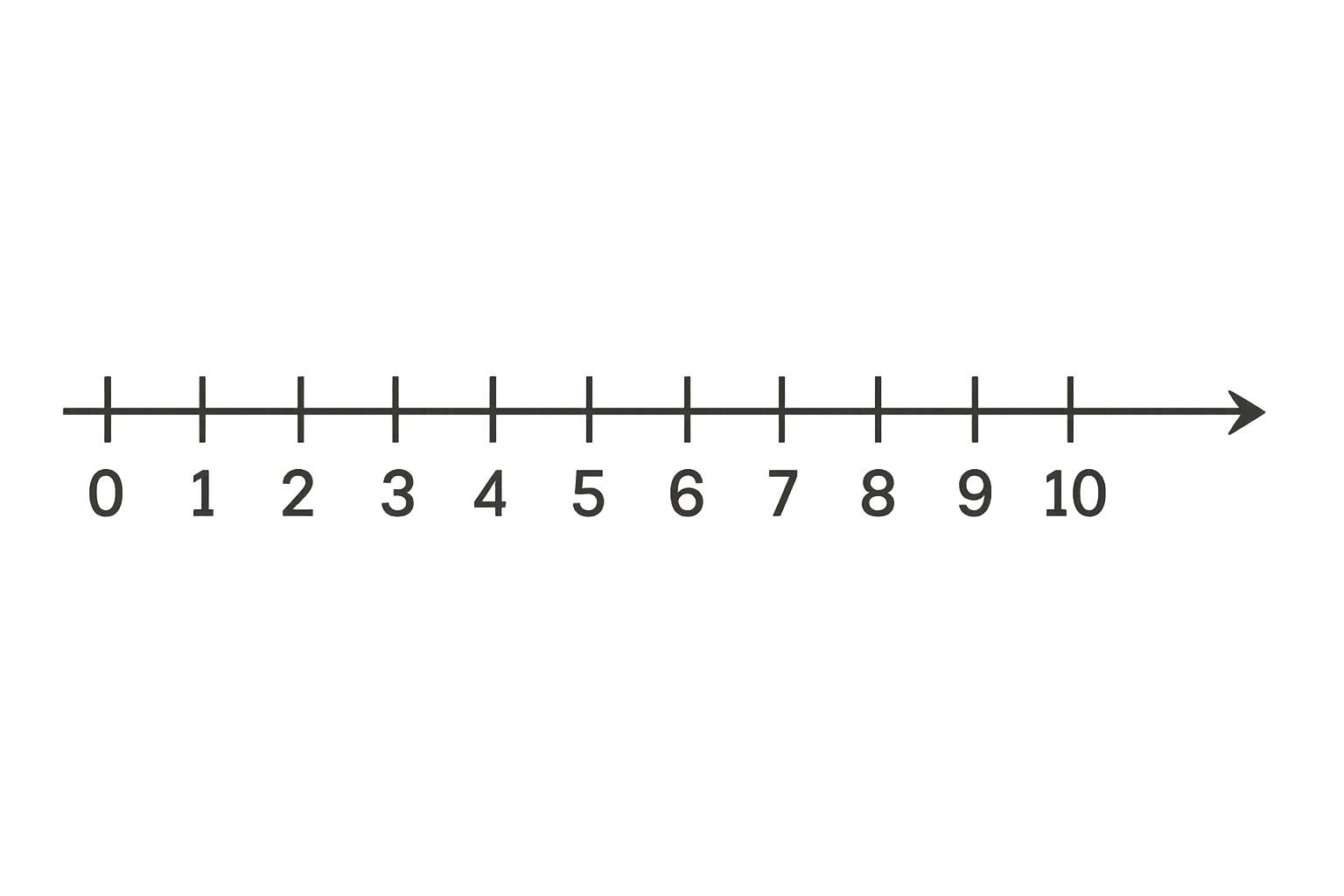
- Direct students to the picture in the Student's Book (page 41). Ask: "How is the number line being used to solve the subtraction? What is the difference between 3 and 8?"
- Count the jumps and agree that the difference is 5. Say: .
-
Main Activity (15 minutes):
- Learners use a 0-10 number line to find the difference to solve the subtractions on the slide.
- Provide small stickers to stick on the numbers, or pencils to cross out numbers as support.
-
Wrap-up (5 minutes):
- Say: "Leo goes to two clubs every week after school. Munisha goes to four clubs. What is the difference between the number of clubs they go to?"
- Ask: "What number sentence would match that subtraction problem?" Write the number sentence on the board.
-
Assessment for Learning (5 minutes):
- Show me how you would find the difference on a number line to solve .
- Which numbers do you count if you are finding the difference between 7 and 10?
- How could you check your answer?
Copy Work Activities (Wednesday Homework)
Based on Lesson 1 and Lesson 2:
-
Number Towers:
- Write the numbers 3 and 7 on the board.
- Instruct students to draw two towers of blocks, one with 3 blocks and one with 7 blocks.
- Ask them to circle the extra blocks in the taller tower and write the difference.
-
Sweet Subtraction:
- Write the subtraction problem on the board.
- Instruct students to draw 6 candies and then cross out 2 of them.
- Ask them to count the remaining candies and write the answer.
Reinforcement Worksheet (Friday Homework)
Unit 9: Subtraction as Difference
-
Finding the Difference with Objects:
- Include pictures of two groups of objects (e.g., apples, cars).
- Ask students to count the number of objects in each group and write the numbers.
- Then, ask them to circle the extra objects in the larger group and write the difference.
-
Subtraction Sentences:
- Provide subtraction sentences (e.g., , ).
- Ask students to draw counters to represent each number and cross out the appropriate number to solve the problem.
-
Number Line Subtraction:
- Include number lines with subtraction problems (e.g., , ).
- Ask students to use the number line to find the difference and write the answer.
-
Word Problems:
- Include simple word problems (e.g., "Maria has 7 balloons. She gives 3 to her friend. How many balloons does Maria have left?").
- Ask students to write a subtraction sentence to solve the problem and write the answer.
I hope your students enjoy this unit!