ASSURE Model Lesson Plan: Trigonometric Ratios in Right Triangles
Subject: Math (Trigonometry) Grade Level: 9th Grade Lesson Duration: 50 minutes
Objectives:
- Students will be able to identify corresponding sides in similar right triangles.
- Students will be able to calculate trigonometric ratios (sine, cosine, tangent) for angles in right triangles.
- Students will be able to demonstrate that the ratios of corresponding sides in similar right triangles are constant.
Analyze Learners:
Consider that you have one student with dyslexia and two students with learning gaps.
State Standards:
This lesson aims to align with Common Core State Standards for Mathematics, specifically focusing on trigonometric ratios and similarity.
Select Methods, Media, and Materials:
- Whiteboard or projector
- Markers or pens
- Rulers
- Protractors
- Worksheets with pre-drawn right triangles
- Scientific calculators
- Computer with internet access for simulations
- Real-world example images (skyscrapers, ramps, etc.)
Utilize Methods, Media and Materials
Engage (5 minutes)
- Begin by asking students about real-world examples where angles and triangles are important (e.g., building construction, sports, navigation).
- Show images of such examples and ask students to identify any right triangles they see
 .
. - Briefly introduce the concept of trigonometry as a tool to relate angles and side lengths in triangles.
State Objectives (2 minutes)
- Clearly state the lesson objectives. For example: "Today, we're going to explore how ratios in similar right triangles are constant, which is the basis for trigonometry."
Preview (3 minutes)
- Briefly review similar triangles and their properties.
- Remind students that corresponding angles in similar triangles are equal, and corresponding sides are proportional.
Present the Content (15 minutes)
- Theoretical Presentation:
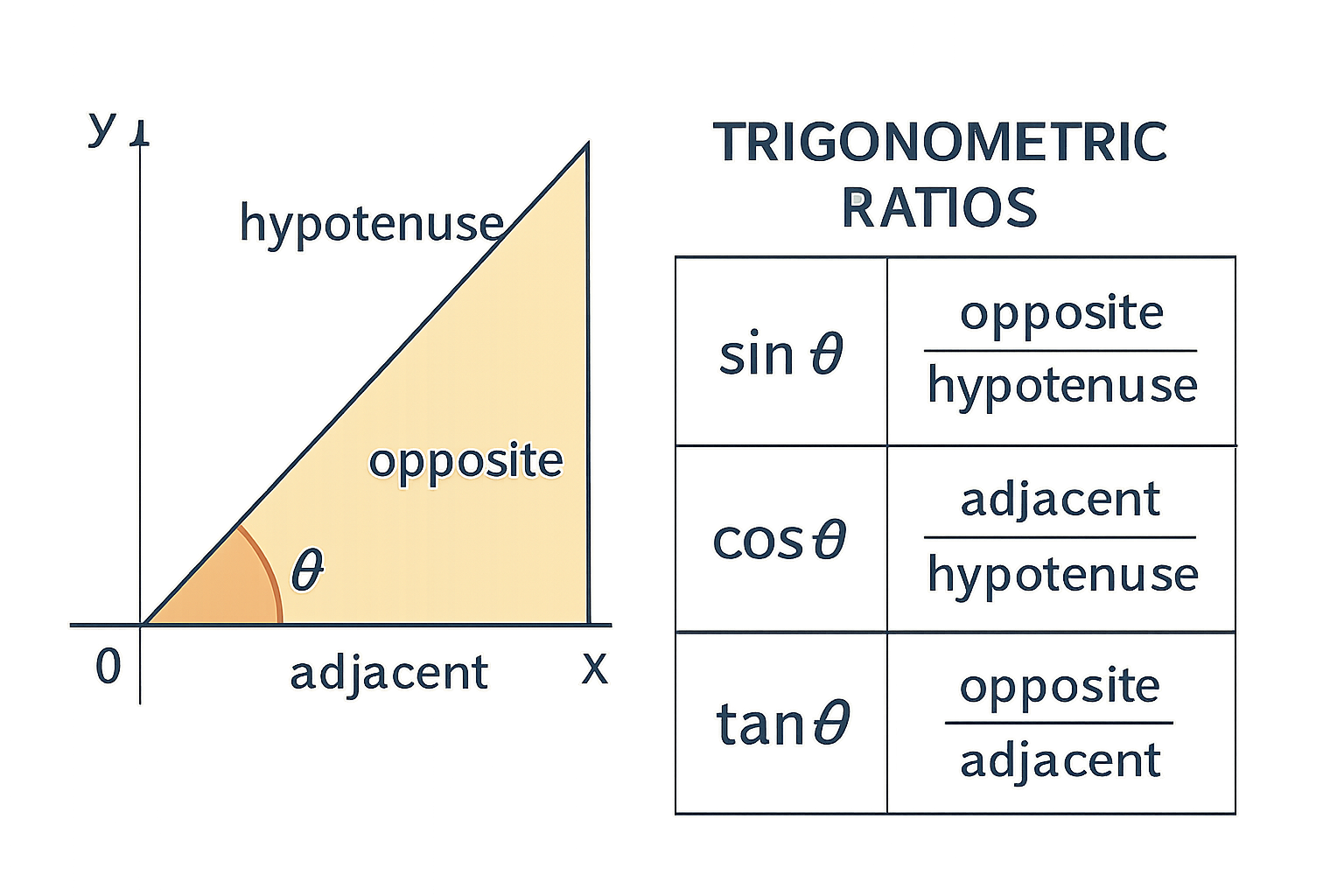
- Define trigonometric ratios (sine, cosine, tangent) using the sides of a right triangle:
- Sine (sin) = Opposite / Hypotenuse
- Cosine (cos) = Adjacent / Hypotenuse
- Tangent (tan) = Opposite / Adjacent
- Use SOH-CAH-TOA mnemonic to help students remember the ratios.
- Explain that these ratios are constant for a given angle, regardless of the size of the triangle.
- Define trigonometric ratios (sine, cosine, tangent) using the sides of a right triangle:
- Real-World Examples:
- Show how trigonometry is used in various professions:
- Engineering: Calculating angles and forces in bridge design.
- Architecture: Determining roof slopes and building heights.
- Navigation: Using angles for determining direction and location.
- Provide specific examples:
- An engineer needs to build a ramp with a 30-degree angle. Use trigonometric ratios to determine the required length of the ramp if the height is 5 feet.
- An architect is designing a building and needs to calculate the angle of elevation from a point 100 feet away from the base to the top of the building, which is 150 feet tall.
- Show how trigonometry is used in various professions:
- Differentiation for Dyslexia and Learning Gaps:
- For the student with dyslexia, provide a visual aid with color-coded sides of the triangle and corresponding ratios. Use clear, concise language.
- For students with learning gaps, provide additional practice problems with simpler numbers and step-by-step guidance.
Require Learner Participation (15 minutes)
- Activity 1: Calculating Ratios (10 minutes)
- Distribute worksheets with various right triangles. Ask students to measure the sides and calculate the sine, cosine, and tangent for a specific angle in each triangle.
- Have students compare their results with classmates for similar triangles to demonstrate that the ratios are the same.
- Activity 2: Interactive Simulation (5 minutes)
- Use an online simulation (e.g., PhET simulation on trigonometry) to allow students to manipulate the size of a right triangle and observe how the trigonometric ratios remain constant for a given angle
 .
. - Encourage students to explore different angles and observe the changes in the ratios.
- Use an online simulation (e.g., PhET simulation on trigonometry) to allow students to manipulate the size of a right triangle and observe how the trigonometric ratios remain constant for a given angle
- Differentiation for Dyslexia and Learning Gaps:
- Provide pre-measured triangles for the student with dyslexia to reduce measurement errors.
- Offer one-on-one support for students with learning gaps, breaking down the calculations into smaller steps.
Assess (10 minutes)
- Quick Quiz:
- Administer a short quiz with problems that require students to calculate trigonometric ratios for given right triangles.
- Include problems that involve finding missing side lengths using trigonometric ratios.
- Real-World Application Problem:
- Present a word problem that requires students to apply trigonometric ratios to solve a practical problem (e.g., finding the height of a tree using the angle of elevation and the distance from the tree).
- Differentiation for Dyslexia and Learning Gaps:
- Allow the student with dyslexia to use a calculator and provide extra time to complete the quiz.
- Offer alternative assessment options for students with learning gaps, such as a verbal explanation of how they would solve a problem.
Evaluate & Revise:
- Collect the quizzes and review student performance to identify areas where further instruction is needed.
- Based on student feedback and performance, adjust the lesson for future classes, providing additional support and practice as necessary.
- Consider incorporating more real-world examples and hands-on activities to enhance student engagement and understanding.
Prepare Environment:
- Ensure that the classroom is set up to facilitate group work and individual practice.
- Have all necessary materials readily available.
- Ensure the computer and projector are working correctly for the simulation.
Prepare Learners:
- Briefly review the concepts of similar triangles and proportions before starting the lesson.
- Explain the objectives of the lesson and what students will be expected to do.