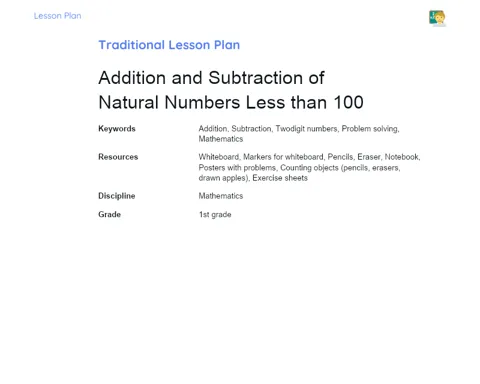
Lesson Plan | Socioemotional Learning | Addition and Subtraction of Natural Numbers Less than 100
| Keywords | Addition, Subtraction, Natural Numbers, Socioemotional Skills, Self-Awareness, Self-Control, Responsible Decision Making, Social Skills, Social Awareness, RULER, Guided Meditation, Problem Solving, Reflection, Emotional Regulation, Personal Goals, Mathematics, Elementary Education, Group, Interactive Activity |
| Required Materials | Comfortable chairs, Calm and quiet environment, Cards with addition and subtraction problems, Game board (can be drawn on the floor or on poster board), Markers or pieces for the board, Notebooks for written reflection, Pencils or pens |
Objectives
Duration: (10 - 15 minutes)
The purpose of this stage of the Socioemotional Lesson Plan is to introduce students to the topic of addition and subtraction of natural numbers less than 100, highlighting the importance of these skills for solving everyday problems. This introduction also aims to emotionally prepare students for learning by promoting an environment of self-awareness and self-control, where they feel confident to express their emotions and regulate their frustrations when facing mathematical challenges.
Main Goals
1. Develop the ability to add and subtract two-digit numbers, such as 33 + 54 = 87, with or without the use of algorithms.
2. Solve practical problems involving the addition and subtraction of two-digit numbers, applying the knowledge acquired in everyday situations.
Introduction
Duration: (20 - 25 minutes)
Emotional Warm-up Activity
Meeting with Calm
Guided Meditation for Focus and Concentration
1. Prepare the environment: Ask students to sit comfortably in their chairs. Ensure the environment is calm and quiet.
2. Explain the activity: Tell students that they will do a brief guided meditation to help them focus better in class.
3. Deep breathing: Instruct students to close their eyes and breathe deeply, inhaling through the nose and exhaling through the mouth.
4. Visualization: Ask students to imagine a calm and peaceful place, like a beach or a green field. Tell them to focus on the sounds and sensations of that place.
5. Focus on the body: Guide students to focus on different parts of their body, starting from their feet and moving up to their head, relaxing each part as they go.
6. Final breathing: Conclude the meditation by asking students to take three more deep breaths before slowly opening their eyes.
7. Brief reflection: Ask students how they feel after the meditation and if they noticed any difference in their level of concentration.
Content Contextualization
Addition and subtraction of numbers less than 100 are fundamental not only for learning in mathematics but also for daily life. Imagine being in a toy store and needing to calculate how many toys you can buy with a certain amount of money. Knowing how to add and subtract helps make more informed decisions and solve practical problems in daily life. Additionally, by learning mathematics, students also develop socioemotional skills such as patience, persistence, and the ability to cope with frustrations. Each problem solved is an opportunity for emotional growth, where the child learns to recognize their emotions, understand their frustrations, name them, express them appropriately, and regulate their feelings to move forward.
Development
Duration: (60 - 75 minutes)
Theoretical Framework
Duration: (20 - 25 minutes)
1. Concept of Addition: Explain that adding is combining two quantities to get a total amount. For example, if we have 33 candies and receive 54 more, we need to add 33 + 54 to find out how many candies we have in total.
2. Concept of Subtraction: Explain that subtracting is taking away one quantity from another to find out what remains. For example, if we have 97 candies and eat 54, we need to subtract 97 - 54 to find out how many candies are left.
3. Components of an Addition: Introduce the terms 'addend' and 'sum'. In the example 33 + 54 = 87, 33 and 54 are addends and 87 is the sum.
4. Components of a Subtraction: Introduce the terms 'minuend', 'subtrahend', and 'remainder'. In the example 97 - 54 = 43, 97 is the minuend, 54 is the subtrahend, and 43 is the remainder.
5. Calculation Strategies: Teach different strategies to perform additions and subtractions, such as using a number line, decomposing numbers, and the traditional algorithm.
6. Practical Examples: Provide practical and interactive examples. Ask students: 'If you have 45 pencils and receive 32 more, how many pencils will you have in total?' or 'If you have 86 stickers and give 47 to a friend, how many stickers will you still have?'
7. Analogies: Use analogies to facilitate understanding, such as comparing addition to 'putting together pieces of a puzzle' and subtraction to 'removing pieces from a puzzle' to see what remains.
Socioemotional Feedback Activity
Duration: (35 - 40 minutes)
Addition and Subtraction Race
In this activity, students will participate in an 'addition and subtraction race' where they must solve mathematical problems to advance in the game. This activity not only reinforces the content learned but also promotes socioemotional skills such as teamwork, patience, and emotional regulation.
1. Divide the class: Organize students into groups of 4 to 5 people.
2. Distribute materials: Give each group a set of cards with addition and subtraction problems of two-digit numbers.
3. Explain the rules: Each group must solve one card at a time. When a problem is solved correctly, the group can move forward one space on a game board (which can be drawn on the floor or on poster board).
4. Set a time: Give a set time for the activity, such as 15 minutes. The group that advances the most spaces by the end of the time will be the winner.
5. Monitor the activity: Move around the room to help groups with questions and check if the answers are correct.
Group Discussion
After the activity, gather students in a circle to discuss how they felt during the 'race'. Use the RULER method to guide the discussion:
Recognize: Ask students to recognize and share the emotions they felt during the activity, such as excitement, frustration, or joy. For example, ask: 'Did anyone feel frustrated when they couldn't solve a problem right away?'
Understand: Encourage students to understand the causes of those emotions. Ask: 'Why do you think you felt that way? What triggered that emotion?' This helps build a deeper understanding of their own reactions.
Name: Help students correctly name the emotions they felt. Use a broad emotional vocabulary to enrich the discussion. For example: 'I felt anxious because I wanted my group to win.'
Express: Teach students to express their emotions appropriately. Discuss healthy ways to deal with frustration or anxiety during competitive activities.
Regulate: Finally, talk about strategies to regulate these emotions in the future. Ask: 'What can we do next time to better manage these emotions?'
Conclusion
Duration: (15 - 20 minutes)
Emotional Reflection and Regulation
Suggest that students engage in a written reflection or participate in a group discussion about the challenges faced during the lesson. Ask them to write or speak about how they felt while solving addition and subtraction problems, what emotions arose, how they dealt with those emotions, and what they could do differently in the future to improve their emotional response and academic performance. For example, ask: 'What were the most challenging moments for you? How did you feel? What did you do to overcome these challenges?'
Objective: The objective of this subsection is to encourage self-assessment and emotional regulation among students, helping them identify effective strategies for coping with challenging situations. By reflecting on their emotions and behaviors, students can develop a better understanding of themselves and learn to cope more effectively with frustrations and future challenges, both in math and other areas of their lives.
Closure and A Look Into The Future
Explain to students that at the end of the lesson, they will set personal and academic goals related to the content learned. For example, ask them to think of a specific goal to improve their addition and subtraction skills, such as 'Solve three addition and subtraction problems every day' or 'Ask for help whenever I don’t understand a question.' Encourage them to write these goals in their notebooks and share with the class if they feel comfortable.
Possible Goal Ideas:
1. Solve three addition and subtraction problems every day.
2. Ask for help whenever I don’t understand a question.
3. Practice addition and subtraction with math games.
4. Help a classmate who is having difficulties with the content.
5. Reflect on the emotions felt during the resolution of math problems. Objective: The objective of this subsection is to strengthen students' autonomy and the practical application of learning, encouraging them to continue developing both academically and personally. By setting clear and specific goals, students can focus on areas that need improvement and monitor their own progress, promoting a sense of responsibility and self-confidence in the learning process.