Lesson Plan | Teachy Methodology | Domestic Accident Prevention
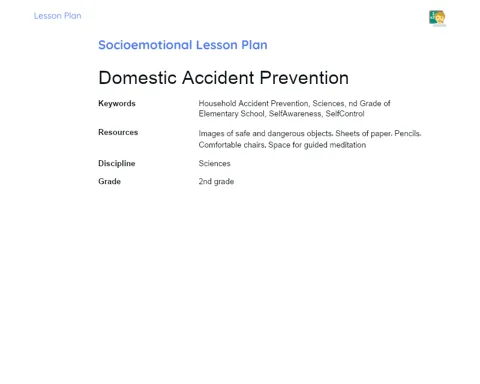
| Keywords | Household Accident Prevention, Sciences, Elementary Education, Digital Methodology, Sharp Objects, Flammable Materials, Electricity, Cleaning Products, Practical Activities, Social Media, Digital Tools, Household Safety, Collaboration, Gamification, Digital Influencers, Digital Detectives, Interactive Game |
| Required Materials | Phones, Computers, Internet Access, Digital clue cards, Multimedia presentation tools (PowerPoint, Google Slides, Canva), Gamification app (Classcraft, Kahoot), Fake social media account or Canva to simulate posts |
Objectives
Duration: 10 - 15 minutes
The purpose of this stage is to establish a clear and concise foundation for understanding the topic of the lesson. By clearly defining the main and secondary objectives, it ensures that students are aware of what is expected of them and the knowledge they should acquire. This allows for a focused approach during practical activities and maximizes student engagement with the presented content.
Main Objectives
1. Understand the different ways to prevent common household accidents, such as how to handle sharp objects, flammable materials, electricity, and cleaning products.
2. Equip students to identify potential risks in a home environment and formulate practical strategies to avoid them.
Side Objectives
- Promote awareness of safety in the home environment through the use of digital technologies and social media.
- Strengthen students' ability to work collaboratively, sharing knowledge and solutions for accident prevention.
Introduction
Duration: 15 - 20 minutes
The purpose of this stage is to engage students in an interactive and practical manner from the start of the lesson, using digital tools that are part of their daily lives. This will help make the topic more relevant and interesting, as well as stimulate curiosity and critical thinking through key questions. This warm-up prepares students for the subsequent practical activities, ensuring better engagement and understanding of the content.
Warming Up
Start the lesson by discussing the importance of knowing and preventing household accidents to ensure safety in daily life. Then, instruct students to use their phones to search for an interesting fact about the topic. For example, they can look for statistics on household accidents or safety tips provided by experts.
Initial Reflections
1. What are the most common types of household accidents that can occur at home?
2. How can we prevent accidents with sharp objects in the kitchen?
3. What should we do to avoid accidents with electricity?
4. What precautions should we take when handling cleaning products?
5. Why is it important to be aware of the risks of flammable materials inside the house?
Development
Duration: 70 - 80 minutes
The purpose of this stage is to allow students to apply their prior knowledge about household accident prevention in practical and interactive activities, using digital technologies to make learning more dynamic, relevant, and engaging. Each activity suggests different teaching approaches, promoting collaboration, creativity, and problem-solving in a realistic context.
Activity Suggestions
It is recommended that only one of the suggested activities be carried out
Activity 1 - Digital Detectives 🕵️♂️🔍
> Duration: 60 - 70 minutes
- Objective: Equip students to identify household hazards and propose practical and technological solutions to prevent them, encouraging collaboration and the use of digital tools.
- Description: Students will be divided into groups and will turn their classrooms into a 'detective scenario.' Each group will receive a set of digital clues that represent different types of household accidents. Using their phones and computers, students will seek solutions to prevent the accidents identified in the scenario, compiling their findings into a multimedia presentation.
- Instructions:
-
Divide the class into groups of up to 5 students.
-
Distribute 'digital clue cards' among the groups with situations that simulate household accidents (for example, a picture of a poorly placed knife in the kitchen, a cleaning product within reach of a child, etc.).
-
Instruct students to use their phones to research online solutions to prevent the accidents represented in the clues.
-
Ask students to compile their findings and create a multimedia presentation using tools like PowerPoint, Google Slides, or Canva. The presentation should include images, texts, and explanatory videos.
-
At the end, each group will present their solutions to the class, explaining how they arrived at their conclusions and the prevention methods they found. Other groups can ask questions and provide additional suggestions.
Activity 2 - Safety Influencers 👩🎤📱
> Duration: 60 - 70 minutes
- Objective: Raise awareness about household accidents and their prevention through the creative use of social media, promoting communication and creativity skills.
- Description: Students will take on the role of digital influencers and create household safety campaigns using social media platforms like Instagram or TikTok. Each group will choose a type of household accident to focus on and will produce creative videos, photos, and posts to educate their 'followers' about preventing these accidents.
- Instructions:
-
Form groups of up to 5 students and ask them to choose a type of household accident to address (for example, accidents involving electricity, cleaning products, etc.).
-
Instruct students to create a fake account on a social network or use tools like Canva to simulate posts.
-
Ask groups to create a series of posts, including short videos, photos, and captions that explain the risks and provide prevention tips for the chosen type of accident.
-
Students can use features like filters, stickers, and music to make their posts more engaging.
-
At the end, each group will share their campaigns with the class, showcasing the posts and explaining the creative process and the safety information included.
Activity 3 - Super Safe Game 🎮🛡️
> Duration: 60 - 70 minutes
- Objective: Teach household accident prevention practices in a playful and collaborative manner, using gamification to increase engagement and knowledge retention.
- Description: In this gamified activity, students will participate in a digital board game where they face various challenges related to household safety. Using a gamification app, they will work in teams to solve problems, answer quizzes, and complete missions that teach household accident prevention.
- Instructions:
-
Divide students into groups of up to 5 and provide access to a gamification app (like Classcraft or Kahoot with custom games).
-
Explain the rules of the game and the objectives: each team must advance through the digital board by completing missions and answering questions about accident prevention.
-
Missions may include tasks such as identifying mistakes in photos of homes, answering interactive quizzes about safety, and proposing solutions for simulated danger scenarios.
-
With each completed mission, the team earns points and advances on the board. The group with the most points at the end of the game wins.
-
During the game, monitor and provide support to the teams as needed, encouraging collaboration and discussion about best safety practices.
Feedback
Duration: 20 - 25 minutes
The purpose of this stage is to ensure that students can reflect on what they learned and how they applied their skills during the activities. The group discussion promotes knowledge exchange and consolidates learning, while the 360° feedback encourages self-critique and personal development, always aiming for a collaborative and respectful environment.
Group Discussion
Facilitate a group discussion with all students, where groups share what they learned during the activities and their conclusions. Follow the outline below to introduce the discussion:
- Introduction: Thank students for participating in the activities and highlight the importance of sharing learnings.
- Sharing: Ask each group to briefly present their findings and solutions for household accident prevention.
- Reflection: Encourage students to reflect on how the activities helped them better understand household hazards and ways to prevent them.
- Open Questions: Create a space for questions and discussions, allowing students to lead part of the conversation with their curiosities and observations.
Reflections
1. What was the main lesson you learned about preventing household accidents during the activities? 2. How did the use of digital tools and social media help in understanding and preventing accidents? 3. What could be done differently or better next time you participate in a similar activity?
360° Feedback
Conduct a 360° feedback session where each student must receive feedback from the other students in their group. Follow these guidelines to ensure that the feedback is constructive and respectful:
- Initial Guidance: Explain what 360° feedback is and the importance of being honest and respectful.
- Positive Feedback: Ask each student to start by highlighting one positive quality or action of each colleague in the group.
- Areas for Improvement: Then, each student should suggest something that could be improved, always with a constructive tone.
- Conclusion: Thank the students for participating and reinforce the importance of feedback for personal and collective growth.
Conclusion
Duration: 10 - 15 minutes
📚 Purpose: The purpose of this stage is to consolidate the knowledge acquired in a fun and practical way, relating the lesson content to the real world and the students' lives. By summarizing the key points and highlighting the relevance of the topic in the modern context, the conclusion reinforces the importance of preventing household accidents and encourages students to apply and share what they have learned in their daily lives.
Summary
🔍 Fun Summary: In this digital detective adventure, students explored the urban jungle of their own homes, uncovering mysteries and finding innovative solutions to avoid household accidents. As true safety influencers, they used their social networks to promote campaigns and taught each other about the hidden dangers of the home environment. Finally, they all became Super Safe in an interactive game, facing challenges and overcoming dangers in every corner of the house. 🚀🛡️
World Connection
🌐 Connecting with the Modern World: Through the use of digital technologies, this lesson allowed students to connect with the dynamic reality of social networks and instant information. They learned the importance of turning knowledge into practical actions and using modern tools to promote a safer and more conscious environment. The lesson demonstrated how learning can be integrated into the digital daily life, making it more relevant and applicable.
Practical Application
🏡 Applications in Daily Life: Preventing household accidents is essential to ensuring the safety and well-being of everyone at home. With the knowledge acquired, students are now prepared to identify and mitigate risks, promoting a safer home environment for their families. They can also share this knowledge with the community, raising awareness about the importance of household safety.