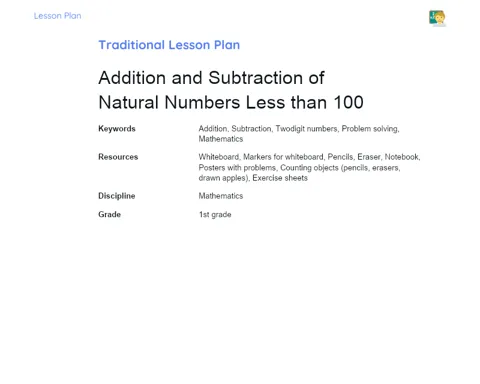
Lesson Plan | Traditional Methodology | Addition and Subtraction Problems
| Keywords | Addition, Subtraction, Mathematical Problems, Natural Numbers, Problem Solving, Step by Step, Practical Examples, Key Words, Guided Practice, Meaningful Learning |
| Required Materials | Board and Chalk or Whiteboard and Markers, Notebooks, Pencils, Erasers, Printed Exercise Sheets, Calculators (optional), Fruits or Objects for Exemplification (optional) |
Objectives
Duration: 10 - 15 minutes
The purpose of this stage of the lesson plan is to ensure that students clearly understand the main objectives of the lesson. By outlining the objectives, students can better focus on what is expected of them and what they will learn. This also helps guide the teacher during the explanation, ensuring all essential points are covered.
Main Objectives
1. Teach students to identify when to use addition and when to use subtraction in mathematical problems.
2. Develop students' ability to solve problems involving addition and subtraction of natural numbers.
3. Promote understanding of the logical reasoning behind addition and subtraction through practical examples.
Introduction
Duration: 10 - 15 minutes
The purpose of this stage of the lesson plan is to capture the students' attention and interest by contextualizing the practical importance of the content to be covered. By doing so, students can see the relevance of what they are learning and become more engaged and motivated to participate in the class.
Context
Start the lesson by asking the students how many of you have ever helped your parents shop at the market? Explain that just like they help count how many fruits or vegetables are bought, math helps us solve these counts and much more. Today, we will learn how to solve problems using addition and subtraction, essential skills not only for the classroom but for everyday life.
Curiosities
Did you know that supermarket cashiers, online sales systems, and even board games use addition and subtraction to calculate prices, discounts, and scores? This shows how these mathematical operations are present in various activities of our daily lives!
Development
Duration: 50 - 60 minutes
The purpose of this stage of the lesson plan is to deepen students' understanding of the concepts of addition and subtraction through detailed explanations and practical examples. By addressing specific topics and solving problems step by step, the teacher ensures that students understand when and how to use each mathematical operation. Guided practice allows students to immediately apply what they have learned, effectively consolidating their knowledge.
Covered Topics
1. Concept of Addition: Explain that addition is the mathematical operation used to sum two or more numbers. Detail that the result of addition is called 'sum' or 'total'. Use simple examples, like adding 3 apples and 2 apples to get a total of 5 apples. 2. Concept of Subtraction: Explain that subtraction is the mathematical operation used to find the difference between two numbers. Detail that the result of subtraction is called 'difference'. Use simple examples, like having 5 apples and eating 2, resulting in 3 apples left. 3. Identification of Key Words in Problems: Teach students to identify key words that indicate when to use addition (such as 'total', 'join', 'sum') and when to use subtraction (such as 'remaining', 'take away', 'less'). 4. Step-by-Step Problem Solving: Demonstrate how to solve addition and subtraction problems step by step. Use a practical example: 'Maria had 8 candies, she got 5 more from her friend. How many candies does Maria have now?' Show how to identify the correct operation (addition) and solve the problem (8 + 5 = 13). 5. Guided Practice: Propose an exercise where students have to solve problems together with the teacher. For example: 'Pedro had 10 stickers and gave 3 to his friend. How many stickers does Pedro have now?' Solve the problem step by step on the board, highlighting the subtraction (10 - 3 = 7).
Classroom Questions
1. João had 15 pencils. He gave 4 pencils to his sister. How many pencils does João have now? 2. Ana had 7 dolls. She received 6 more dolls as a gift. How many dolls does Ana have now? 3. Carlos had 12 toy cars and lost 5. How many toy cars does Carlos have now?
Questions Discussion
Duration: 15 - 20 minutes
The purpose of this stage of the lesson plan is to review and consolidate students' understanding of the concepts of addition and subtraction. By discussing the solved questions and engaging students with reflective questions, the teacher can identify potential doubts and ensure that students fully understand how and when to use each mathematical operation. This stage also allows students to reflect on the practical application of what they have learned, promoting a deeper and more meaningful learning experience.
Discussion
-
For the question 'João had 15 pencils. He gave 4 pencils to his sister. How many pencils does João have now?', explain that we start with 15 pencils and subtract 4 pencils because he gave those pencils to his sister. The operation is 15 - 4, resulting in 11 pencils. This is an example of subtraction because we are taking away a quantity from the pencils João initially had.
-
For the question 'Ana had 7 dolls. She received 6 more dolls as a gift. How many dolls does Ana have now?', explain that we start with 7 dolls and add 6 dolls because she received those dolls as a gift. The operation is 7 + 6, resulting in 13 dolls. This is an example of addition because we are joining a quantity to what Ana already had.
-
For the question 'Carlos had 12 toy cars and lost 5. How many toy cars does Carlos have now?', explain that we start with 12 toy cars and subtract 5 toy cars because he lost those toy cars. The operation is 12 - 5, resulting in 7 toy cars. This is an example of subtraction because we are removing a part of Carlos's toy cars.
Student Engagement
1. How many of you have ever needed to count something at home, like toys or sweets? How did you do that? 2. Do you find it easier to add or subtract? Why? 3. What words did you hear in the problems that helped you decide whether to add or subtract? 4. Can someone create an example of an addition or subtraction problem that we can solve together? 5. How do you think addition and subtraction can be useful in situations outside the classroom?
Conclusion
Duration: 10 - 15 minutes
The purpose of this stage of the lesson plan is to review and consolidate the main points covered during the lesson, ensuring that students have a clear and complete understanding of the concepts of addition and subtraction. Additionally, this stage reinforces the practical importance and application of these concepts in the students' daily lives, promoting a more meaningful learning experience.
Summary
- Addition is the mathematical operation used to sum two or more numbers, resulting in a 'sum' or 'total'.
- Subtraction is the mathematical operation used to find the difference between two numbers, resulting in a 'difference'.
- Key words such as 'total', 'join', 'sum' indicate the need for addition, while 'remaining', 'take away', 'less' indicate the need for subtraction.
- The resolution of addition and subtraction problems can be done step by step, identifying the correct operation and applying it to the problem.
- Practical examples were used to demonstrate how to solve addition and subtraction problems, and guided exercises allowed for immediate practice.
During the lesson, theoretical concepts of addition and subtraction were presented, followed by practical examples illustrating how these concepts apply in everyday life. Guided practice and step-by-step problem solving helped students understand how to identify and solve problems that require these mathematical operations.
Addition and subtraction are fundamental mathematical operations that we often use in our daily lives, from counting change at the supermarket to calculating ingredient quantities in a recipe. Understanding and mastering these operations is essential for various everyday activities and for developing logical reasoning skills.