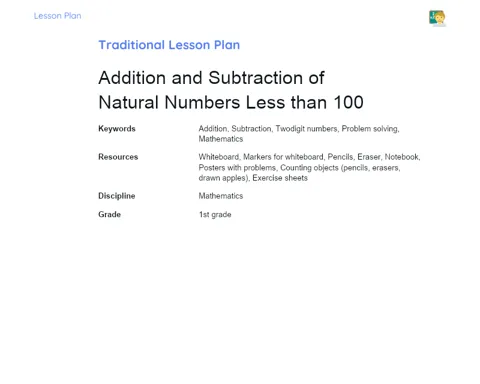
Lesson Plan | Traditional Methodology | Operations: Mixed Numbers
| Keywords | Mixed Numbers, Addition, Subtraction, Multiplication, Division, Conversion, Improper Fractions, Real Problems, Engagement, Discussion |
| Required Materials | Whiteboard, Markers, Eraser, Projector, Presentation Slides, Notebook, Pencil, Eraser, Exercise Sheets, Calculator |
Objectives
Duration: (10 - 15 minutes)
The purpose of this stage of the lesson plan is to ensure that students clearly understand the main objectives of the class. This establishes a solid foundation for learning, allowing students to know exactly what to expect and which skills they should acquire by the end of the lesson. As a result, students will be more focused and engaged in the learning process.
Main Objectives
1. Recognize and identify mixed numbers.
2. Perform operations of addition, subtraction, multiplication, and division with mixed numbers.
3. Solve problems that involve data provided in the form of mixed numbers.
Introduction
Duration: (10 - 15 minutes)
The purpose of this stage of the lesson plan is to capture students' attention and connect them to the theme of the lesson in a meaningful and engaging way. By introducing the context of mixed numbers' usage and sharing curiosities, students can see the relevance of the content in real life, which increases their interest and motivation to learn. This initial approach establishes a solid base for learning, preparing students for the more technical content that will be presented next.
Context
To start the lesson on mixed numbers, it is important to contextualize students with everyday situations where these numbers are applied. For example, when measuring ingredients for a recipe, we often use mixed numbers. Imagine a recipe that calls for 2 1/2 cups of flour. This is a practical example of a mixed number, combining a whole number and a fraction. These numbers appear in various everyday situations, such as in cooking recipes, time measurements, and distances. By understanding mixed numbers, students will be better prepared to solve real-world problems.
Curiosities
Did you know that mixed numbers are used in construction? When measuring building materials, such as concrete and wood, mixed numbers are often used for greater precision. For example, a carpenter may need 3 3/4 meters of wood for a specific project. Understanding how to work with these numbers helps ensure that projects are completed accurately and efficiently.
Development
Duration: (50 - 60 minutes)
The purpose of this stage is to provide a detailed and practical understanding of operations with mixed numbers. By addressing each topic sequentially and with clear examples, students will develop the necessary skills to recognize, convert, and operate with mixed numbers. Solving practical questions will consolidate the acquired knowledge and apply it to real problems.
Covered Topics
1. 📘 Definition of Mixed Numbers: Explain that mixed numbers are composed of a whole part and a fractional part. For example, 2 1/2 is a mixed number where 2 is the whole part and 1/2 is the fractional part. 2. 🧮 Conversion of Mixed Numbers to Improper Fractions: Detail the conversion process. Multiply the denominator by the whole number and add the numerator, keeping the denominator. For example, 2 1/2 = (2*2 + 1)/2 = 5/2. 3. ➕ Addition of Mixed Numbers: Demonstrate how to add mixed numbers. First, add the whole parts and then the fractional parts. If necessary, convert the resulting fraction into a mixed number. 4. ➖ Subtraction of Mixed Numbers: Explain the procedure for subtracting mixed numbers. If the fractional part of the minuend is less than that of the subtrahend, borrow 1 from the whole part. 5. ✖️ Multiplication of Mixed Numbers: Detail how to convert mixed numbers into improper fractions before multiplying, and then simplify the result if possible. 6. ➗ Division of Mixed Numbers: Describe the process of converting mixed numbers into improper fractions, inverting the fraction of the divisor, and then multiplying.
Classroom Questions
1. Convert the mixed number 3 2/5 into an improper fraction. 2. Add the mixed numbers 4 1/3 and 2 2/3. 3. Divide 5 1/2 by 1 1/4.
Questions Discussion
Duration: (20 - 25 minutes)
The purpose of this stage is to review and consolidate the knowledge acquired during the lesson, ensuring that students fully understand operations with mixed numbers. The detailed discussion of the solved questions and student engagement through reflective questions help clarify doubts, reinforce concepts, and promote a deeper understanding of the content.
Discussion
-
📘 Discussion of Questions:
-
Convert the mixed number 3 2/5 into an improper fraction.
-
Multiply the denominator by the whole number and add the numerator: (5 * 3) + 2 = 15 + 2 = 17. Therefore, the improper fraction is 17/5.
-
Add the mixed numbers 4 1/3 and 2 2/3.
-
Add the whole parts: 4 + 2 = 6.
-
Add the fractional parts: 1/3 + 2/3 = 3/3 = 1.
-
Add the results: 6 + 1 = 7. Therefore, 4 1/3 + 2 2/3 equals 7.
-
Divide 5 1/2 by 1 1/4.
-
Convert the mixed numbers to improper fractions: 5 1/2 = 11/2 and 1 1/4 = 5/4.
-
Invert the fraction of the divisor and multiply: 11/2 * 4/5 = 44/10.
-
Simplify the resulting fraction: 44/10 = 22/5 = 4 2/5.
Student Engagement
1. 🗣️ Student Engagement: 2. Why is it important to know how to convert mixed numbers into improper fractions? 3. How can the addition of whole and fractional parts be applied in everyday situations, like cooking or construction? 4. What challenges do you encounter when performing operations with mixed numbers? How can we overcome them? 5. Can you think of other everyday situations where mixed numbers are used? Provide examples. 6. Explain the division process of mixed numbers to a classmate who is having difficulty. What steps are essential?
Conclusion
Duration: (10 - 15 minutes)
The purpose of this stage is to review and consolidate the key points addressed during the lesson, ensuring that students understand the importance of operations with mixed numbers. Additionally, it reinforces the connection between theory and practice, highlighting the relevance of the content to students' daily lives.
Summary
- Definition of mixed numbers: combination of a whole part and a fractional part.
- Conversion of mixed numbers to improper fractions.
- Addition of mixed numbers: add the whole parts and fractional parts separately.
- Subtraction of mixed numbers: borrow from the whole part if necessary.
- Multiplication of mixed numbers: convert to improper fractions before multiplying.
- Division of mixed numbers: convert to improper fractions and invert the divisor fraction.
During the lesson, it was demonstrated how mixed numbers are applied in real situations, such as measuring ingredients in a recipe or building materials. By learning to perform operations with mixed numbers, students could see the connection between mathematical theory and its practical application in everyday life.
Understanding and operating with mixed numbers is crucial for various daily activities, such as cooking, construction, and measurement. For example, when following a recipe that requires '2 1/2 cups of flour', it is essential to know how to handle this mixed number to achieve the desired result. This skill is also frequently used in professions such as carpentry and engineering.