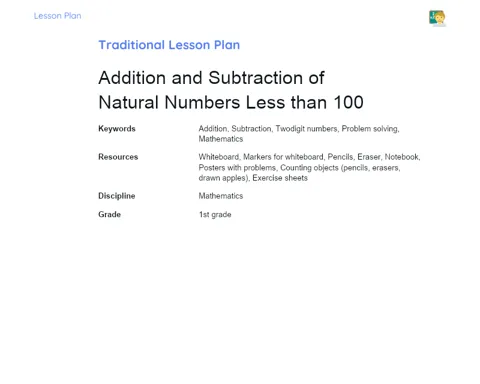
Lesson Plan | Traditional Methodology | Operations: Natural Numbers
| Keywords | basic operations, natural numbers, addition, subtraction, multiplication, division, problem solving, practical examples, contextualization, student engagement, discussion, learning consolidation |
| Required Materials | whiteboard, markers, slide presentation (optional), paper, pencil, eraser, calculator (optional) |
Objectives
Duration: (10 - 15 minutes)
The purpose of this stage is to clearly outline the learning goals for the students, providing a clear direction for the content that will be covered. By understanding the objectives, students will be able to focus on developing the skills necessary to solve problems involving calculations with natural numbers, promoting a more structured and effective learning experience.
Main Objectives
1. Understand and apply the four basic operations (addition, subtraction, multiplication, and division) with natural numbers.
2. Solve practical problems involving natural numbers using basic operations.
3. Identify and select the appropriate mathematical operation to solve different types of problems.
Introduction
Duration: (10 - 15 minutes)
The purpose of this stage is to situate the students in the universe of natural numbers and their basic operations, showing the relevance and practical application of the content that will be covered. By contextualizing the theme, students will feel more engaged and understand the importance of learning to solve mathematical problems in daily life.
Context
To start the class, begin by explaining to the students that natural numbers are the numbers we use in our daily lives to count and perform basic operations such as addition, subtraction, multiplication, and division. Say that these operations are essential not only in mathematics but in various everyday situations, such as shopping, dividing tasks, and calculating times and distances.
Curiosities
Did you know that the origin of natural numbers dates back to early civilizations? The ancient Egyptians and Babylonians used natural numbers for agriculture, trade, and even pyramid construction. Today, we use the same basic operations for everything, from calculating change at the supermarket to programming computers.
Development
Duration: (50 - 60 minutes)
The purpose of this stage is to provide a detailed understanding of the basic operations with natural numbers, using practical and everyday examples that facilitate the absorption of the content. By solving teacher-guided problems, students will be able to apply the operations of addition, subtraction, multiplication, and division in different contexts, developing essential skills for solving mathematical problems.
Covered Topics
1. Addition: Explain that addition is the mathematical operation that consists of summing two or more numbers. Provide clear examples, such as calculating the total number of stickers of two siblings. Example: João has 15 stickers and Maria has 10 stickers. How many stickers do they have together? (15 + 10 = 25). 2. Subtraction: Detail that subtraction is the operation used to find the difference between two numbers. Use practical examples, such as subtracting the number of fruits purchased from an initial total. Example: If João had 20 apples and gave 5 to Maria, how many apples does he have now? (20 - 5 = 15). 3. Multiplication: Describe multiplication as the operation that involves the repeated addition of a number. Use everyday examples, such as calculating the total number of balls in several boxes. Example: If each box contains 4 balls and there are 3 boxes, how many balls are there in total? (4 * 3 = 12). 4. Division: Explain that division is the operation of splitting a number into equal parts. Present practical examples, such as dividing the number of candies among friends. Example: If there are 20 candies and 4 friends, how many candies does each one receive? (20 / 4 = 5).
Classroom Questions
1. João has 30 candies and wants to divide them equally among his 5 friends. How many candies will each friend receive? 2. Maria had 50 stickers but gave 15 to her brother. How many stickers does she have now? 3. A box contains 6 pens. How many pens are there in 8 boxes?
Questions Discussion
Duration: (15 - 20 minutes)
The purpose of this stage is to review and consolidate the content covered, ensuring that students understand the explanations and solutions to the presented questions. By engaging students in discussions and reflections, the teacher promotes a collaborative learning environment where students can clarify doubts and reinforce their understanding of basic operations with natural numbers.
Discussion
-
Discussion of the Questions:
-
Question 1: João has 30 candies and wants to divide them equally among his 5 friends. How many candies will each friend receive?
-
Explain that to solve this question, it is necessary to use the division operation. Divide 30 candies by 5 friends. (30 / 5 = 6). Each friend will receive 6 candies.
-
Question 2: Maria had 50 stickers but gave 15 to her brother. How many stickers does she have now?
-
To solve this question, use the subtraction operation. Subtract 15 stickers from 50 stickers. (50 - 15 = 35). Maria now has 35 stickers.
-
Question 3: A box contains 6 pens. How many pens are there in 8 boxes?
-
Use the multiplication operation to solve this question. Multiply 6 pens by 8 boxes. (6 * 8 = 48). There are 48 pens in total.
Student Engagement
1. Questions and Reflections to Engage Students: 2. 1. Why is it important to understand how to divide quantities equally among friends? 3. 2. How would you use subtraction to calculate the change while making a purchase? 4. 3. In which everyday situations would you use multiplication to count objects? 5. 4. Which mathematical operation would you use to calculate the total hours of study in a week, if you study 2 hours a day?
Conclusion
Duration: (10 - 15 minutes)
The purpose of this stage is to consolidate learning, recap the key points covered in the lesson, and reinforce the practical relevance of the content. By concluding the lesson with this recap, students will be able to review and solidify the concepts learned, ensuring a lasting understanding of the topic.
Summary
- Understanding and applying the four basic operations: addition, subtraction, multiplication, and division.
- Solving practical problems involving natural numbers.
- Identifying and selecting the appropriate mathematical operation for different types of problems.
- Practical examples such as adding stickers, subtracting fruits, multiplying balls, and dividing candies.
The class connected the theory of mathematical operations with practice through everyday examples, facilitating students' understanding of how these operations are used in real life. For example, calculating the total number of stickers added or dividing candies among friends demonstrated the direct application of the learned operations.
Understanding basic operations with natural numbers is essential for daily life, as these operations are used in everyday situations such as calculating change, dividing tasks, and estimating times. Additionally, knowing how to correctly apply these operations helps develop logical reasoning and problem-solving skills.