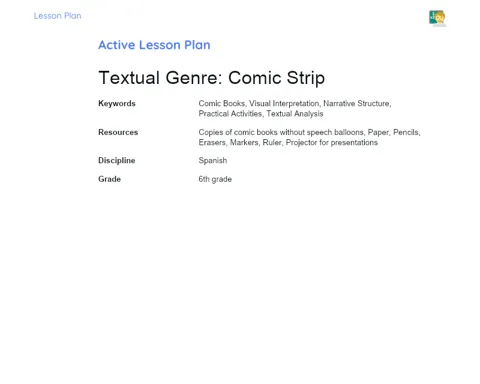
Lesson Plan | Traditional Methodology | Textual Genre: Comic Strip
| Keywords | Comic Book, Textual Genre, Elements of Comics, Panels, Speech Bubbles, Thought Bubbles, Onomatopoeias, Characters, Expressions, Plot, Interpretation, Critical Analysis |
| Required Materials | Exemplary panels from comic books, Images of speech and thought bubbles, Examples of onomatopoeias, Comic books for analysis, Whiteboard and markers, Projector or screen for displaying examples, Printed copies of comics for students |
Objectives
Duration: 10 to 15 minutes
The purpose of this stage is to provide students with an initial and clear understanding of what comic books are and what their essential elements are. This will serve as a foundation for subsequent activities, where students will interpret and analyze comic books. With a detailed explanation and examples, students will be better prepared to recognize and understand the unique characteristics of this textual genre.
Main Objectives
1. Explain the concept of comic books and their main characteristics.
2. Identify the elements that compose a comic book, such as speech bubbles, panels, and onomatopoeias.
3. Demonstrate how to interpret a comic book by analyzing text and image together.
Introduction
Duration: 10 to 15 minutes
The purpose of this stage is to provide students with an initial and clear understanding of what comic books are and what their essential elements are. This will serve as a foundation for subsequent activities, where students will interpret and analyze comic books. With a detailed explanation and examples, students will be better prepared to recognize and understand the unique characteristics of this textual genre.
Context
To start the class on comic books, explain that this is a very popular and accessible textual genre, found in magazines, newspapers, and even on the internet. Comic books combine visual and textual elements to tell a story in a dynamic and engaging way. Show that they consist of a sequence of panels, where both the images and texts are essential for understanding the plot.
Curiosities
Did you know that the first comic books date back to the 19th century and were published in newspapers? Additionally, characters like Superman and Batman, who originated in comics, became so influential that they became icons of pop culture and inspired movies, series, and games. Comics are not just entertainment but also a rich form of artistic and narrative expression.
Development
Duration: 45 to 50 minutes
The purpose of this stage is to deepen students' knowledge about the elements that compose a comic book, providing a detailed understanding of each component. With this solid foundation, students will be equipped to analyze and interpret comic books critically and knowledgeably. The proposed questions aim to stimulate the practical application of the acquired knowledge, reinforcing learning through the observation and analysis of concrete examples.
Covered Topics
1. Panels: Explain that panels are the divisions of the page that contain specific scenes from the story. Each panel represents a moment or action in the narrative. Show examples of different types of panels, such as single panels, double panels, and sequential panels. 2. Speech and thought bubbles: Detail that bubbles are elements that contain the text of the characters' speeches or their thoughts. Speech bubbles typically have an oval shape and a pointer indicating the character who is speaking, while thought bubbles have a cloud shape. Show examples and explain the importance of each type of bubble. 3. Onomatopoeias: Explain that onomatopoeias are words that imitate sounds and are used to give more liveliness to the story. Common examples include 'bang', 'crash', and 'splash'. Show how onomatopoeias are graphically represented in comics and how they contribute to the reading experience. 4. Characters and expressions: Show how the characters are drawn and how their facial and body expressions convey emotions and actions. Explain the importance of observing visual details to better understand the story. 5. Plot: Discuss how the plot is developed in comics, usually sequentially, with a beginning, middle, and end. Explain the importance of following the order of the panels to understand the progression of the story.
Classroom Questions
1. Identify the different types of bubbles in a comic book that you know. Which are the speech bubbles and which are the thought bubbles? 2. Choose an onomatopoeia from a comic book and explain what sound it represents. How does this onomatopoeia contribute to the narrative? 3. Observe a sequence of panels in a comic and describe how the plot develops in that sequence. What visual and textual elements help to tell the story?
Questions Discussion
Duration: 20 to 25 minutes
The purpose of this stage is to consolidate learning, allowing students to reflect on what they have learned and apply that knowledge in analyzing concrete examples of comic books. By discussing responses and reflections in groups, students can reinforce their understanding of the elements of comics and enhance their interpretive skills.
Discussion
-
Explain that speech bubbles are identified by their oval shape and the pointer directed at the character who is speaking. Thought bubbles, on the other hand, have a cloud shape and indicate what the characters are thinking.
-
Highlight the importance of onomatopoeias for the narrative, explaining that they help create a sense of movement and action. Provide specific examples such as 'bang' for gunshots, 'crash' for collisions, and 'splash' for water.
-
Describe how the different panels of a comic present a sequence of events that build the plot. Emphasize the importance of reading each panel in the correct order to understand the progression of the story. Show how visual elements (facial expressions, gestures) and textual elements (bubbles, onomatopoeias) work together to tell the story.
Student Engagement
1. Ask students what types of bubbles they identified in their favorite comics. They can share specific examples and explain how speech and thought bubbles are used in the narrative. 2. Ask students to choose an onomatopoeia from a comic they brought or know about, and explain what sound it represents. Discuss how this onomatopoeia contributes to the narrative, bringing liveliness and dynamism to the scene. 3. Request that students select a sequence of panels from a comic they like and describe how the plot develops in that sequence. What visual and textual elements helped tell the story? How did the characters' expressions and the onomatopoeias influence the understanding of the scene?
Conclusion
Duration: 10 to 15 minutes
The purpose of this stage is to summarize and consolidate the main contents covered during the class, reinforcing students' understanding. By recapping the discussed points, students have the opportunity to better retain the acquired knowledge and reflect on the importance and practical application of what they learned.
Summary
- Explanation of the concept of comic book and its main characteristics.
- Identification of the elements that compose a comic book: panels, speech and thought bubbles, onomatopoeias, characters and expressions, and plot.
- Detailed analysis of practical examples of comic books for better understanding of the elements.
- Discussion about the importance and function of each element in the narrative of comics.
The lesson connected theory to practice by presenting concepts and characteristics of comic books and then applying this knowledge in the analysis of concrete examples. This allowed students to visualize and interpret the discussed elements, relating theory directly to the comics they know and appreciate.
The study of comic books is important for students' daily lives, as this textual genre is widely present in pop culture and media. Understanding how comics are constructed enriches students' reading and interpretation skills, as well as highlighting the importance of visual arts and graphic narrative. Curiosities such as the origin of comics and their cultural impact also make learning more engaging.