Lesson Plan | Active Methodology | Human Coexistence: Social Interaction and Isolation
| Keywords | Social interaction, Isolation, Relationship networks, Modern loneliness, Practical activities, Debate, Theatre, Social relationship maps, Empathy, Critical analysis, Sociology, Digital age |
| Necessary Materials | Large blank sheets of paper, Coloured markers, Space for theatre presentations, Internet access for research, Materials for note-taking, Projector for presentations, Copies of studies and articles on loneliness and social interaction |
Premises: This Active Lesson Plan assumes: a 100-minute class duration, prior student study both with the Book and the beginning of Project development, and that only one activity (among the three suggested) will be chosen to be carried out during the class, as each activity is designed to take up a large part of the available time.
Objective
Duration: (5 - 10 minutes)
This objective phase is vital for setting the foundation of the lesson and clarifying learning expectations for students. By explicitly outlining objectives, students can better channel their prior studies and class involvement, enhancing the effectiveness of our active learning approach. This step additionally ensures that the following activities are aligned with the intended learning outcomes, promoting a coherent and focused method.
Objective Utama:
1. Empower students to understand and distinguish social relationships in various contexts, recognizing social interaction and isolation as key phenomena.
2. Cultivate the ability to critically analyze and discuss prejudice and modern loneliness in relation to today's social dynamics.
Objective Tambahan:
- Foster empathy and an understanding of diverse perspectives in contexts of social interaction and isolation.
Introduction
Duration: (15 - 20 minutes)
The introduction aims to engage students with material they've previously studied, using relatable situations that provoke critical thought on the subject. Additionally, contextualizing the topic connects it to the real world, highlighting the significance of understanding social interactions and modern loneliness. This phase prepares students for a more profound, applied conversation in the classroom.
Problem-Based Situation
1. Consider a group of school friends who drift apart over the years after attending different universities. Explore how physical distance affects their social interaction and can lead to feelings of isolation.
2. Picture someone who frequently relocates due to personal circumstances, who struggles to form lasting connections. Discuss how constant movement influences social relationships and can lead to loneliness.
Contextualization
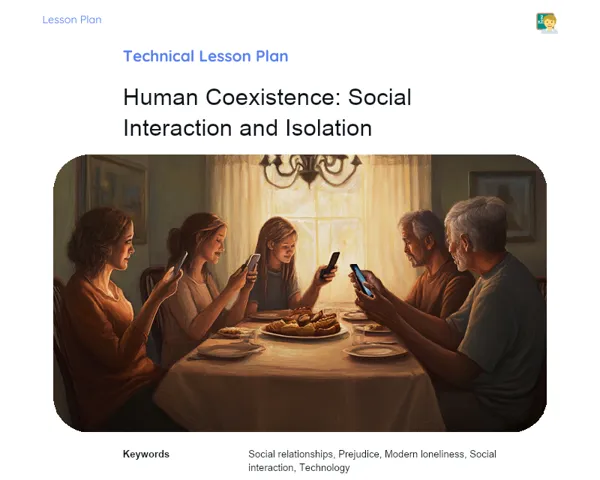
Social interaction and isolation are deeply connected to the human experience, ranging from small family units to the larger global context. Interestingly, while loneliness is often viewed as a modern phenomenon, it has historical roots and is shaped by cultural, technological, and economic factors. For example, social media, originally meant to foster connections, can sometimes intensify feelings of isolation. These themes are rich with practical and theoretical examples that aid in understanding the complexities of human interactions.
Development
Duration: (75 - 80 minutes)
This stage allows students to put into practice and deepen their understanding of social interaction and isolation through engaging activities. By visualising, dramatizing, and debating the concepts covered, they will hone their critical analysis and empathy skills. This active and participatory approach aims to solidify students' comprehension and prepare them for a deeper exploration of modern social dynamics.
Activity Suggestions
It is recommended that only one of the suggested activities be carried out
Activity 1 - Social Relationship Map
> Duration: (60 - 70 minutes)
- Objective: Visualise and evaluate their own relationship networks to enhance understanding of interaction dynamics and isolation.
- Description: In this activity, students will be grouped, and each group will receive a large sheet of paper and some colorful markers. They will create a map illustrating their relationship networks, including family, friends, classmates, and other social groups. Each point on the map will denote a person, while the links between them will show the nature of their relationships (for instance, friendship, family ties, classmate). They should also pinpoint 'islands' of isolation – sections of the map where few or no connections exist.
- Instructions:
-
Divide the class into groups of up to 5 students.
-
Hand out a large sheet of paper and markers to each group.
-
Guide students to draw a map that represents their relationship networks.
-
Every point on the map should reflect a person, with links labeled according to the type of relationship.
-
Identify and indicate the 'islands' of isolation on the map.
-
Prepare a brief presentation of the maps to share with the class.
Activity 2 - Theatre of Relationships
> Duration: (60 - 70 minutes)
- Objective: Dramatically explore the subtleties of social relationships and isolation, enhancing empathy and understanding.
- Description: Students will compose and present short plays that portray various types of social interaction and isolation. Each group will select a common scenario, like a party, classroom, or park, and develop a brief scene that highlights these themes. They can incorporate dialogue, body language, and expressions that clearly illustrate both inclusion and exclusion dynamics.
- Instructions:
-
Create groups of up to 5 students.
-
Decide on a common scenario for the scene (party, classroom, park, etc.).
-
Develop a script that depicts different social interactions and instances of isolation.
-
Rehearse the play, focusing on dialogue, gestures, and expressions.
-
Present the play to the class.
-
Engage in a discussion following the performances.
Activity 3 - Debate: Loneliness in the Digital Era
> Duration: (60 - 70 minutes)
- Objective: Critically assess the impact of digital technologies on social relationships and the associated levels of loneliness.
- Description: This classroom debate will tackle the theme of modern loneliness, especially within digital contexts. Students will be split into two groups: one asserting that digital technologies contribute to loneliness, and the other arguing that they do not. Each group will have time to prepare arguments using research and real-life examples, leading to a structured debate, with the teacher moderating.
- Instructions:
-
Divide the class into two teams, one for each side of the debate.
-
Allocate time for both groups to prepare their arguments.
-
Conduct the debate, allowing each group to present their points and counter those of their opponents.
-
Encourage questions or comments from the audience at the end of the debate.
-
Finish with a class discussion about the arguments presented.
Feedback
Duration: (15 - 20 minutes)
The aim of this stage is to consolidate learning, giving students an opportunity to articulate and reflect on the knowledge gained through experiential activities. Group discussions facilitate sharing ideas and perspectives, deepening their understanding of social interaction and isolation issues. This phase also serves to gauge students' comprehension and the effectiveness of the activities in achieving the intended learning objectives.
Group Discussion
Kick off the group discussion by gathering all students together and inviting each group to share their insights and experiences from the activities. It's essential for the teacher to foster an open and inclusive atmosphere, encouraging everyone to join in and respect differing opinions. Suggest that students use these guiding questions: 'What surprised you while mapping social relationships? How did the plays enhance your understanding of social interaction and isolation? And the debate, what did it add to your perspective on loneliness in the digital age?'
Key Questions
1. What factors lead to the creation of 'islands' of isolation in our social networks?
2. How did the dramatizations help you grasp the concepts of social inclusion and exclusion?
3. In what ways did the debate regarding loneliness in the digital age alter or reinforce your views on technology's influence on social relationships?
Conclusion
Duration: (5 - 10 minutes)
The conclusion stage aims to ensure that students clearly understand the topics discussed during the lesson, along with the relationship between theory and practice. This moment also reinforces the relevance of sociology in grasping complex social phenomena and developing critical and empathetic awareness. The wrap-up and synthesis help solidify learning and prepare students to apply their newfound knowledge in everyday and academic scenarios.
Summary
To close off, the teacher should wrap up by summarising the key points regarding social interaction and isolation, recalling the activities undertaken, such as the 'Social Relationship Map,' the 'Theatre of Relationships,' and the debate on loneliness in the digital age. It is important to revisit the definitions of each concept and how they manifest in the real world, drawing upon examples discussed during the lesson.
Theory Connection
Today's lesson effectively bridged theory and practice, enabling students to apply sociological concepts to practical and theatrical situations reflecting real life. The mapping, dramatization, and debate activities provided a more profound and thorough understanding of theoretical content, showcasing sociology's relevance in interpreting contemporary social dynamics.
Closing
At last, it is vital to underscore the importance of studying sociology in everyday life, particularly in relation to issues of social interaction and isolation. Grasping these themes not only enhances knowledge about society but also helps nurture the critical and empathetic skills essential for active and informed participation in the modern world.