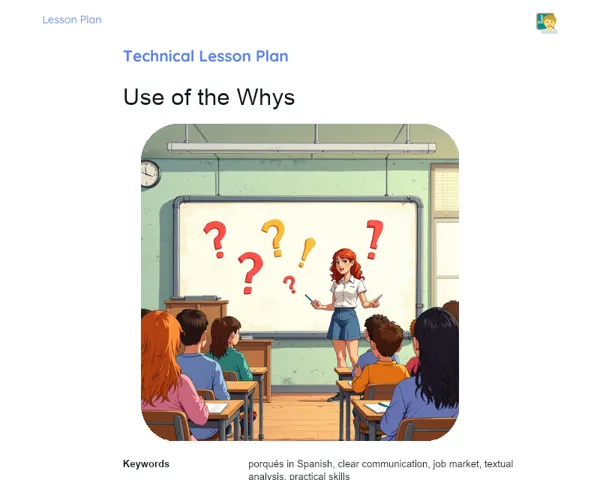

Lesson Plan | Lesson Plan Tradisional | Interrogative Pronouns
| Keywords | Interrogative Pronouns, Spanish, Communication, Questions, Practical examples, High School, Social interaction, Curiosities, Question formulation, Pronoun identification |
| Resources | Whiteboard or chalkboard, Markers or chalk, Projector or slides with examples, Paper and pens for notes, Printed materials with exercises, Textbook or supporting materials on interrogative pronouns |
Objectives
Duration: (10 - 15 minutes)
The aim of this stage in the lesson plan is to provide learners with a clear understanding of the objectives that will be achieved during the lesson. This clarity will help focus the learners and highlight the importance of the content to be discussed, prepping them for a more engaged learning experience.
Objectives Utama:
1. Become familiar with interrogative pronouns in Spanish.
2. Properly use interrogative pronouns in sentences.
3. Recognize interrogative pronouns in written texts.
Introduction
Duration: (10 - 15 minutes)
The aim of this stage of the lesson plan is to set the scene for learners regarding interrogative pronouns, highlighting their practical and everyday significance. By sharing these intriguing points and real-life applications, we aim to spark the students' interest and attention, creating an environment that fosters active learning. This introduction will highlight the importance of interrogative pronouns and how they'll be integrated throughout the lesson.
Did you know?
Interesting tidbit: Did you know that most interrogative pronouns in Spanish start with the letter 'Q'? For example, '¿Qué?' (What?), '¿Quién?' (Who?), '¿Cuándo?' (When?), '¿Dónde?' (Where?). This interesting fact can make it easier to remember and identify these words in sentences. Plus, they always have a question mark at both the beginning and the end of the question, which is a unique feature of Spanish.
Contextualization
To kick off our lesson on interrogative pronouns in Spanish, we need to dive into the world of questions and communication. Explain to the learners that interrogative pronouns are the words we use to ask direct or indirect questions, which are essential for gathering specific information during conversations. For instance, when you travel to a Spanish-speaking country, knowing how to ask the right questions can mean the difference between finding your way and getting completely lost. Stress that interrogative pronouns are vital tools for effective communication and social interactions.
Concepts
Duration: (50 - 60 minutes)
The purpose of this stage of the lesson plan is to deepen students' understanding of interrogative pronouns in Spanish, offering thorough explanations and practical examples. This will empower learners to grasp the correct usage of these pronouns in various contexts, enabling them to identify and formulate questions effectively. Engaging with questions in class will solidify their understanding and foster practical application of the content.
Relevant Topics
1. ¿Qué? (What?)
2. Explain that '¿Qué?' is used to inquire about things or actions.
3. Example: ¿Qué haces? (What are you doing?)
4. ¿Quién? (Who?)
5. Describe that '¿Quién?' is used to ask about people.
6. Example: ¿Quién es tu amigo? (Who is your friend?)
7. ¿Dónde? (Where?)
8. Detail that '¿Dónde?' is used to ask about places.
9. Example: ¿Dónde vives? (Where do you live?)
10. ¿Cuándo? (When?)
11. Explain that '¿Cuándo?' is used to ask about time.
12. Example: ¿Cuándo es tu cumpleaños? (When is your birthday?)
13. ¿Por qué? (Why?)
14. Describe that '¿Por qué?' is used to inquire about reasons or motives.
15. Example: ¿Por qué estudias español? (Why do you study Spanish?)
16. ¿Cómo? (How?)
17. Explain that '¿Cómo?' is used to ask about the manner or way.
18. Example: ¿Cómo llegas a la escuela? (How do you get to school?)
19. ¿Cuál/Cuáles? (Which/Which ones?)
20. Detail that '¿Cuál?' and '¿Cuáles?' are used to ask about choices or selections.
21. Example: ¿Cuál es tu color favorito? (What is your favourite colour?)
22. ¿Cuánto/Cuántos/Cuantas? (How much/How many?)
23. Explain that '¿Cuánto?' and its variations are used to ask about quantity.
24. Example: ¿Cuántos libros tienes? (How many books do you have?)
To Reinforce Learning
1. Formulate a question using the pronoun '¿Dónde?'.
2. Identify the interrogative pronoun in this sentence: ¿Cuántos años tienes?
3. Explain the difference between '¿Qué?' and '¿Cuál?' with examples.
Feedback
Duration: (20 - 25 minutes)
The aim of this stage in the lesson plan is to review and reinforce the knowledge acquired by learners, ensuring they fully grasp the correct use of interrogative pronouns in Spanish. By discussing the answers to the presented questions, teachers can clear up uncertainties and reinforce learning, while the questions and reflections prompt active participation and critical thinking from the learners.
Diskusi Concepts
1. Discussion of the questions from the Development stage: 2. Formulate a question using the pronoun '¿Dónde?' 3. - Possible response: ¿Dónde está la biblioteca? (Where is the library?) 4. - Explanation: In this question, '¿Dónde?' is used to inquire about the location of a specific place. 5. Identify the interrogative pronoun in this sentence: ¿Cuántos años tienes? 6. - Answer: '¿Cuántos?' 7. - Explanation: '¿Cuántos?' is used to ask about quantity, in this case, the number of years. 8. Explain the difference between '¿Qué?' and '¿Cuál?' with examples. 9. - Answer: '¿Qué?' is used to inquire about things or actions in general, while '¿Cuál?' is aimed at a specific choice or selection. 10. - Example: 11. - ¿Qué estudias? (What are you studying?) - This asks about the subject in general. 12. - ¿Cuál es tu libro favorito? (What is your favourite book?) - This asks about a specific book choice.
Engaging Students
1. Questions and Reflections to Engage Students: 2. Think of a scenario in your daily life where you would need to use '¿Cuándo?'. Create a question based on that situation. 3. Read the following sentence: '¿Quién es la persona que viene contigo?' and identify the interrogative pronoun. Explain why it was used. 4. Compare the interrogative pronouns in Spanish with their counterparts in Portuguese. What similarities and differences can you spot? 5. Imagine you're dining at a restaurant in Spain and want to know what's on the menu. How would you ask the waiter with '¿Qué?'? 6. Chat with a classmate: Why do you think it's important to use interrogative pronouns correctly when conversing in Spanish?
Conclusion
Duration: (10 - 15 minutes)
The purpose of this stage in the lesson plan is to recap and reinforce the key points covered during the lesson, ensuring that learners have a clear and solid understanding of the content. By revisiting the interrogative pronouns and their applications, students can consolidate their knowledge and feel more confident in using these structures when interacting in Spanish.
Summary
['¿Qué? (What?) - Used to inquire about things or actions.', '¿Quién? (Who?) - Used to ask about people.', '¿Dónde? (Where?) - Used to inquire about locations.', '¿Cuándo? (When?) - Used to ask about time.', '¿Por qué? (Why?) - Used to ask about reasons or motives.', '¿Cómo? (How?) - Used to ask about the manner or way.', '¿Cuál/Cuáles? (Which/Which ones?) - Used to ask about choices or selections.', '¿Cuánto/Cuántos/Cuantas? (How much/How many?) - Used to ask about quantity.']
Connection
The lesson linked theory with practice by providing clear and straightforward examples of each interrogative pronoun in various contexts. The activities of forming questions and identifying pronouns in sentences allowed learners to apply their theoretical knowledge in practical, everyday situations.
Theme Relevance
Correctly using interrogative pronouns is crucial for effective communication in Spanish, particularly in social interactions and travel situations. Grasping and applying these pronouns aids in obtaining accurate information and enhances fluency in the language. Moreover, interesting facts like the commonality of the letter 'Q' can help with memory retention and recognition of these pronouns.