Lesson Plan | Lesson Plan Tradisional | Proust's Law of Definite Proportions
| Keywords | Proust's Law, Fixed Proportions, Joseph Louis Proust, Copper Carbonate, Water (H₂O), Stoichiometry, Chemical Reactions, Pharmaceutical Industry, Efficacy and Safety of Medications |
| Resources | Whiteboard and markers, Projector or presentation slides, Printed copies of practical examples, Calculators, Paper for notes, Chemistry textbooks |
Objectives
Duration: 10 - 15 minutes
This stage aims to introduce students to the core idea of Proust's Law, highlighting the significance of fixed mass ratios in the formation of chemical compounds. Grasping this concept is essential for applying the law accurately in upcoming reactions and challenges, thereby building a robust base for more advanced Chemistry topics.
Objectives Utama:
1. Grasp the essence of Proust's Law and its significance in Chemistry.
2. Recognise that a chemical compound is always made up of its constituents in fixed mass ratios.
3. Implement Proust's Law in practical scenarios of chemical reactions.
Introduction
Duration: 10 - 15 minutes
This stage's goal is to introduce students to the foundational concept of Proust's Law, priming them to appreciate the importance of fixed mass ratios in chemical substances. This early comprehension is crucial for their future application of the law in reactions and problems, establishing a solid groundwork for advanced Chemistry topics.
Did you know?
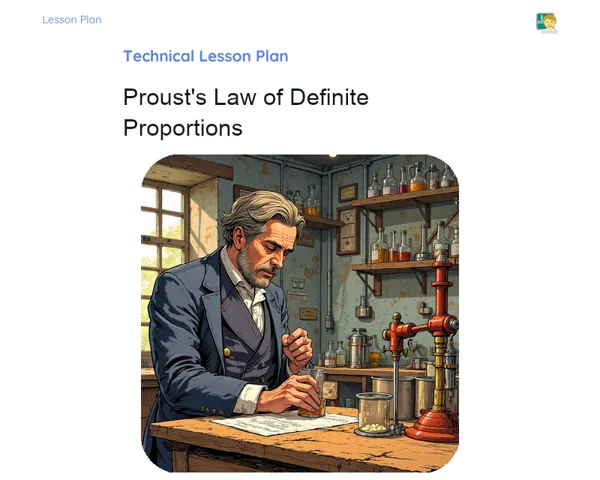
📚 An intriguing fact to captivate students is that Proust's Law, also referred to as the Law of Definite Proportions, was put forth by Joseph Louis Proust, a French chemist. He noted that copper carbonate consistently contains the same proportions of copper, carbon, and oxygen, irrespective of its source or preparation method. This indicates that nature adheres to specific rules, which is fundamental for the predictability and reproducibility of chemical experiments. Additionally, this law is pivotal in the pharmaceutical sector, ensuring medications contain the precise proportions of active ingredients, thereby guaranteeing their efficacy and safety.
Contextualization
As we kick off the lesson on the Law of Definite Proportions, particularly Proust's Law, it's vital to set the context for students about the significance of fixed mass ratios in chemical compound formation. Explain that prior to these laws, scientists had limited insight into how elements bonded to form compounds. Proust's Law, established in the late 18th century, played a key role in the progression of Chemistry, laying down that a chemical compound is invariably formed by combining its elements in fixed mass ratios. This principle laid the groundwork for stoichiometry and our current understanding of chemical reactions.
Concepts
Duration: 50 - 60 minutes
This stage aims to enhance students' grasp of Proust's Law by presenting practical examples and real-world applications that reinforce theoretical knowledge. This enrichment is vital for students to apply the law in real-world situations, solve challenges, and appreciate its significance in both Chemistry and industry.
Relevant Topics
1. Definition and Historical Context of Proust's Law: Explain that Proust's Law, or the Law of Definite Proportions, was introduced by Joseph Louis Proust in the late 18th century. It states that a chemical compound is always formed by the combination of its components in fixed mass ratios. Highlight that this law was essential for the evolution of modern chemistry and the formulation of stoichiometric principles.
2. Practical Examples of Proust's Law: Provide concrete examples, such as the formation of copper carbonate, which consistently comprises the same proportions of copper, carbon, and oxygen. Additional examples include water (H₂O), which is always made up of two parts hydrogen to one part oxygen by mass.
3. Application of Proust's Law in Industry: Discuss how Proust's Law is relevant in today's industries, particularly in pharmaceuticals, to ensure the effectiveness and safety of treatments. Stress that accuracy in ingredient proportions is vital for the quality of chemical and pharmaceutical products.
To Reinforce Learning
1. 1. According to Proust's Law, how many grams of hydrogen and oxygen are in 100g of water? Justify your answer.
2. 2. If a 50g sample of copper carbonate shows 20g of copper, what is the mass of the other elements in the compound? Support your conclusion with Proust's Law.
3. 3. Why is Proust's Law critical for the pharmaceutical industry? Provide an example of its application in medicine production.
Feedback
Duration: 15 - 20 minutes
This stage seeks to ensure that students have truly comprehended Proust's Law by discussing and dissecting their responses to the raised questions. This opportunity for feedback allows for rectifying misconceptions, bolstering learning, and fostering a culture of discussion and critical reflection on the concepts taught.
Diskusi Concepts
1. Discussion of the Development Stage Questions: 2. 1. According to Proust's Law, how many grams of hydrogen and how many grams of oxygen are in 100g of water? Justify your reasoning. 3. Water, represented as H₂O, consists of 2 hydrogen atoms and 1 oxygen atom. The molar mass of hydrogen is roughly 1g/mol and that of oxygen is 16g/mol. Hence, for every 18g of water (2g of hydrogen + 16g of oxygen), we derive approximately 11.11g of hydrogen and 88.89g of oxygen in 100g of water. 4. 2. In a 50g sample of copper carbonate, if 20g of copper is identified, what is the mass of the other elements present in the compound? Justify your response using Proust's Law. 5. Copper carbonate (CuCO₃) maintains a fixed ratio of its components. If 50g of the compound contains 20g of copper, then the other 30g must be comprised of carbon and oxygen. Proust's Law confirms that this ratio is consistently maintained, irrespective of the overall amount of copper carbonate. 6. 3. Why is Proust's Law fundamental for the pharmaceutical industry? Provide an example of its potential application in drug formulation. 7. Proust's Law holds immense value in the pharmaceutical sector, ensuring medications have the correct percentage of active ingredients, thus preserving their effectiveness and safety. For instance, a paracetamol tablet must precisely contain 500mg of the active ingredient for effective pain relief, as any deviation in proportion could compromise its efficacy.
Engaging Students
1. Questions and Reflections to Engage Students: 2. How did the introduction of Proust's Law transform the scientific community's understanding of chemical reactions at that time? 3. Can you think of other real-life scenarios where fixed mass proportions are essential? Share with your classmates. 4. How would you simplify the significance of Proust's Law to someone unfamiliar with Chemistry? 5. What other sectors, apart from pharmaceuticals, do you think benefit from applying Proust's Law?
Conclusion
Duration: 10 - 15 minutes
The purpose of this conclusive stage is to revisit and summarise the key points discussed throughout the lesson, helping reinforce students' comprehension of Proust's Law. This ensures they depart with a clear grasp of the theory, its practical implications, and its relevance, consolidating their learnings and equipping them for future discussions and applications of these concepts.
Summary
["Proust's Law, or the Law of Definite Proportions, asserts that a chemical compound is always the result of combining its components in fixed mass ratios.", 'This principle was articulated by Joseph Louis Proust in the late 18th century.', "The law has been pivotal in modern chemistry's development and the establishment of stoichiometric laws.", 'Concrete instances include copper carbonate and water, both of which exhibit fixed ratios of their constituent elements.', "Proust's Law is significant in industries, particularly pharmaceuticals, to authenticate the efficacy and safety of products."]
Connection
The lesson effectively connects the theory of Proust's Law with pragmatic examples of chemical compounds, such as water and copper carbonate, while exploring their applications in the pharmaceutical sector. These instances illustrate how the fixed mass proportions of constituents are key to the reliability and predictability of chemical reactions.
Theme Relevance
The significance of Proust's Law continues in everyday life, particularly in drug manufacturing, where the precise ratio of active ingredients is critical to the effectiveness and safety of medications. Furthermore, the law is equally relevant in areas such as food production, where ingredient proportions must be exact to maintain product quality and taste.