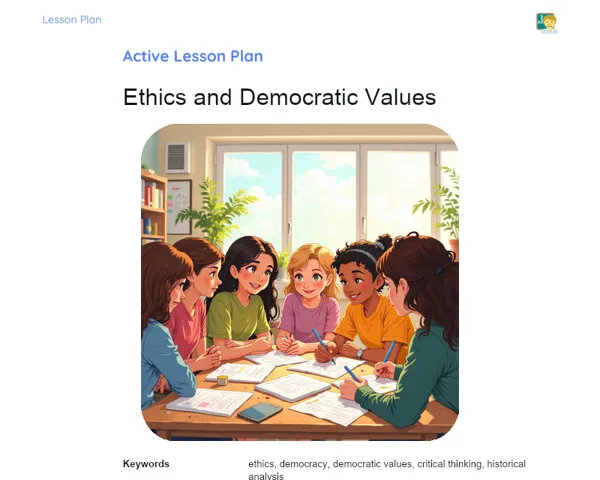
Lesson Plan | Active Methodology | Reflection on Ethics
| Keywords | Ethics, Critical thinking, Ethical dilemmas, Practical activities, Values, Ethical theories, Debate, Ethical decisions, Application of knowledge, Civic development |
| Necessary Materials | Sealed envelopes with printed ethical dilemmas, Written cases of ethical scenarios, Blocks representing varied ethical values, Presentation materials (computer, projector), Adequate space for group discussions, Whiteboard and markers |
Premises: This Active Lesson Plan assumes: a 100-minute class duration, prior student study both with the Book and the beginning of Project development, and that only one activity (among the three suggested) will be chosen to be carried out during the class, as each activity is designed to take up a large part of the available time.
Objective
Duration: (5 - 10 minutes)
Setting clear objectives is key to guiding both students and teachers during the lesson. By outlining the expected outcomes, students can prepare themselves for hands-on activities and discussions. This section also helps align expectations, ensuring everyone has a shared understanding of the topics to be addressed and the anticipated learning outcomes.
Objective Utama:
1. Empower students to recognize and analyze ethical situations in their everyday lives and in society, harnessing critical thinking.
2. Explore the core components of ethics, such as values, duties, and virtues, and their relevance in various contexts.
3. Familiarize students with both classical and modern ethical thinkers, facilitating an understanding of diverse viewpoints on the topic.
Introduction
Duration: (15 - 20 minutes)
The introduction aims to engage students and refresh their understanding of ethics using relatable scenarios that prompt reflection. By situating the topic within real-life and historical contexts, we demonstrate ethics' relevance in today's world, setting the stage for deeper discussions during classroom activities.
Problem-Based Situation
1. Imagine your close friend is about to betray someone's trust. How would you handle this situation considering your values and ethical teachings?
2. Think about a politician who, although benefiting the community, faces accusations of corruption. Is it ethical to support this politician? Why or why not?
Contextualization
Ethics is not just a theoretical concept; it profoundly influences our daily actions and the decisions made across society. From how we treat our peers to significant choices made by leaders globally, ethics is ever-present. Throughout history, philosophers from various cultures have contributed theories to guide moral behavior, showcasing the evolving and diverse nature of ethical thought. This rich tapestryhelps us appreciate the complexity and significance of the subject.
Development
Duration: (70 - 75 minutes)
The development phase aims to immerse students in practical scenarios that require applying ethical knowledge. Through engaging and thought-provoking activities, students are encouraged to think critically, debate collaboratively, and find solutions to challenging ethical dilemmas. This experiential learning reinforces theoretical concepts while honing argumentation, teamwork, and decision-making skills vital for their ethical and civic development.
Activity Suggestions
It is recommended that only one of the suggested activities be carried out
Activity 1 - The Ethical vs. the Illegal: A Battle of Values
> Duration: (60 - 70 minutes)
- Objective: Cultivate critical thinking and the ability to resolve intricate ethical dilemmas while considering different perspectives and values.
- Description: In this exercise, students will form groups of up to 5. Each group will be given a real-life ethical dilemma where moral values clash with the law or societal expectations. For instance, one group might tackle the dilemma of a parent stealing food to feed their family. Students will analyze the dilemma, identify the underlying ethical values, and propose balanced solutions.
- Instructions:
-
Divide the class into groups of up to 5 students.
-
Hand each group a sealed envelope containing a printed ethical dilemma.
-
Groups will have 30 minutes to discuss the dilemma, pinpoint the ethical values involved, and suggest solutions.
-
After discussions, each group will share their analysis and solution with the class.
-
Conduct a vote to determine which group offered the most balanced resolution between ethics and legality.
Activity 2 - Ethical Judgment: The Case of Fund Misappropriation
> Duration: (60 - 70 minutes)
- Objective: Improve understanding of ethical theories and apply this knowledge in analyzing a practical case, fostering argumentation and critical debate.
- Description: Students, working in groups, will be presented with the case of a manager who misuses funds from a charitable organization to rescue their company from bankruptcy. They will act as an ethics committee to assess the case, evaluate the manager's conduct, and decide on fair consequences. This will be a mock trial where each group must present their judgment and justify it based on earlier discussed ethical theories.
- Instructions:
-
Divide the class into groups of up to 5 students.
-
Provide each group with the case details regarding the manager's actions.
-
Groups will have 40 minutes to analyze the case and prepare their arguments for defense or prosecution.
-
Groups will present their decisions and supporting arguments to the class.
-
Facilitate a debate among the groups to discuss various perspectives and decisions.
Activity 3 - Moral Bridge Builders
> Duration: (60 - 70 minutes)
- Objective: Encourage students’ creativity and critical thinking in finding solutions that harmonize seemingly opposing ethical values.
- Description: In this activity, students will collaborate in groups to create 'moral bridges' that link contrasting ethical values. For instance, they may aim to connect the value of empathy with justice. Each group will receive blocks representing different values and will construct a model demonstrating how these values can coexist or support each other.
- Instructions:
-
Form groups of up to 5 students.
-
Distribute blocks, each symbolizing a different ethical value.
-
Groups will have 40 minutes to build their 'moral bridge' and prepare an explanation of the value connections.
-
Each group will present their creation and elucidate the relationship among the chosen values.
-
Engage in an open discussion about the various structures built and the meanings behind the connections.
Feedback
Duration: (15 - 20 minutes)
This stage's goal is to consolidate learning, allowing students to articulate the knowledge and skills acquired during practical activities. Through group discussions, students can collaboratively reflect on the various ethical approaches and the complexities of the dilemmas presented, enhancing their understanding of the content and fostering their argumentation and critical thinking abilities.
Group Discussion
Begin the group discussion by summarizing the ethical dilemmas tackled and activities conducted. Invite each group to share key conclusions and solutions they arrived at, focusing on how they applied ethical frameworks to address the dilemmas. Encourage students to articulate the rationale behind their choices and how they considered various viewpoints and ethical theories. This is an opportunity for students to learn from each other, enriching the dialogue with a multitude of perspectives.
Key Questions
1. What were the main challenges in balancing ethics and legality in the dilemmas discussed?
2. How did the ethical theories introduced in class aid your decision-making during activities?
3. Was there a moment when your group had to rethink an initial ethical choice? What led to that change?
Conclusion
Duration: (5 - 10 minutes)
The conclusion serves to reinforce learning, ensuring that students have comprehended the key concepts of the lesson and their practical applications. Furthermore, it underscores the importance of ethics in daily life, reinforcing the relevance of learned content and motivating students to continue reflecting on their actions and ethical decisions.
Summary
In wrapping up the lesson, the teacher should highlight the main points discussed, such as the components of ethics (values, duties, virtues) and the ethical dilemmas encountered during the practical activities. It is essential to recap ethical theories discussed and how they were applied in both real and hypothetical situations, reinforcing students' understanding.
Theory Connection
Today's class was pivotal in linking ethical theory with practical application through examples and activities simulating genuine dilemmas. Students not only grasped ethical theories but also engaged them in decision-making scenarios, thus reinforcing learning and highlighting the significance of ethics in daily life and society.
Closing
Finally, it must be emphasized that studying ethics is crucial for personal growth and developing conscientious and responsible citizens. Grasping and applying ethical principles fosters healthier and fairer relationships, both in personal and professional realms, equipping students for the ethical challenges of today’s world.