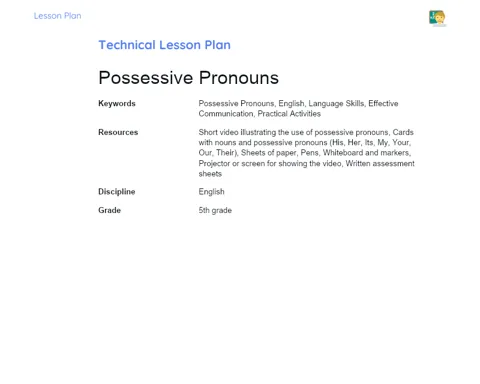
Lesson Plan | Traditional Methodology | Personal Pronouns
| Keywords | Personal Pronouns, English, I, he, she, it, you, they, we, 1st year of high school, Communication, Practical Examples, Problem Solving, Lecture, Pronoun, Simple Sentences |
| Required Materials | Whiteboard, Markers, Projector, Presentation Slides, Exercise Sheets, Pens, Eraser, Support Material (Examples in Portuguese and English) |
Objectives
Duration: (10 - 15 minutes)
The purpose of this stage is to provide students with a clear and basic understanding of personal pronouns in English, preparing them to recognize and use these pronouns correctly in various contexts. This stage lays the foundation for the development of essential language skills that are crucial for effective communication in English.
Main Objectives
1. Present and describe personal pronouns in English: 'I', 'he', 'she', 'it', 'you', 'they', and 'we'.
2. Demonstrate the proper use of personal pronouns in simple sentences.
Introduction
Duration: (10 - 15 minutes)
The purpose of this stage is to provide students with a clear and basic understanding of personal pronouns in English, preparing them to recognize and use these pronouns correctly in various contexts. This stage lays the foundation for the development of essential language skills that are crucial for effective communication in English.
Context
Start the lesson by explaining to students that, just like in Portuguese, personal pronouns are essential in communication in English. They are used to replace names and avoid repetitions, making speech and writing more fluid. Use examples in Portuguese, such as 'eu', 'ele', 'ela', 'nós', 'vocês', and 'eles', to create a bridge with the content that will be addressed in the lesson.
Curiosities
Did you know that the pronoun 'you' in English serves for both singular and plural? This can be a challenge for those learning, but it makes the language more practical in daily life. Furthermore, English does not differentiate formality in the second person, unlike Portuguese, which uses 'você' and 'senhor(a)'.
Development
Duration: (50 - 60 minutes)
The purpose of this stage is to deepen students' understanding of personal pronouns in English by providing them with practical examples and exercises to reinforce their learning. This section aims to ensure that students can recognize and correctly use personal pronouns in different contexts, preparing them for more effective communication in English.
Covered Topics
1. Pronoun 'I': Explain that 'I' means 'eu' in Portuguese and is used to speak about oneself. Example: 'I am a student.' 2. Pronoun 'he': Detail that 'he' means 'ele' and is used to refer to a man or boy. Example: 'He is my brother.' 3. Pronoun 'she': Clarify that 'she' means 'ela' and is used to refer to a woman or girl. Example: 'She is my friend.' 4. Pronoun 'it': Explain that 'it' is used for things, animals, or abstract concepts. Example: 'It is a book.' 5. Pronoun 'you': Highlight that 'you' serves for both singular and plural and means 'você' or 'vocês'. Example: 'You are my teacher.' 6. Pronoun 'they': Explain that 'they' means 'eles' or 'elas' and is used for groups of people or things. Example: 'They are students.' 7. Pronoun 'we': Clarify that 'we' means 'nós' and is used to talk about a group that includes the speaker. Example: 'We are a team.'
Classroom Questions
1. Complete the sentence with the correct personal pronoun: '___ am going to the park.' 2. Replace the name with the appropriate pronoun: 'Maria is happy. ___ is happy.' 3. Choose the correct pronoun to complete the sentence: 'John and I are friends. ___ are friends.'
Questions Discussion
Duration: (20 - 25 minutes)
The purpose of this stage is to review and reinforce students' understanding of personal pronouns in English. Through discussion of answers and engaging students in reflective questions, this section aims to consolidate learning, clarify doubts, and promote a deeper understanding of personal pronouns, ensuring that students are confident in using them correctly in different contexts.
Discussion
-
Complete the sentence with the correct personal pronoun: '___ am going to the park.'
-
The correct answer is 'I'. The complete sentence is 'I am going to the park.' This is because 'I' is the personal pronoun that means 'eu' in Portuguese, used to refer to the speaker.
-
Replace the name with the appropriate pronoun: 'Maria is happy. ___ is happy.'
-
The correct answer is 'She'. The complete sentence is 'She is happy.' This is because 'she' is the personal pronoun that means 'ela' in Portuguese, used to refer to a woman or girl.
-
Choose the correct pronoun to complete the sentence: 'John and I are friends. ___ are friends.'
-
The correct answer is 'We'. The complete sentence is 'We are friends.' This is because 'we' is the personal pronoun that means 'nós' in Portuguese, used to refer to a group that includes the speaker.
Student Engagement
1. Why is it important to use personal pronouns correctly in a sentence? 2. How do you think the use of personal pronouns can change the meaning of a sentence? 3. Can you create a sentence using each of the personal pronouns we learned today? Share with the class. 4. What was the easiest and hardest part of learning about personal pronouns? Why? 5. How are personal pronouns in English different from personal pronouns in Portuguese?
Conclusion
Duration: (10 - 15 minutes)
The purpose of this stage is to review and consolidate the main points covered in the lesson, ensuring that students have a clear and cohesive understanding of personal pronouns in English. Additionally, it aims to reinforce the connection between theory and practice, highlighting the importance of the topic for everyday use of the English language.
Summary
- The personal pronouns in English are: 'I', 'he', 'she', 'it', 'you', 'they', and 'we'.
- The pronoun 'I' means 'eu' and is used to talk about oneself.
- The pronoun 'he' means 'ele' and is used to refer to a man or boy.
- The pronoun 'she' means 'ela' and is used to refer to a woman or girl.
- The pronoun 'it' is used for things, animals, or abstract concepts.
- The pronoun 'you' serves for both singular and plural and means 'você' or 'vocês'.
- The pronoun 'they' means 'eles' or 'elas' and is used for groups of people or things.
- The pronoun 'we' means 'nós' and is used to talk about a group that includes the speaker.
The lesson connected theory with practice by presenting personal pronouns in English and then providing practical usage examples in sentences. The guided resolution of exercises allowed students to apply theoretical knowledge practically, consolidating their learning.
Understanding and correctly using personal pronouns is essential for effective communication in English. They help avoid repetitions and make speech and writing more fluid. Moreover, knowing the peculiarities of pronouns in English, such as the use of 'you' for both singular and plural, is fundamental for understanding and interacting in various contexts.