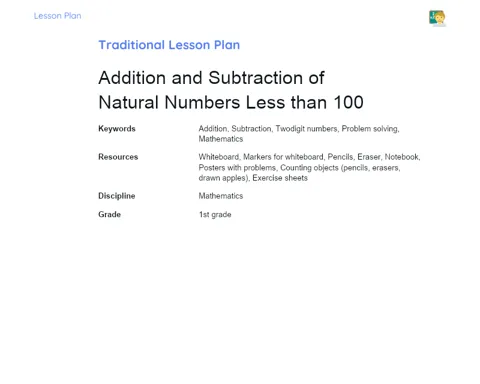
Lesson Plan | Socioemotional Learning | Operations: Addition and Subtraction
| Keywords | Mathematics, Addition, Subtraction, Socio-emotional Skills, RULER, Self-awareness, Self-control, Responsible Decision-Making, Social Skills, Social Awareness, Deep Breathing, Problem Solving, Socio-emotional Feedback, Reflection, Emotional Regulation |
| Required Materials | Board and markers, Sheets of paper, Pens and pencils, Printed set of addition and subtraction problems, Clock or timer, Comfortable chairs for the breathing activity, Notebook for students' notes |
Objectives
Duration: (10 - 15 minutes)
The purpose of this stage is to establish a clear and understandable foundation on the subject of mathematical operations while introducing the importance of socio-emotional development. This will allow students to understand what will be addressed in the lesson and how cognitive and emotional skills will be integrated into learning.
Main Goals
1. Explain the basic operations of addition and subtraction, highlighting the importance of correctly recognizing and identifying the terms, the total, minuend, subtrahend, and the remainder.
2. Develop the students' ability to solve problems involving addition and subtraction operations, applying socio-emotional skills through the RULER method.
Introduction
Duration: (15 - 20 minutes)
Emotional Warm-up Activity
Deep Breathing for Focus and Concentration
The Deep Breathing activity is a simple and effective technique to promote focus, presence, and concentration among students. Through a series of slow and controlled breaths, students will learn to calm down, increase mental clarity, and improve their attention span. This practice is especially useful to start the class with a centered mindset, open to learning.
1. Ask the students to sit comfortably in their chairs, with their feet flat on the floor and their hands resting on their laps.
2. Instruct them to close their eyes or maintain a soft gaze at a fixed point in front of them.
3. Guide the students to take a deep breath in through their nose, mentally counting to four.
4. Ask them to hold their breath for a brief moment, also counting to four.
5. Instruct them to slowly exhale through their mouth, counting again to four.
6. Repeat this breathing cycle for approximately five minutes, encouraging students to focus on the rhythm of their breath and set aside any distracting thoughts.
7. After the exercise, ask the students to slowly open their eyes and have a quick reflection on how they feel calmer and more focused.
Content Contextualization
Mathematics is an integral part of our daily lives, from calculating change at the supermarket to planning a monthly budget. However, a deep understanding of basic operations, such as addition and subtraction, goes beyond simply arriving at the correct answer. It is about developing critical thinking and problem-solving skills that are essential in everyday life. Furthermore, by learning to deal with frustrations and mathematical challenges, students also enhance their socio-emotional skills such as self-control and responsible decision-making.
Development
Duration: (60 - 75 minutes)
Theoretical Framework
Duration: (20 - 25 minutes)
1. Components of Addition:
2. Term: One of the numbers being added. Example: in the expression 3 + 4, 3 and 4 are terms.
3. Total: The result of the addition. Example: in the expression 3 + 4, the total is 7.
4. Components of Subtraction:
5. Minuend: The number from which another number is subtracted. Example: in the expression 7 - 3, 7 is the minuend.
6. Subtrahend: The number that is subtracted from the minuend. Example: in the expression 7 - 3, 3 is the subtrahend.
7. Remainder: The result of the subtraction. Example: in the expression 7 - 3, the remainder is 4.
8. Definitions:
9. Addition: A mathematical operation that combines two or more numbers into a single number, called the total.
10. Subtraction: A mathematical operation that determines the difference between two numbers.
11. Examples and Analogies:
12. Addition Example: If John has 3 apples and Maria gives him 4 more, how many apples does John have now? Answer: 3 + 4 = 7.
13. Subtraction Example: If John has 7 apples and eats 3, how many apples does he have now? Answer: 7 - 3 = 4.
14. Analogies: Addition can be compared to putting pieces of a puzzle together, while subtraction can be seen as taking pieces away from a puzzle to see what remains.
Socioemotional Feedback Activity
Duration: (30 - 35 minutes)
Addition and Subtraction Problems with Socio-emotional Feedback
Students will be divided into small groups to solve a series of problems involving addition and subtraction. Each group will receive a set of problems tailored to their level. After solving the problems, students should discuss their answers and the methods used, emphasizing the identification and management of emotions during the process.
1. Divide the students into small groups of 4 to 5 people.
2. Distribute to each group a set of addition and subtraction problems.
3. Instruct the students to solve the problems together, discussing and justifying their answers.
4. Ask the students to observe and note any emotions that arise during the problem-solving (frustration, joy, anxiety, etc.).
5. After solving the problems, each group should share their answers and discuss the emotions felt during the activity.
Group Discussion
After the activity, lead a group discussion to apply the RULER method. Recognize the emotions that arose during problem-solving, asking students to share their experiences. Understand the causes of these emotions by discussing why they felt this way and how it influenced their performance. Name the emotions accurately, helping students to identify and label their feelings appropriately. Express the emotions appropriately, encouraging students to communicate their experiences constructively. Regulate the emotions effectively by discussing strategies to cope with negative feelings and reinforcing the importance of self-control and resilience.
Conclusion
Duration: (15 - 20 minutes)
Emotional Reflection and Regulation
To reflect on the challenges faced in the lesson and how the students managed their emotions, organize a roundtable discussion or ask each student to write a short paragraph. In the roundtable discussion, encourage students to share their experiences and feelings during the addition and subtraction problem-solving. Ask how they felt when facing difficulties and what strategies they used to maintain calm and focus. In the case of written reflection, ask students to describe in a paragraph the emotions they felt during the lesson and how they dealt with those emotions.
Objective: The objective of this subsection is to encourage self-assessment and emotional regulation, helping students identify effective strategies to handle challenging situations. This will allow students to reflect on their emotional reactions and develop self-control and resilience skills, which are important for both academic and everyday life.
Closure and A Look Into The Future
To set personal and academic goals related to the lesson content, ask students to think about two objectives they would like to achieve: one related to math performance and another linked to the development of socio-emotional skills. Explain the importance of setting clear and realistic goals, and how this can help them stay motivated and focused on continuous learning.
Possible Goal Ideas:
1. Improve accuracy and speed in solving addition and subtraction problems.
2. Practice emotional self-control techniques during challenging situations.
3. Actively participate in classes and collaborate with peers to solve mathematical problems.
4. Develop the ability to recognize and name emotions during the learning process.
5. Apply emotional regulation strategies in other subjects and everyday situations. Objective: The objective of this subsection is to strengthen student autonomy and the practical application of learning, aiming for continuity in academic and personal development. By setting clear goals, students will be encouraged to reflect on their progress and identify areas for improvement in both mathematical skills and socio-emotional competencies.