Lesson Plan | Traditional Methodology | Globalized World and Migration Flows
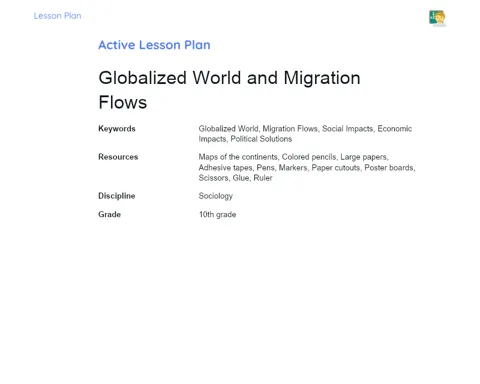
| Keywords | Globalization, Migration Flows, Economic Relations, Cultural Diversity, Technology, Communications, Public Policies, International Migration, Social Impacts, Integration of Migrants, Case Studies, Economic Opportunities, Safety, Xenophobia, Contemporary Challenges |
| Required Materials | Whiteboard and markers, Projector and computer, Presentation slides, Supplementary texts and articles, Updated statistics and data, Notetaking materials (notebooks, pencils, pens), World map, Audiovisual resources (short videos on migration), Activity sheets for discussion |
Objectives
Duration: (10 - 15 minutes)
The purpose of this stage is to present students with clear and specific objectives for the lesson, ensuring that they know exactly what they will learn and what skills they will develop throughout the period. This helps maintain focus and motivation, allowing for a deeper understanding of the topics covered.
Main Objectives
1. Understand the concept of globalization and how it influences migration flows.
2. Analyze contemporary issues related to globalization and migration.
3. Identify solutions and public policies that address the challenges of migration flows in a globalized world.
Introduction
Duration: (10 - 15 minutes)
📚 Purpose: The purpose of this stage is to contextualize students on the topic of the lesson, sparking their curiosity and interest. By presenting a rich and relevant context, students will be able to connect with the content more meaningfully, which will facilitate their understanding of the concepts and participation in subsequent discussions. Additionally, the curiosity presented aims to engage students by highlighting the relevance of the topic in the real world and in their own lives.
Context
🌍 Context: Globalization is a phenomenon that has transformed the world into a global village. This process involves the intensification of economic, cultural, and social relations between countries, facilitated by technological advances and the speed of communications. At the center of this phenomenon are migration flows, which have intensified in recent decades. Millions of people move from one country to another in search of better living conditions, job opportunities, safety, and other reasons. Understanding how globalization affects these migration movements and what the consequences are for both source and destination societies is essential to grasping the challenges of the contemporary world.
Curiosities
💡 Curiosity: Did you know that, according to the International Organization for Migration (IOM), there were around 281 million international migrants in 2020? This represents approximately 3.6% of the world's population. Many of these people migrate to developed countries in search of better economic opportunities, but there are also significant migration flows within developing countries.
Development
Duration: (50 - 60 minutes)
📝 Purpose: The purpose of this stage is to deepen students' knowledge on the themes of globalization and migration flows, providing a detailed and comprehensive view. By addressing essential topics and proposing questions for reflection, students will be able to develop a critical and analytical understanding of the subject, in addition to being prepared to discuss possible solutions to the problems raised. This detailed development aims to ensure that students not only memorize information but also understand and apply the learned concepts in real contexts.
Covered Topics
1. 📌 Concept of Globalization: Explain what globalization is, highlighting the intensification of economic, cultural, and social relations between countries. Address how technological advances and the speed of communications facilitate this process. 2. 📌 Causes of Migration Flows: Detail the main reasons that lead people to migrate, such as the search for better economic opportunities, safety, family reunification, and fleeing from conflicts or natural disasters. 3. 📌 Consequences of Migration: Describe the impacts of migration for both the countries of origin and destination. Include positive aspects, such as cultural diversity and labor supply, and negatives, such as xenophobia and overload on public systems. 4. 📌 Migration Policies and Solutions: Analyze different public policies and solutions adopted by various countries to deal with the challenges of migration flows, such as refugee reception, integration programs, and international agreements. 5. 📌 Case Studies: Present concrete examples of migration flows, such as the migration of Syrian refugees to Europe or the migration of Latin American workers to the United States. Use updated data and statistics to illustrate these cases.
Classroom Questions
1. What are the main factors driving migration flows in the context of globalization? 2. How can migration impact the destination countries positively and negatively? 3. What public policies can be implemented to improve the integration of migrants into destination societies?
Questions Discussion
Duration: (20 - 25 minutes)
🎯 Purpose: The purpose of this stage is to ensure that students consolidate their understanding of the concepts presented through a detailed and reflective discussion of the issues raised. This interaction allows students to express their own ideas and understandings, encouraging active and collaborative learning. Additionally, engagement with questions and reflections promotes critical thinking and the practical application of the discussed concepts, facilitating the internalization of the content.
Discussion
-
What are the main factors driving migration flows in the context of globalization? Explain that the main factors include the search for better economic opportunities, safety, family reunification, and fleeing from conflicts or natural disasters. Emphasize how globalization facilitates mobility through technological advances and communications, allowing people to move more easily.
-
How can migration impact the destination countries positively and negatively? Detail how migration can bring cultural diversity, skilled labor, and innovation to destination countries. On the other hand, it can also generate challenges such as xenophobia, strain on public systems (such as healthcare and education), and social tensions.
-
What public policies can be implemented to improve the integration of migrants into destination societies? Analyze policies such as refugee reception, cultural and linguistic integration programs, access to the labor market, and international agreements aimed at protecting migrants' rights and facilitating their integration into destination societies.
Student Engagement
1. How has globalization influenced migration in your own community or country? 2. What are some examples of successful public policies in dealing with the challenges of migration flows? Explain why they are effective. 3. What measures could be taken to reduce the negative aspects of migration and maximize the benefits? Discuss based on the examples studied.
Conclusion
Duration: (10 - 15 minutes)
The purpose of this stage is to consolidate learning by recapping the main points addressed in the lesson and reinforcing the connection between theory and practice. This ensures that students have a clear and integrated view of the content, facilitating the internalization and application of the discussed concepts.
Summary
- Concept of globalization and the intensification of economic, cultural, and social relations.
- Main causes of migration flows, including economic opportunities, safety, family reunification, and fleeing from conflicts.
- Impacts of migration on the countries of origin and destination, positives like cultural diversity and labor supply, and negatives like xenophobia and overload on public systems.
- Analysis of migration policies and solutions adopted to address the challenges of migration flows.
- Case studies illustrating migration flows, such as the migration of Syrian refugees to Europe and Latin American workers to the United States.
The lesson connected theory to practice by presenting concrete examples of migration flows and real public policies, providing an applied understanding of the concepts of globalization and migration. This allowed students to see the relevance of the topics discussed in the current context and in their own lives.
The topic presented is extremely relevant to everyday life, as globalization and migration flows are phenomena that directly affect our societies. Understanding these processes helps to comprehend the social, economic, and cultural dynamics that shape the current world, as well as promote a critical view of the challenges and solutions related to migration.