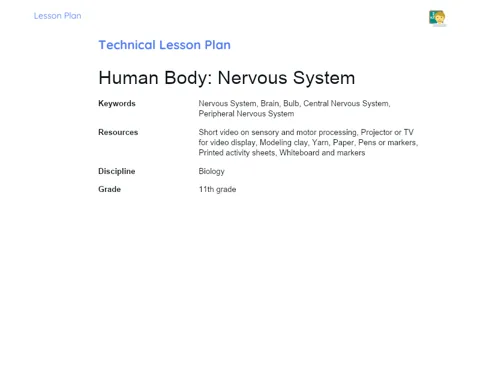
Lesson Plan | Traditional Methodology | Human Body: Nervous System
| Keywords | Nervous System, Brain, Medulla, Central Nervous System (CNS), Peripheral Nervous System (PNS), Neurons, Synapses, Autonomic Functions, Sensory Processing, Motor Coordination |
| Required Materials | Whiteboard, Markers, Multimedia projector, Presentation slides, Printed material with diagrams of the nervous system, Laser pointer, Notebook and pen for student notes |
Objectives
Duration: (10 - 15 minutes)
This stage of the lesson plan aims to prepare students for the content that will be covered, establishing clear expectations about the knowledge and skills that will be developed. By defining specific objectives, the teacher helps to direct students' attention to the most important points of the lesson, facilitating understanding and retention of the content.
Main Objectives
1. Identify and describe the main organs of the nervous system, including the brain and the medulla, and their functions.
2. Understand the general functioning of the nervous system.
3. Differentiate the central nervous system from the peripheral nervous system.
Introduction
Duration: (10 - 15 minutes)
The purpose of this stage is to capture students' interest and provide relevant and engaging context for the lesson. By presenting intriguing information and curiosities about the nervous system, the teacher awakens students' curiosity and sets the stage for a deeper understanding of the content. This introduction also establishes the importance of the topic in the students' daily lives, helping them to see the practical relevance of what they are about to learn.
Context
The nervous system is one of the most complex and fascinating systems in the human body. It is responsible for controlling and coordinating all the functions of our body, from conscious movements, such as walking and speaking, to automatic functions, such as breathing and digestion. The nervous system allows us to perceive the world around us through our senses and respond appropriately to external stimuli. In this lesson, we will explore the structure and functioning of the nervous system, focusing on the central and peripheral nervous systems, and understand how these components work together to keep our body functioning.
Curiosities
Did you know that the human brain contains approximately 86 billion neurons? These neurons communicate through synapses, allowing information to be transmitted at an impressive speed. To give you an idea, the speed of a nerve impulse can reach 120 meters per second! Furthermore, the brain consumes about 20% of the oxygen and calories we ingest daily, despite representing only about 2% of body weight.
Development
Duration: (50 - 60 minutes)
The purpose of this stage is to provide a detailed and comprehensive explanation of the nervous system, allowing students to understand not only the structures and functions of its main components but also how these components interact to perform vital functions. This stage includes moments for students to note important information and engage actively through solving questions, promoting deeper and more meaningful learning.
Covered Topics
1. Structure of the Nervous System: Explain the division of the nervous system into the Central Nervous System (CNS) and the Peripheral Nervous System (PNS). Detail the main components of each, such as the brain and spinal cord in the CNS, and the cranial and spinal nerves in the PNS. 2. The Brain: Describe the main parts of the brain, including the cerebral cortex, the cerebellum, and the brainstem. Explain the functions of each of these parts, such as the control of motor functions, balance and coordination, and the regulation of vital functions. 3. The Medulla: Detail the location and function of the medulla, which is part of the brainstem. Explain its role in regulating autonomic functions, such as breathing and heart rate. 4. Neurons and Synapses: Explain the structure of neurons, including the cell body, dendrites, and axon. Detail the process of transmitting nerve impulses through synapses and the importance of neurotransmitters. 5. Functioning of the Nervous System: Describe how the nervous system processes sensory and motor information. Explain the difference between simple reflexes and voluntary actions, and how the CNS and PNS work together to coordinate these functions.
Classroom Questions
1. What are the main differences between the Central Nervous System and the Peripheral Nervous System? 2. Describe the function of two parts of the brain and how they contribute to the overall functioning of the body. 3. Explain how neurons communicate with each other and the importance of this communication for the functioning of the nervous system.
Questions Discussion
Duration: (20 - 25 minutes)
The purpose of this stage is to review and consolidate the knowledge acquired by the students, addressing the questions presented in the Development stage with depth and clarity. Discussing the answers allows the teacher to clarify doubts, reinforce key points, and promote a deeper understanding of the content. Student engagement through questions and critical reflections stimulates active participation and practical application of knowledge.
Discussion
-
What are the main differences between the Central Nervous System and the Peripheral Nervous System? The Central Nervous System (CNS) consists of the brain and spinal cord. It is responsible for processing and integrating information, as well as coordinating voluntary and involuntary activities of the body. The Peripheral Nervous System (PNS) consists of cranial and spinal nerves that branch out from the CNS and extend throughout the body. The PNS transmits information between the body and the CNS, allowing for sensory and motor responses.
-
Describe the function of two parts of the brain and how they contribute to the overall functioning of the body. The cerebral cortex is responsible for higher cognitive functions, such as thinking, memory, and decision-making. The cerebellum coordinates movement and balance, ensuring smooth and accurate execution of motor activities.
-
Explain how neurons communicate with each other and the importance of this communication for the functioning of the nervous system. Neurons communicate through synapses, where a nerve impulse is transmitted from one neuron to another via neurotransmitters. This communication is crucial for the transmission of information and the coordination of quick and precise responses by the nervous system.
Student Engagement
1. How do you think the function of the brain influences your daily activities? 2. Can you give an example of a simple reflex we experience in daily life? 3. Why is it important for the brain to consume a significant amount of oxygen and calories? 4. Which part of the nervous system do you find most fascinating and why? 5. How do you think advancements in the study of the nervous system could impact medicine in the future?
Conclusion
Duration: (10 - 15 minutes)
The purpose of this stage is to reinforce the main points of the lesson, ensuring that students have a clear and consolidated view of the content covered. By recapping the main themes, connecting theory to practice, and highlighting the relevance of the subject, the teacher facilitates the retention of knowledge and demonstrates its applicability in everyday life.
Summary
- Identification and description of the main organs of the nervous system, such as the brain and the medulla, and their functions.
- Understanding of the general functioning of the nervous system.
- Difference between the Central Nervous System (CNS) and the Peripheral Nervous System (PNS).
- Structure and function of neurons and synapses.
- Processing of sensory and motor information by the nervous system.
The lesson connected theory with practice by explaining how each part of the nervous system contributes to specific functions of the human body, such as breathing, movement, and coordination. Through practical examples and detailed explanations, students could see how theoretical knowledge applies to everyday situations and to human health.
The nervous system is fundamental to all daily activities, from the simplest, such as walking and breathing, to the most complex, such as thinking and making decisions. Understanding its functioning allows us to appreciate the complexity of the human body and the importance of maintaining neurological health. Furthermore, advancements in the study of the nervous system have the potential to revolutionize medical treatments and improve quality of life.