Lesson Plan | Teachy Methodology | Verbs: Simple Past
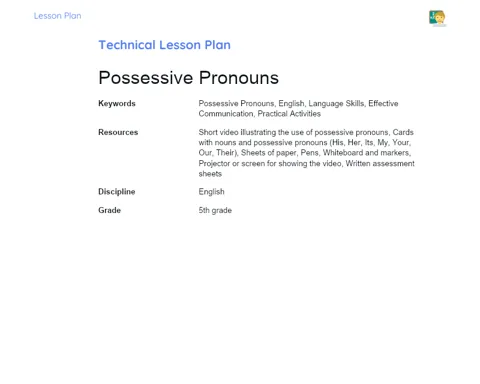
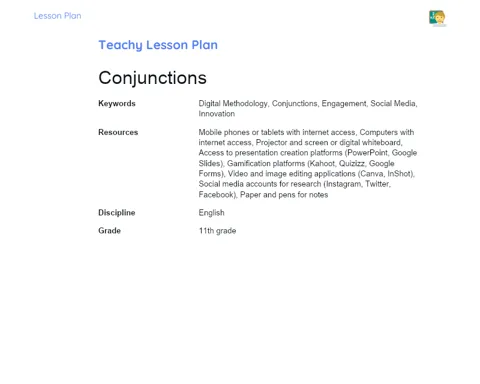
| Keywords | Verbs, Simple Past, Regular, Irregular, Collaborative Narratives, Social Media, Gamification, Interactivity, Digital Methodology, Creative Writing, Digital Tools |
| Required Materials | Cell phones or tablets, Computers with internet access, Collaborative writing applications (Google Docs), Graphic design tools (Canva, Adobe Spark), Social media tools (Instagram, Twitter, Facebook), Game creation platforms (Scratch, Twine), Annotation materials (notebooks, pencils, pens) |
Objectives
Duration: 10 minutes
The purpose of this stage of the lesson plan is to ensure that students have a clear and explicit understanding of the main objectives of the lesson. Aligning expectations helps to direct students' attention and provides a clear roadmap for what will be covered during the lesson. This section prepares students to engage more effectively in the practical activities that will follow, ensuring that they know exactly what they should achieve by the end of the lesson.
Main Objectives
1. Identify and correctly use regular and irregular verbs in the simple past.
2. Understand the use of the simple past in contrast with other verb tenses.
Introduction
Duration: (10 - 15 minutes)
The purpose of this stage of the lesson plan is to introduce the topic in an engaging and relevant way for the students, connecting the content to their digital world and reality. This initial warm-up aims to capture students' interest, preparing them for active and collaborative participation in the upcoming activities. Additionally, the key questions promote an initial debate that reinforces previously acquired knowledge and establishes a solid foundation for the practical lesson.
Warming Up
Warm-up:
Explain to the students that today's lesson will focus on deepening the use of verbs in the simple past, both regular and irregular. To start, ask the students to use their cell phones to look up an interesting or curious fact about the use of the simple past in the English language. For example, they can research how the simple past is used in newspaper headlines to report events. Then, ask them to share what they found with the class. This initial activity will help connect the lesson topic with the digital world and the students' reality.
Initial Reflections
1. What is the difference between a regular and an irregular verb in the simple past?
2. Why is it important to know the simple past and how it is used in everyday conversations?
3. Can you give examples of sentences using regular and irregular verbs in the simple past?
4. How can the use of the simple past change the meaning of a sentence?
5. What are some common irregular verbs you already know?
Development
Duration: 70 - 80 minutes
The purpose of this stage of the lesson plan is to allow students to practically and contextually apply their knowledge of verbs in the simple past. The proposed activities stimulate creativity, collaboration, and the use of digital technologies, making learning more engaging and meaningful.
Activity Suggestions
It is recommended that only one of the suggested activities be carried out
Activity 1 - 🏰 Building the Simple Past Castle 🏰
> Duration: 60 - 70 minutes
- Objective: Practice the use of regular and irregular verbs in the simple past creatively and collaboratively.
- Description: Students will create a collaborative narrative using regular and irregular verbs in the simple past. Each group will be responsible for a chapter of a story set in a medieval castle. They will use digital tools to write and illustrate the story.
- Instructions:
-
Divide the class into groups of up to 5 students.
-
Each group will be responsible for writing a chapter of a story set in a medieval castle.
-
Use collaborative writing applications, such as Google Docs, to allow all members to contribute simultaneously.
-
Include regular and irregular verbs in the simple past in the narratives.
-
Use graphic design tools or drawing applications, such as Canva or Adobe Spark, to create illustrations that accompany the text.
-
After all groups finish their chapters, compile the complete story and present it to the class.
Activity 2 - 📱 Time Influencers 📱
> Duration: 60 - 70 minutes
- Objective: Encourage the practice of the simple past in the context of digital communication and social media.
- Description: Students will become 'digital influencers' for a day, creating social media posts that describe past events using the simple past. They will use their real or fictitious social media accounts to share their posts.
- Instructions:
-
Divide the class into groups of up to 5 students.
-
Each group should choose a historical event or a recent occurrence and create a series of social media posts about it, using verbs in the simple past.
-
Use social media tools like Instagram, Twitter, or Facebook to create and publish the posts.
-
Include images, videos, or GIFs that illustrate the posts to make them more engaging.
-
Ask each group to present its posts to the class, explaining the use of verbs in the simple past.
Activity 3 - 🎮 Game Over - The Simple Past Saga 🎮
> Duration: 60 - 70 minutes
- Objective: Apply the use of the simple past in an interactive and gamified scenario, stimulating creativity and collaboration.
- Description: In this gamified activity, students will divide into groups and create a digital game where characters need to solve challenges and puzzles involving the correct use of verbs in the simple past to advance the story.
- Instructions:
-
Divide the class into groups of up to 5 students.
-
Each group should create a script for a digital game that includes challenges and puzzles that can only be solved using verbs in the simple past.
-
Use simplified game creation platforms, such as Scratch or Twine, to develop the game.
-
Students must write dialogues, descriptions, and instructions in the simple past.
-
After completing the development, each group will present and play the game created in front of the class.
Feedback
Group Discussion
💬 Group Discussion: Start the discussion by asking each group to share their narratives, social media posts, or digital games they created. Ask the students what the biggest challenges were in using verbs in the simple past and how they overcame those challenges. Encourage them to talk about what they enjoyed most about the activity and what they learned from the experience. Conclude by asking each group to offer a tip to their peers on how to use the simple past effectively.
Reflections
1. What were the main challenges in using regular and irregular verbs in the simple past during your activities? 2. How did the chosen digital tools help or hinder the creation process? 3. In what way did interaction with peers and group work contribute to your learning?
360° Feedback
🔄 360° Feedback: Explain to students the importance of constructive and respectful feedback. Ask each student to share one positive thing they found in each of their groupmate's work and a suggestion for improvement. Instruct them to be specific and clear in their feedback to promote a collaborative and welcoming learning environment. Use a feedback structure such as 'I liked... because... and I think you can improve... by doing...'.
Conclusion
Duration: (10 - 15 minutes)
📚 Purpose of the Conclusion 📚
The purpose of this stage of the lesson plan is to consolidate the knowledge acquired during the lesson, reinforcing the main concepts in a light and fun way. This helps fix the content in the students' memory and highlights the practical relevance of what was learned, motivating them to apply these skills in various everyday contexts.
Summary
✨ Magical Summary: Simple Past Quiz! ✨
Let's play a quick quiz and see how much you've learned! 🎉 What is the simple past of 'go'? (It was 'went'!). And 'play'? (Yes, it's 'played'!).
Regular verbs generally end in '-ed', while irregular verbs... well, they are irregular! We learned to use them in sentences to report past events, both in medieval stories and in posts on social media. You all did great! 🚀
World Connection
🌍 In the Real and Digital World 🌍
The ability to master the simple past is essential, both for writing a good essay and for creating impactful digital content. In today's world, where social media dominates communication, knowing how to tell a story clearly and engagingly can make the difference between being overlooked and being noticed. Furthermore, the correct use of verbs enriches our everyday and professional interactions.
Practical Application
💡 Daily Applications 💡
Mastering the simple past is crucial for reporting events clearly, whether in everyday conversations, academic writing, or even in digital narratives. From telling a story to describing past experiences in interviews or posts, this skill is an important differentiator. And with the world increasingly connected through the internet, knowing how to communicate well in the simple past is a powerful tool.