Lesson Plan | Teachy Methodology | Organic Functions: Organic Salt Nomenclature
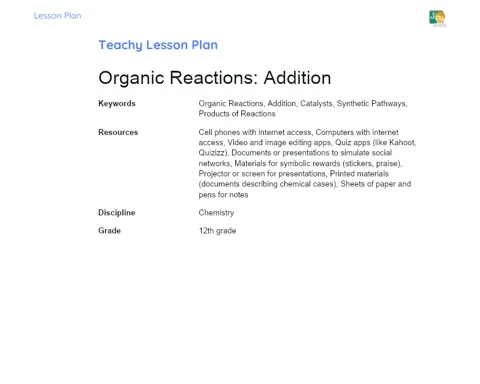
| Keywords | Digital Methodology, Active Methodology, Organic Salts, Chemical Nomenclature, Organic Chemistry, Sodium Methanoate, Sodium Propanoate, Social Networks, Augmented Reality, Gamification, Storytelling, Interactive Education, Collaboration, 360° Feedback |
| Required Materials | Cell phones with internet access, Computers or tablets, Software for quiz creation (Kahoot, Quizizz), Augmented Reality applications, Projector or shared screen, Materials for notes (paper, pen, or note-taking apps) |
Objectives
Duration: 10 - 15 minutes
This stage aims to present the main and secondary objectives of the lesson to the students, guiding the learning process and ensuring that everyone clearly understands the goals that need to be achieved. This helps to effectively focus the students' attention and the structure of the lesson.
Main Objectives
1. Recognize and name common organic salts, such as sodium methanoate and sodium propanoate.
2. Correctly apply the nomenclature of organic salts in different contexts.
Side Objectives
- Relate the nomenclature of organic salts to their respective chemical structure.
- Understand the role of organic salts in different everyday applications, such as in the food and pharmaceutical industries.
Introduction
Duration: 15 - 20 minutes
This stage aims to contextualize the lesson's theme, energize students about the subject, and create an interactive and collaborative environment. Researching and sharing interesting facts encourage the use of digital skills and promote curiosity and engagement. The key questions are intended to initiate an initial debate, helping students review and deepen their previously acquired knowledge.
Warming Up
Organic functions are a fundamental part of organic chemistry, and understanding the nomenclature of organic salts is essential for various applications ranging from biotechnology to the pharmaceutical industry. To start the lesson, ask students to use their cell phones to research and share an interesting fact about organic salts they find on the internet. This will help contextualize the topic and initiate an engaging discussion.
Initial Reflections
1. What is the importance of understanding the nomenclature of organic salts in the context of chemistry and the pharmaceutical and food industries?
2. What are the basic components of an organic salt and how do they combine?
3. Can you give an example of an organic salt present in our daily lives?
4. How does the structure of an organic salt influence its properties and applications?
5. What challenges have you encountered while studying the nomenclature of organic salts?
Development
Duration: 70 - 75 minutes
This stage aims to deepen students' knowledge of the nomenclature and applications of organic salts through hands-on and interactive activities that utilize digital technologies. By working in groups, students develop collaboration and communication skills while engaging creatively and interactively with the academic content.
Activity Suggestions
It is recommended that only one of the suggested activities be carried out
Activity 1 - 📱 The Saga of Chemical Influencers
> Duration: 60 - 70 minutes
- Objective: Engage students in learning the nomenclature of organic salts through digital tools and social media, allowing them to apply their knowledge in a practical and creative way.
- Description: In this activity, each group of students must create a storytelling narrative where fictional digital influencers discuss the properties and applications of organic salts, such as sodium methanoate and sodium propanoate. Students are asked to create social media posts (Instagram, TikTok, Twitter) using texts, images, and short videos to explain the nomenclature and applications of these organic salts in a creative and engaging way.
- Instructions:
-
Divide the class into groups of up to 5 students.
-
Each group must choose two organic salts (sodium methanoate and sodium propanoate).
-
Students should research the properties, uses, and structure of the chosen salts.
-
Using cell phones and computers, create digital content (posts, videos) simulating publications from digital influencers, focusing on creatively and clearly explaining the nomenclature and applications of the salts.
-
Share the created content in a private group or classroom platform, and discuss the posts as the class views them on the main screen.
Activity 2 - 🧩 Gamer Chemistry: Organic Salt Mission
> Duration: 60 - 70 minutes
- Objective: Promote active and collaborative learning through gamification, reinforcing knowledge about the nomenclature and applications of organic salts in a fun and interactive way.
- Description: Students will participate in a gamified activity to solve puzzles and challenges related to organic salts. Using an online quiz creation platform, such as Kahoot or Quizizz, each group will answer questions about the nomenclature and applications of organic salts to advance in the game and unlock additional information.
- Instructions:
-
Divide the class into groups of up to 5 students.
-
The teacher should create an interactive quiz using a digital platform (Kahoot, Quizizz) with questions related to nomenclature, structure, and applications of organic salts.
-
Each group uses their cell phones to access the quiz and answer the questions in real-time.
-
Groups earn points as they answer questions correctly and advance in the game.
-
After completing the quiz, discuss the correct answers and reinforce the main points using practical examples.
Activity 3 - 🔬 Augmented Reality: Exploring Organic Salts
> Duration: 60 - 70 minutes
- Objective: Facilitate the understanding of molecular structures and nomenclature of organic salts through interactive visualization in augmented reality, connecting theory and practice.
- Description: In this activity, students use augmented reality (AR) applications to visualize and interact with three-dimensional models of organic salts. Students can explore the molecular structures and understand how the components combine to form organic salts. The application will allow students to annotate and share their observations in real-time.
- Instructions:
-
Divide the class into groups of up to 5 students.
-
Ask each group to download an augmented reality application recommended by the teacher.
-
Students use the app to visualize and interact with 3D models of organic salts, such as sodium methanoate and sodium propanoate.
-
Ask the groups to note their observations about the structure and nomenclature of the salts and how these structures influence their properties.
-
Present the observations using a projector or shared screen and promote an interactive discussion about the students' discoveries.
Feedback
Duration: 20 - 25 minutes
The purpose of this stage is to consolidate learning by promoting critical and collaborative reflection on the activities conducted. The 360° feedback also allows for a continuous learning environment and shares different perspectives, helping students develop academically and socially.
Group Discussion
💬 Group Discussion: Promote a group discussion with all students, where the groups share what they learned by completing the activity and their conclusions. Follow this script to introduce the discussion:
- Start the discussion by thanking all the students for their efforts in the activities performed.
- Ask each group to present a summary of the activities they undertook, highlighting the main learnings.
- Encourage students to comment on the posts and quizzes of other groups, fostering a healthy and constructive debate.
- Ask students how they relate the practical activities to the theoretical content they studied previously.
Reflections
1. 📌 Reflection Questions:
- What did you enjoy most about using digital tools to learn about organic salts?
- What were the main difficulties encountered during the activities and how did you overcome them?
- How did the augmented reality visualization help you understand the molecular structure of organic salts?
360° Feedback
🔄 360° Feedback: Conduct a 360° feedback session where each student should receive feedback from the other students in their group who worked on the activity. Instruct students to focus on three main aspects:
- Strengths: What the student did well during the activities.
- Areas for Improvement: Aspects that could be improved next time.
- Constructive Suggestions: Ideas on how the student can enhance their performance.
Guide the class to ensure that the feedback is constructive and respectful, emphasizing that the objective is to promote collective growth and development.
Conclusion
Duration: 10 - 15 minutes
🎯 Purpose: The purpose of this stage is to consolidate the knowledge acquired during the lesson and connect this knowledge with real life and its practical applications. By summarizing the main points creatively and relating the importance of organic salts to today's world, students leave the lesson with a more comprehensive and applicable understanding of the content studied. Additionally, this stage provides a final reflection for students to internalize and appreciate the importance of learning.
Summary
🌟 Summary: Imagine that organic salts are the superheroes of Chemistry! 🦸♂️ Sodium Methanoate and Sodium Propanoate are the protagonists of our story, and today we learned how to recognize and name these amazing compounds. We used digital tools like social networks, quizzes, and augmented reality to explore their molecular structures and understand their applications. The students became chemical influencers and gamified learning to make everything more exciting and interactive!
World Connection
🌍 In the World: In the digital universe we live in, knowledge like the nomenclature of organic salts can be explored in innovative ways connected to our daily lives. From social media posts that explain scientific concepts in an accessible way to the use of augmented reality technology to visualize molecules in 3D, we are preparing our students for a world where technology and science go hand in hand.
Practical Application
🏥 Applications: Learning the nomenclature of organic salts, such as sodium methanoate and sodium propanoate, is vital not only for academic advancement in Chemistry but also for practical applications in industries such as pharmaceuticals, food, biotechnology, and many others. By understanding these compounds, students are better prepared to comprehend their uses in food preservation, drug formulation, and even cutting-edge technologies.