Lesson Plan | Traditional Methodology | Organic Reactions: Addition
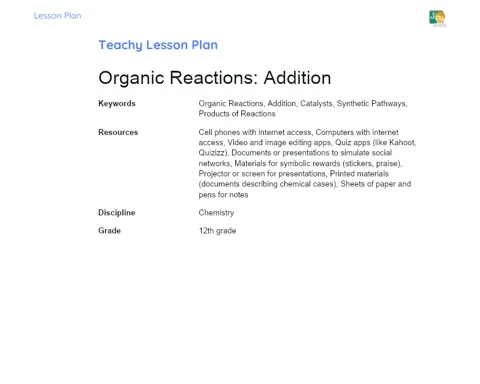
| Keywords | Organic Reactions, Addition Reactions, Electrophilic Addition, Nucleophilic Addition, Radical Addition, Catalysts, Synthetic Routes, Polymers, Pharmaceuticals, Unsaturated Compounds, Organic Chemistry, Petrochemical Industry |
| Required Materials | Whiteboard and markers, Projector and computer for slide presentation, Presentation slides with explanations and examples, Printed material with summary and discussion questions, Molecular models (optional), Organic Chemistry textbooks, Exercise booklets on organic reactions |
Objectives
Duration: (10 - 15 minutes)
The purpose of this stage is to ensure that students have a clear and precise view of what will be addressed in the class, establishing a solid foundation for understanding addition reactions. These objectives will guide the structure of the class, allowing students to know exactly what to expect and what skills and knowledge they should acquire by the end of the lesson.
Main Objectives
1. Understand the concept of organic reactions and their importance in chemistry.
2. Identify and describe the main addition reactions.
3. Understand the role of catalysts in addition reactions.
Introduction
Duration: (10 - 15 minutes)
The purpose of this stage is to capture students' attention and contextualize the theme of the lesson, showing the relevance of addition reactions in the real world. This will help students understand the importance of the content that will be covered and keep them engaged during the lesson.
Context
To start the lesson on Organic Reactions: Addition, explain to the students that organic reactions are chemical transformations that occur in organic compounds. These reactions are fundamental in the synthesis of new materials, medicines, and many other essential products for our daily lives. Addition reactions, in particular, are a type of reaction in which two or more reactants combine to form a single product. They are common in unsaturated compounds such as alkenes and alkynes.
Curiosities
Did you know that the production of many plastics, such as polyethylene used in plastic bags, involves addition reactions? These reactions are crucial in the petrochemical industry, which transforms oil into a vast array of products that we use daily.
Development
Duration: (40 - 45 minutes)
The purpose of this stage is to deepen students' knowledge about addition reactions, addressing different types, mechanisms, and specific examples. Additionally, it aims to clarify the role of catalysts and the practical application of these reactions in synthetic routes and the production of everyday materials. This section also promotes problem-solving and the application of acquired knowledge through specific questions.
Covered Topics
1. Definition of Addition Reactions: Explain that addition reactions are those in which two or more atoms or molecules combine to form a single product. Highlight the importance of addition reactions in unsaturated compounds, such as alkenes and alkynes. 2. Types of Addition Reactions: Describe the main types of addition reactions, such as electrophilic addition, nucleophilic addition, and radical addition. Provide examples of each type to illustrate their characteristics and differences. 3. Electrophilic Addition: Detail that this type of addition occurs in unsaturated compounds (alkenes and alkynes) and involves the addition of an electrophile (an electron-attracting agent) to the double or triple bond. Give examples, such as the hydration of alkenes to form alcohols. 4. Nucleophilic Addition: Explain that in nucleophilic additions, a nucleophile (an electron-donating agent) adds to an unsaturated compound. Illustrate with the addition of hydrogen cyanide (HCN) to aldehydes and ketones. 5. Radical Addition: Address that in radical addition, free radicals (highly reactive species) are added to unsaturated compounds. Provide an example with the polymerization of ethylene to form polyethylene, a common plastic. 6. Catalysts in Addition Reactions: Explain the role of catalysts in accelerating addition reactions without being consumed in the process. Give examples of common catalysts, such as acids (H2SO4) and transition metals (Pd, Pt). 7. Synthetic Routes and Products: Discuss how addition reactions are used in synthetic routes to produce various chemical products, such as polymers, pharmaceuticals, and industrial materials. Provide examples of products resulting from these reactions.
Classroom Questions
1. Explain the difference between electrophilic addition and nucleophilic addition, providing an example of each. 2. Describe the role of catalysts in addition reactions and give two examples of catalysts used in these reactions. 3. Explain how radical addition is used in polymer production and provide an example of a polymer produced by this method.
Questions Discussion
Duration: (20 - 25 minutes)
The purpose of this stage is to review and consolidate the knowledge acquired by the students throughout the class. Discussing the answers to the presented questions promotes a deeper understanding of the content, clarifying doubts and reinforcing key concepts. Additionally, engaging students with reflective questions stimulates critical thinking and practical application of theoretical knowledge.
Discussion
-
✅ Explain the difference between electrophilic addition and nucleophilic addition, providing an example of each.
-
In electrophilic addition, an electrophile (an electron-attracting agent) is added to a double or triple bond, usually in unsaturated compounds like alkenes and alkynes. A classic example is the hydration of alkenes, where the electrophile H+ is added to the double bond, followed by the addition of a water molecule to form an alcohol.
-
In nucleophilic addition, a nucleophile (an electron-donating agent) is added to an unsaturated compound, often aldehydes and ketones. An example is the addition of hydrogen cyanide (HCN) to an aldehyde, resulting in the formation of a cyanohydrin.
-
✅ Describe the role of catalysts in addition reactions and give two examples of catalysts used in these reactions.
-
Catalysts are substances that accelerate the speed of chemical reactions without being consumed in the process. They work by lowering the activation energy required for the reaction to occur. Common examples include acids like sulfuric acid (H2SO4), which catalyzes the hydration of alkenes, and transition metals like palladium (Pd) and platinum (Pt), which are used in the hydrogenation of alkenes to form alkanes.
-
✅ Explain how radical addition is used in polymer production and provide an example of a polymer produced by this method.
-
Radical addition involves the formation of free radicals, which are highly reactive species with unpaired electrons. These radicals initiate a chain reaction that results in the polymerization of unsaturated monomers. An example is the polymerization of ethylene (CH2=CH2) to form polyethylene (PE), one of the most common plastics used in plastic bags and packaging.
Student Engagement
1. 📝 Questions and reflections to engage students: 2. 1. How would you explain the importance of addition reactions in the synthesis of new materials? 3. 2. What are the main differences between the three types of addition reactions discussed (electrophilic, nucleophilic, and radical)? 4. 3. Can you think of other industrial applications of addition reactions besides plastic production? 5. 4. How do catalysts impact the efficiency and selectivity of addition reactions? 6. 5. What advantages does radical addition offer compared to other forms of addition in terms of control and industrial applicability?
Conclusion
Duration: (10 - 15 minutes)
The purpose of this stage is to consolidate students' learning by reviewing the main points presented in the lesson and reinforcing the connection between theory and its practical applications. This ensures that students leave the class with a clear and integrated understanding of the content, ready to apply the knowledge in future contexts.
Summary
- Organic reactions are chemical transformations in organic compounds essential for the synthesis of new materials.
- Addition reactions involve the combination of two or more reactants to form a single product, common in unsaturated compounds such as alkenes and alkynes.
- There are three main types of addition reactions: electrophilic addition, nucleophilic addition, and radical addition.
- Catalysts are substances that accelerate reactions without being consumed; examples include acids and transition metals.
- Addition reactions are used in synthetic routes to produce various chemical products, such as polymers and pharmaceuticals.
The lesson connected theory with practice by explaining how addition reactions are applied in the industry for the production of plastics, pharmaceuticals, and other essential materials. By discussing practical examples, such as the polymerization of ethylene to form polyethylene, students could see the direct relevance of these theoretical concepts in the real world.
The topic presented is of great importance for daily life since many of our daily needs, such as plastic packaging, medicines, and even clothing, are products of addition reactions. Understanding these processes allows students to recognize the chemistry behind the products they use daily and the importance of organic chemistry in modern industry.