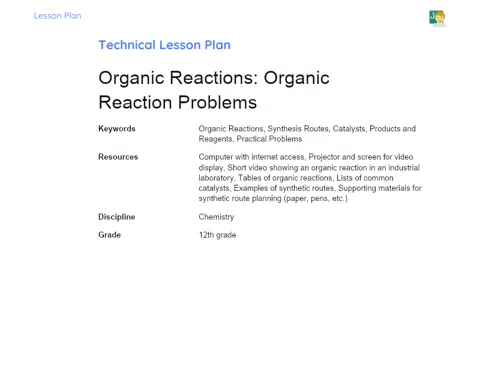
Lesson Plan | Active Learning | Organic Reactions: Organic Reaction Problems
| Keywords | Organic reactions, Identification of reactants and products, Synthesis routes, Catalysts, Practical activities, Teamwork, Critical thinking, Problem-solving, Knowledge application, Debate and discussion |
| Required Materials | Cards with descriptions of organic reactions, Notebooks for recording answers, Workstations, Reagent kits for synthesis, Instructions for synthesis reactions, Materials for presentation and debate, Internet access for research |
Assumptions: This Active Lesson Plan assumes: a 100-minute class, prior student study with both the Book and the start of Project development, and that only one activity (among the three suggested) will be chosen to be conducted during the class, as each activity is designed to take up a significant portion of the available time.
Objectives
Duration: (5 - 7 minutes)
The objectives stage is crucial to clearly establish the learning goals for the lesson. By defining specific objectives, the teacher guides students on what is expected of them to learn and apply during the session. This initial clarity helps to focus subsequent activities and ensures that students can direct their prior study efforts to the essential points of the material. Furthermore, by detailing the skills to be developed, students can self-assess their progress and participation, increasing engagement and learning effectiveness.
Main Objectives:
1. Empower students to recognize and identify reactants and products in organic reactions.
2. Develop the skill to analyze and determine synthetic routes in organic reactions.
3. Enhance understanding of catalysts and their function in organic reactions.
4. Enable students to solve practical problems involving organic reactions, applying prior knowledge effectively.
Side Objectives:
- Stimulate critical thinking and problem-solving through practical activities.
Introduction
Duration: (15 - 20 minutes)
The introduction serves to engage students and connect previously acquired knowledge at home with practical application in the classroom. The proposed problem situations encourage students to think critically and apply their knowledge of organic reactions in practical contexts, paving the way for more in-depth activities. The contextualization, in turn, highlights the importance and ubiquity of organic reactions in the real world, increasing student interest in the subject.
Problem-Based Situations
1. Consider the synthesis reaction of acetylsalicylic acid, the active ingredient in aspirin, from salicylic acid. What reactants would be necessary and what would the final product be? Discuss the intermediate steps that could be employed.
2. Imagine you are a researcher who needs to develop a new method for producing biodiesel from vegetable oils. What would be the necessary reactants and conditions for this reaction to occur efficiently? How could knowledge about catalysts be applied to improve the reaction yield?
Contextualization
Organic reactions are fundamental both in nature and in industry. They are present in biological processes such as protein synthesis and the production of metabolites, and are essential for the manufacture of chemicals, pharmaceuticals, and large-scale materials. For example, penicillin is produced by an organic reaction that transforms 6-aminopenicillanic acid into penicillin G, an important antibiotic. These examples demonstrate the relevance of organic reactions in daily life and their impact on improving quality of life.
Development
Duration: (75 - 85 minutes)
The Development stage is designed to allow students to practically and interactively apply the concepts previously studied about organic reactions. The proposed activities aim to consolidate the recognition of reactants and products, understanding of synthesis routes, and the importance of catalysts. By working in groups, students also develop communication and teamwork skills, essential for the academic and professional environment.
Activity Suggestions
It is recommended to carry out only one of the suggested activities
Activity 1 - The Hunt for Products and Reactants
> Duration: (60 - 70 minutes)
- Objective: Quickly recognize and identify reactants and products in organic reactions, promoting mental agility and teamwork.
- Description: In this activity, students will form groups of up to 5 people and receive cards with descriptions of organic reactions. Each card will describe the reactants of a reaction and ask students to identify the resulting product. The cards will be placed at different stations around the room.
- Instructions:
-
Form groups of up to 5 students.
-
Each group starts at a different station.
-
Read the card description and determine the product of the reaction.
-
Record your answers in the group's notebook.
-
After 10 minutes, groups should switch stations.
-
At the end, each group presents their answers and discusses the reactions with the class.
Activity 2 - Real-Time Synthesis Route
> Duration: (60 - 70 minutes)
- Objective: Develop practical synthesis skills and understanding of reaction routes, as well as reinforce the importance of experimental conditions.
- Description: Students, divided into groups, will receive a 'reagent kit' and a series of instructions to perform a simple synthesis reaction, such as ester formation. They must follow the instructions to discover the correct synthesis route and produce the expected product.
- Instructions:
-
Divide the class into groups of up to 5 students.
-
Distribute reagent kits and instructions to each group.
-
Follow the instructions to perform the synthesis reaction.
-
Identify the product formed and note the process followed.
-
Discuss with the group whether the reaction was successful and why.
-
Present the results and discuss the different possible synthesis routes.
Activity 3 - The Great Catalyst Debate
> Duration: (60 - 70 minutes)
- Objective: Deepen knowledge about the role of catalysts and develop argumentation and public speaking skills.
- Description: In this scenario, each student group will be designated to defend a specific catalyst in a common organic reaction. They will receive advance information about the catalyst and must prepare arguments to convince the class that their catalyst is the most effective.
- Instructions:
-
Organize students into groups of up to 5 people and assign a different catalyst to each group.
-
Allow each group to quickly research the catalyst and its application.
-
Each group must prepare a defense of why their catalyst is best for the assigned reaction.
-
Hold a class debate where each group presents their arguments.
-
Conclude with a vote to decide which group presented the most convincing argument.
Feedback
Duration: (10 - 15 minutes)
The purpose of this stage is to allow students to articulate and reflect on the knowledge acquired and applied during practical activities. The group discussion helps consolidate learning, enabling students to express their ideas, hear different perspectives, and enhance their understanding through dialogue. Additionally, the key questions focus reflection on essential learning points, ensuring that students can critically evaluate their own understanding and progress on organic reactions.
Group Discussion
Start the group discussion with a brief recap of the activities performed, highlighting the importance of recognizing reactants and products in organic reactions, understanding synthesis routes, and exploring the role of catalysts. Encourage students to share insights and challenges encountered during the activities, and how these learnings can be applied in real situations and future studies.
Key Questions
1. What were the main difficulties your group encountered when identifying reactants and products in organic reactions?
2. How can understanding synthesis routes help optimize the production of compounds in industrial applications?
3. In what ways can the use of different catalysts influence the efficiency and yield of an organic reaction?
Conclusion
Duration: (5 - 10 minutes)
The purpose of this stage is to consolidate the learning, ensuring that students have understood and internalized the key concepts discussed during the lesson. By summarizing and linking theoretical content with practical activities, this stage helps students perceive the applicability of knowledge in real situations and the importance of their continued study in academic and professional development.
Summary
In conclusion, the teacher should summarize the main points addressed during the lesson, reinforcing the identification of reactants and products, the analysis of synthesis routes, and the importance of catalysts in organic reactions. It is essential for students to revisit the practical activities performed, highlighting the insights gained and the practical applications of the theoretical concepts.
Theory Connection
During the lesson, the connection between the theory studied at home and the practice in class was clearly established. Activities such as the hunt for products and reactants, real-time synthesis, and debate on catalysts allowed students to apply theoretical knowledge in simulated scenarios and discuss their real practical applications.
Closing
Finally, it is important to highlight the relevance of organic reactions in daily life, from the production of pharmaceuticals to the manufacturing of materials, emphasizing how understanding these processes can positively influence students' lives, both academically and professionally.