Lesson Plan | Socioemotional Learning | Reflexive Pronouns
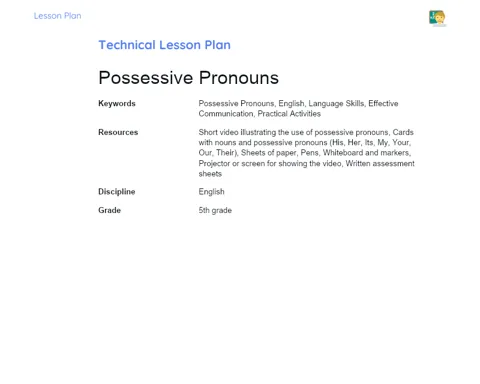
| Keywords | Reflexive Pronouns, English, Socio-emotional, Self-awareness, Self-control, Responsible Decision Making, Social Skills, Social Awareness, RULER, Mindfulness, Empathy, Emotional Regulation |
| Required Materials | Whiteboard and markers, Sheets of paper, Pens or pencils, Computers or tablets (optional), English texts for reflexive pronouns analysis, Clock or timer for timed activities |
Objectives
Duration: 10 to 15 minutes
The purpose of this stage of the Socio-emotional Lesson Plan is to establish a solid foundation for learning reflexive pronouns in English, combining the development of linguistic skills with socio-emotional abilities. By setting clear objectives, students can understand the importance of the subject while emotionally connecting with the content, facilitating a more meaningful and engaged learning experience.
Main Goals
1. Develop the ability to identify and use reflexive pronouns in English correctly in various contexts.
2. Promote students' self-awareness through reflection on their emotions while using reflexive pronouns in practical activities.
3. Encourage social awareness and empathy by recognizing and understanding peers' emotions during group interactions.
Introduction
Duration: 15 to 20 minutes
Emotional Warm-up Activity
Mindfulness: Focus on the Present
Mindfulness practice is a technique that involves focusing attention on the present moment, recognizing and accepting one's own feelings and thoughts without judgment. This activity helps students become more aware of their emotions and develop the ability to regulate their emotional reactions more effectively.
1. Ask students to sit comfortably in their chairs, with their feet flat on the floor and hands resting on their laps.
2. Instruct them to gently close their eyes and focus on their own breathing, observing the flow of air in and out of their body.
3. Guide them to inhale deeply through the nose, holding the breath for a few seconds, and then exhale slowly through the mouth.
4. During the process, ask them to notice any thoughts or feelings that arise, without trying to change or judge them. Just recognize and let them pass.
5. After a few minutes, ask students to gradually open their eyes and bring their attention back to the classroom, reflecting on how they feel now compared to the beginning of the activity.
Content Contextualization
Reflexive pronouns are essential for constructing sentences that indicate actions that return to the subject. In many situations, we use these pronouns to express actions we do for ourselves or emotions we feel. For example, when saying 'I taught myself to play the guitar,' we are expressing a self-directed action and a sense of personal achievement.
By learning to use reflexive pronouns, students not only improve their linguistic skills but also develop greater self-awareness and self-control. This happens because they need to reflect on the actions and emotions they are describing, promoting a better understanding of themselves and others.
Development
Duration: 60 to 75 minutes
Theoretical Framework
Duration: 20 to 25 minutes
1. Definition of Reflexive Pronouns: Reflexive pronouns are used when the subject and the object of the sentence are the same person or thing. They end in '-self' in the singular and '-selves' in the plural.
2. List of Reflexive Pronouns:
3. Singular: myself, yourself, himself, herself, itself.
4. Plural: ourselves, yourselves, themselves.
5. Use of Reflexive Pronouns:
6. Reflexive Action: When the action of the verb falls on the subject itself. Example: 'She taught herself to play the piano.'
7. Emphasis: To emphasize that no one else performed the action. Example: 'I did the homework myself.'
8. Prevention of Ambiguity: To avoid confusion about who performed the action. Example: 'He looked at himself in the mirror.'
9. Reflexive Pronouns in Texts:
10. Reflexive pronouns are often used in narratives and descriptions to show actions performed by the subject itself, providing clarity and emphasis to the text. Example: 'During the meeting, she found herself constantly checking her phone.'
11. Analogies and Additional Examples:
12. Think of reflexive pronouns as a grammatical mirror – they reflect the action back to the subject. For example, 'He prepared himself for the exam' shows that he took the action to prepare.
Socioemotional Feedback Activity
Duration: 30 to 35 minutes
Reflections on Reflexive Pronouns
In this activity, students will work in pairs to create sentences using reflexive pronouns, reflecting on actions they have performed themselves. They will then share their sentences with the class and discuss the emotions associated with those actions.
1. Form pairs among the students.
2. Each pair should create five sentences using reflexive pronouns in different contexts (reflexive action, emphasis, prevention of ambiguity).
3. Encourage students to think of actions they have performed in their daily lives and how they felt while performing those actions.
4. Ask each pair to share their sentences with the class, explaining the context and emotions associated with each action.
5. Write down the sentences on the board so everyone can see and discuss.
Group Discussion
To apply the RULER method during the group discussion, start by asking students to recognize the emotions they felt while performing the actions described in their sentences. Encourage them to understand that these emotions are natural and are part of the learning and personal growth process. Ask students how they would name these emotions (e.g., pride, frustration, joy) and how they would express them healthily.
Then, discuss ways to regulate these emotions in future contexts. For example, how they could deal with the frustration of a difficult task or how they could enjoy the feeling of achievement after completing a challenging task. Encourage students to share personal strategies and learn from each other, promoting an atmosphere of mutual support and empathy.
Conclusion
Duration: 15 to 20 minutes
Emotional Reflection and Regulation
Suggest that students write a paragraph reflecting on the challenges faced during the lesson, such as difficulties in using reflexive pronouns correctly or in understanding the theory presented. Ask them to describe how they felt facing these challenges and what strategies they used to manage those emotions. Alternatively, conduct a group discussion where each student can share their experiences and feelings, promoting an open dialogue about the emotions experienced and effective ways to deal with them.
Objective: The objective of this activity is to encourage students to make an honest self-assessment of their emotional experiences during the lesson. This helps to develop the ability to recognize and manage emotions, identifying effective strategies to deal with challenging situations. By reflecting on their emotions and discussing openly with peers, students can learn from each other and strengthen their emotional regulation skills.
Closure and A Look Into The Future
To conclude the lesson, ask students to set personal and academic goals related to the content learned. Guide them to think of specific objectives, such as using reflexive pronouns correctly in their writing or identifying these pronouns in reading texts. Encourage them to write down these goals and reflect on how achieving these objectives can contribute to their academic and personal development.
Possible Goal Ideas:
1. Use reflexive pronouns correctly in writing.
2. Identify reflexive pronouns in reading texts.
3. Reflect on personal actions using reflexive pronouns.
4. Develop greater emotional awareness when facing academic challenges.
5. Enhance self-management and emotional regulation skills. Objective: The goal of this subsection is to strengthen students' autonomy and encourage the practical application of learning reflexive pronouns. By setting personal and academic goals, students commit to their own development, both in content mastery and in managing their emotions. This promotes continuity in academic and personal growth, preparing them to face future challenges more consciously and effectively.