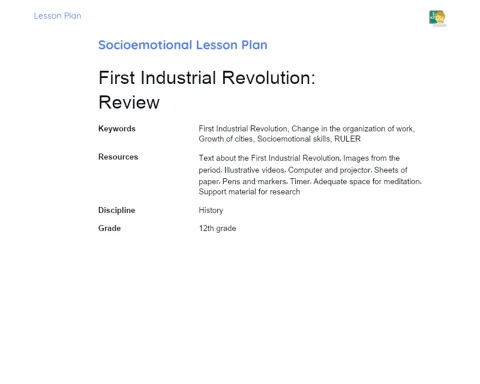
Lesson Plan | Active Learning | Fall of the Western Roman Empire, Late Antiquity: Review
| Keywords | Fall of the Western Roman Empire, Late Antiquity, Division between West and East, Beginning of the Middle Ages, Growth of Christianity, Interactive activities, Critical analysis, Dramatization, Interactive map, Group discussion, Council of Wise Men of Rome |
| Required Materials | Interactive maps, Materials for dramatization (costumes, sets, etc.), Printed documents for research and notes, Internet access for research, Projector for presentations, Papers and pens for notes and document preparation |
Assumptions: This Active Lesson Plan assumes: a 100-minute class, prior student study with both the Book and the start of Project development, and that only one activity (among the three suggested) will be chosen to be conducted during the class, as each activity is designed to take up a significant portion of the available time.
Objectives
Duration: (5 - 10 minutes)
The stage of defining objectives is crucial to guide both the teacher and the students about what will be addressed and what is expected to be achieved at the end of the lesson. This section serves to clarify the fundamental points that students should understand and discuss, ensuring that all proposed activities are aligned with the learning objectives. Furthermore, it helps maintain focus and cohesion in classroom discussions.
Main Objectives:
1. Present and discuss the main factors that led to the fall of the Western Roman Empire.
2. Analyze the consequences of the division between the Western and Eastern Roman Empires.
3. Explore the beginning of the Middle Ages and the role of Christianity during this period.
Side Objectives:
- Develop students' analytical and critical skills when evaluating key historical events.
Introduction
Duration: (15 - 20 minutes)
The introduction aims to engage students through problem-based situations that cause them to reflect and critically apply prior knowledge. Additionally, by contextualizing the importance of the topic with curiosities and relevant facts, it seeks to awaken students' interest and curiosity, facilitating the connection of content with the reality and with the ongoing impact of these events on modern society.
Problem-Based Situations
1. How did the crisis of the third century contribute to the fall of the Western Roman Empire?
2. In what way did the cultural and religious transformation of the empire influence its division between West and East?
Contextualization
The fall of the Western Roman Empire is one of the most significant moments in history, not only because of its political dimension but also due to the lasting influence it had on the entire subsequent history of Europe. Curiosities such as the change of capital from Rome to Constantinople, the barbarian invasions, and the subsequent collapse of imperial power are starting points for understanding not only the political history but also the social and cultural aspects of the time.
Development
Duration: (75 - 80 minutes)
The development stage is designed to allow students to practically and creatively apply the knowledge acquired about the fall of the Western Roman Empire. By working in groups and engaging in playful activities, students develop skills in collaboration, critical thinking, and communication. Through simulations, interactive maps, and dramatizations, students are able to visualize and internalize the complex factors that contributed to this crucial historical event.
Activity Suggestions
It is recommended to carry out only one of the suggested activities
Activity 1 - The Council of Wise Men of Rome
> Duration: (60 - 70 minutes)
- Objective: Develop critical analysis and argumentation skills, applying knowledge about the fall of the Roman Empire.
- Description: In this activity, students are divided into groups of up to 5 people, each representing an advisor of the Western Roman Empire. They must present solutions to the problems that led to the fall of the empire, considering political, economic, and social aspects. Each group will have to prepare a presentation and a written document with their proposals and justifications.
- Instructions:
-
Divide the class into groups of up to 5 students.
-
Assign each group one of the main problems that led to the fall of the Roman Empire (e.g., barbarian invasions, economic crisis, internal divisions).
-
The groups should research and discuss together possible solutions to the assigned problem, considering different perspectives and impacts.
-
Each group will prepare a presentation for the 'Council of Wise Men of Rome,' where they will defend their solutions and argue for their viability.
-
At the end, each group will submit a written document summarizing their proposals.
Activity 2 - Interactive Map: The Journey of the Barbarians
> Duration: (60 - 70 minutes)
- Objective: Understand and geographically visualize the migrations of barbarian peoples and their impact on the Roman Empire.
- Description: Students, in groups, will use an interactive map to trace the routes and movements of different barbarian peoples during the period of the fall of the Roman Empire. They should identify the causes and consequences of these movements and how they impacted the regions of the empire.
- Instructions:
-
Organize the class into groups of up to 5 students.
-
Provide access to an interactive map showing the migratory routes of barbarian peoples.
-
Each group should choose a barbarian people and trace their journey on the map, noting the causes and consequences of their movements.
-
The groups will present their findings to the class, using the map and other visual tools.
-
At the end, each group will write a short essay on the main conclusions of their research.
Activity 3 - Historical Drama: The Fall of Rome
> Duration: (60 - 70 minutes)
- Objective: Explore the events of the fall of the Roman Empire through a dramatic lens, promoting empathy and understanding of the various perspectives involved.
- Description: Students will stage a dramatization of the fall of the Western Roman Empire, representing different groups involved in the event, such as emperors, barbarians, citizens, and religious leaders. Each group must research the role of their 'character' and prepare dialogues and scenarios for the presentation.
- Instructions:
-
Divide students into groups of up to 5, assigning each a historical role to research and act out.
-
The groups must research the actions and motivations of their character during the period of the fall of the Roman Empire.
-
Each group will prepare a small play, including dialogues, scenes, and costumes, to present to the class.
-
The presentations will be followed by a discussion on the different perspectives and impacts of the represented events.
-
At the end, students will write individual reflections on what they learned from the activity.
Feedback
Duration: (15 - 20 minutes)
The purpose of this stage is to allow students to articulate and reflect on the knowledge acquired during the practical activities. Group discussion helps consolidate learning, allowing students to verbalize and share their understandings, which facilitates the identification of gaps in understanding and promotes greater assimilation of content. Additionally, this stage serves as a formative assessment, where the teacher can observe how well students were able to apply the studied concepts.
Group Discussion
To conclude the lesson, organize a group discussion with all students. Start the discussion with a brief review of the main points addressed in the activities, and then ask each group to share the most significant conclusions and insights that emerged during the tasks. Encourage students to discuss the different perspectives and proposed solutions, and how they relate to the actual historical contexts. Use this opportunity to reinforce the collective understanding of the events that led to the fall of the Western Roman Empire.
Key Questions
1. What were the main factors that you identified as determinants for the fall of the Western Roman Empire?
2. How did the division between the Western and Eastern Roman Empires influence the subsequent development of Europe?
3. In what way did the practical activities help solidify theoretical understanding of Late Antiquity?
Conclusion
Duration: (5 - 10 minutes)
The purpose of the Conclusion is to reinforce the key concepts discussed during the lesson and highlight the connection between the studied theory and the practical activities carried out. Additionally, it aims to emphasize the importance of the topics addressed in students' lives, not only as historical knowledge but as lessons that can be applied to understanding current social and political dynamics. This stage helps consolidate learning and prepares students for future reflections and studies.
Summary
In this lesson, we explored the Fall of the Western Roman Empire, analyzing factors such as barbarian invasions, economic crisis, and the division between West and East. We reviewed how these events led to the beginning of the Middle Ages and the growth of Christianity, highlighting the importance of each element in shaping the Western world.
Theory Connection
Today's lesson was structured to connect theory and practice, using interactive activities such as dramatization, the interactive map, and the council of wise men. These approaches allowed students to apply theoretical knowledge in practical scenarios, facilitating understanding of historical events and their implications.
Closing
Understanding the fall of the Roman Empire is fundamental, as the events of this period profoundly shaped the history of Europe and influenced the subsequent development of its societies. This knowledge helps contextualize many of the political, social, and cultural aspects that are still relevant in the contemporary world, making it essential for a holistic and critical education.