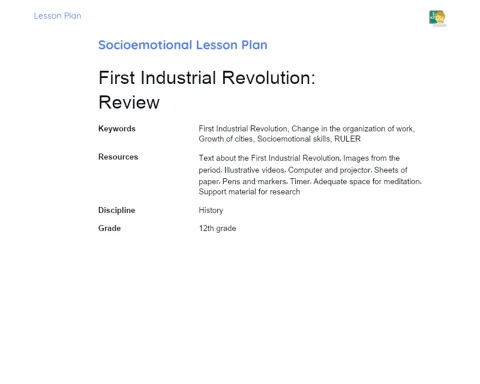
Lesson Plan | Technical Methodology | First Industrial Revolution: Review
| Keywords | First Industrial Revolution, organization of work, city growth, technological inventions, social transformations, economic impact, practical activities, critical reflection, job market, analytical skills, interactive timeline, working conditions, urban changes |
| Required Materials | Computers or tablets with internet access, Projector and screen for video display, Short video about urban transformation in the Industrial Revolution, Digital tools for creating timelines (Google Slides, Prezi, etc.), Research material (books, articles, online resources), Papers and pens for notes, Historical images and videos for the timeline |
Objectives
Duration: 10 to 15 minutes
The purpose of this stage is to provide students with a clear and detailed understanding of the First Industrial Revolution, emphasizing the development of practical and analytical skills. This stage highlights the importance of connecting historical knowledge with contemporary contexts, preparing students for the job market through critical analysis of the organizational and urban changes that occurred during this period.
Main Objectives
1. Understand the First Industrial Revolution and its implications for the organization of work.
2. Analyze the impact of city growth during the Industrial Revolution.
Side Objectives
- Identify the main inventions and technological innovations of the First Industrial Revolution.
- Recognize the social and economic changes resulting from the Industrial Revolution.
Introduction
Duration: 10 to 15 minutes
The purpose of this stage is to provide students with an engaging initial understanding of the First Industrial Revolution, connecting historical content with contemporary contexts and skills. This prepares students to deepen their knowledge of the changes in work organization and city growth during this period.
Contextualization
During the First Industrial Revolution, which began in the late 18th century in England, the world witnessed a radical transformation in how products were manufactured and how people lived and worked. The introduction of steam engines, factories, and new production techniques drastically changed the economy and society. This was the era when manual labor began to be replaced by machines, resulting in a significant increase in production and efficiency.
Curiosities and Market Connection
🔧 Curiosity: Did you know that James Watt's steam engine, one of the most iconic inventions of the First Industrial Revolution, not only revolutionized industry but also paved the way for modern steam turbines used in power plants? 🚀 Market Connection: The production management and efficiency skills developed during the Industrial Revolution are fundamental today in sectors such as automotive manufacturing, information technology, and even project management, where process optimization is essential for success.
Initial Activity
📽️ Initial Activity: Show a short video (3 to 5 minutes) illustrating the transformation from a pre-industrial city to an industrialized city. After the video, ask the following provoking question to the students: 'How do you think people's lives changed with the arrival of factories and new machines?' Encourage a brief group discussion for students to share their impressions.
Development
Duration: 60 to 65 minutes
The purpose of this stage is to deepen students' knowledge about the First Industrial Revolution through practical and interactive activities, encouraging research, information organization, and presentation. Additionally, it promotes critical reflection on historical changes and their implications in contemporary society and the job market.
Covered Topics
- Inventions and technological innovations of the First Industrial Revolution.
- Changes in the organization of work and the emergence of factories.
- Impact of urban growth on society and the economy.
- Working and living conditions during the Industrial Revolution.
Reflections on the Theme
Guide students to reflect on how the First Industrial Revolution transformed the way people lived and worked. Ask students how these changes can be compared to the technological and organizational transformations occurring in the modern world. Encourage them to consider the positive and negative impacts of these changes on people's lives today and in the future.
Mini Challenge
Building an Interactive Timeline
Students will be divided into groups to create an interactive timeline highlighting the major events and inventions of the First Industrial Revolution. The timeline should include descriptions, images, and videos (if possible) illustrating each important milestone.
Instructions
- Divide students into groups of 4 to 5 people.
- Each group will receive a set of events and inventions to research.
- Guide students to use online resources and school libraries for information gathering.
- Ask students to organize the events and inventions chronologically in a digital timeline (using tools like Google Slides, Prezi, or any other presentation platform).
- Encourage groups to include detailed descriptions, images, and, if possible, videos for each event or invention.
- At the end, each group will present their timeline to the class, explaining the importance of each event and invention in the First Industrial Revolution.
Objective: Develop research, information organization, and presentation skills, as well as deepen knowledge about the major events and inventions of the First Industrial Revolution.
Duration: 40 to 45 minutes
Evaluation Exercises
- What were the main inventions of the First Industrial Revolution? Explain the importance of at least two of them.
- Describe how the organization of work changed with the emergence of factories.
- What were the impacts of city growth during the Industrial Revolution?
- Compare working conditions during the First Industrial Revolution with current working conditions in modern industries.
Conclusion
Duration: 15 to 20 minutes
The purpose of this stage is to consolidate students' learning, promoting an integrated understanding of the covered content and its practical applications. Additionally, it aims to stimulate critical reflection on the connections between the past and the present, preparing students to use historical knowledge in contemporary contexts and the job market.
Discussion
📢 Discussion: Facilitate an open discussion with the class, encouraging them to share their reflections on the content covered. Ask students how the First Industrial Revolution influenced the organization of work and city growth. Request that they relate these historical transformations to contemporary technological and social changes, highlighting both positive and negative aspects. Lead the reflection on the practical and analytical skills developed during the lesson and how they can be applied in today's job market.
Summary
📝 Summary: Recap the main points of the lesson, highlighting the inventions and technological innovations of the First Industrial Revolution, changes in the organization of work, and the impact of city growth on society and the economy. Reinforce the importance of understanding the working and living conditions during this historical period.
Closing
🔗 Closure: Explain to students how the lesson connected theory and practice by using interactive activities and challenges. Reinforce the relevance of the topic for the current job market, explaining that many of the skills developed during the lesson, such as research, information organization, and presentation, are highly valued in various careers. Conclude by emphasizing the importance of understanding the past to better face future challenges.