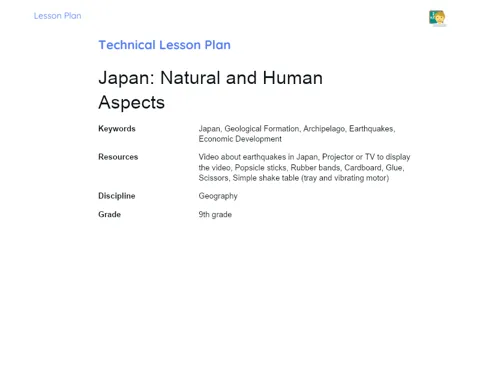
Lesson Plan | Active Learning | Japan: Natural and Human Aspects
| Keywords | Japan, archipelago, earthquakes, technological development, post-World War II, innovation, seismic engineering, geographical education, interactive activities, practical application, technological leadership, architectural solutions |
| Required Materials | Popsicle sticks, Glue, Rubber bands, Computers with internet access, Earthquake simulation software, Materials for visual presentation (paper, markers, etc.), Books and online resources about Japan's technological history |
Assumptions: This Active Lesson Plan assumes: a 100-minute class, prior student study with both the Book and the start of Project development, and that only one activity (among the three suggested) will be chosen to be conducted during the class, as each activity is designed to take up a significant portion of the available time.
Objectives
Duration: (5 - 10 minutes)
This phase of the lesson plan aims to establish the learning objectives that will guide classroom activities and discussions. By clearly defining what is expected for students to understand and analyze, the teacher can ensure a focused and effective approach to studying the natural and human aspects of Japan. Through these objectives, students will be able to connect previously studied information with practical activities, promoting a deeper and more integrated understanding of the topic.
Main Objectives:
1. Understand the formation of Japan as an archipelago and its geographical and cultural implications.
2. Analyze the impacts of earthquakes on urban development and Japanese security policy.
3. Explore Japan's economic and technological development in the post-World War II period, highlighting its position as a global technological leader.
Side Objectives:
- Foster critical thinking skills by relating natural phenomena to human and technological development.
- Stimulate synthesis and presentation skills through interactive activities.
Introduction
Duration: (15 - 20 minutes)
The introduction aims to engage students through problem-solving situations that make them think about the geographical conditions and the social and technological responses of Japan to significant challenges. Additionally, it seeks to contextualize the relevance of studying Japan by bringing real-world elements that highlight the country's importance on the global stage. This phase prepares students for a deeper immersion into the themes that will be explored in detail during the lesson.
Problem-Based Situations
1. Imagine being in Tokyo during a major earthquake. What would be the geographical, social, and technological implications faced by the city and its inhabitants?
2. Think of Japan post-World War II, devastated and defeated. How do you think the country managed to transform into a global technological powerhouse in just a few decades?
Contextualization
Japan, located in a highly seismic region of the planet, frequently faces earthquakes, which directly influences its architecture and urban planning. In addition, the country is recognized for its impressive recovery and technological innovation following World War II, becoming a leader in various areas of technology and innovation. These aspects are essential to understanding the natural and human dynamics that shape contemporary Japanese society.
Development
Duration: (70 - 80 minutes)
The Development phase is designed for students to practically and interactively apply the knowledge acquired about the natural and human aspects of Japan. Through the proposed activities, it seeks to promote a deeper understanding of Japan's technological and architectural adaptations in response to its geographical and social challenges, in addition to stimulating collaboration, creativity, and critical thinking among students.
Activity Suggestions
It is recommended to carry out only one of the suggested activities
Activity 1 - Tokyo Architects: Building Against Earthquakes
> Duration: (60 - 70 minutes)
- Objective: Understand the importance of architectural planning in seismic zones and develop teamwork and problem-solving skills.
- Description: In this activity, students will be challenged to design a model of an earthquake-resistant building using low-cost materials like popsicle sticks, glue, and rubber bands. This exercise simulates the challenges faced by engineers in Japan due to frequent seismic activity.
- Instructions:
-
Divide the class into groups of up to 5 students.
-
Distribute construction materials: popsicle sticks, glue, and rubber bands.
-
Explain the basic principles of earthquake-resistant construction.
-
Challenge the students to build a structure that can withstand a simulated 'earthquake'.
-
Conduct the earthquake test by shaking the table where the structures are supported.
-
Debate the strategies used and why some structures withstood more than others.
Activity 2 - From Kyoto to Silicon Valley: Japan's Technological Trajectory
> Duration: (60 - 70 minutes)
- Objective: Analyze Japan's technological development and its global impact, in addition to fostering research and presentation skills.
- Description: Students will create an interactive timeline highlighting Japan's major technological advancements from the post-World War II period to the present. They will research innovations such as bullet trains, robotics, and consumer electronics.
- Instructions:
-
Form groups of up to 5 students.
-
Provide access to online resources and books about Japan's technological history.
-
Instruct students to select and research major Japanese technological innovations.
-
Each group should prepare a visual presentation of the timeline.
-
Organize a presentation session where each group shares their findings with the class.
Activity 3 - Earthquake Simulator: The Japanese Challenge
> Duration: (60 - 70 minutes)
- Objective: Understand the impacts of earthquakes and the application of technology in civil engineering to combat these natural disasters.
- Description: Using earthquake simulation software, students will better understand how earthquakes affect urban structures and how technology can help predict and mitigate their impacts.
- Instructions:
-
Divide the class into groups of up to 5 students.
-
Introduce the simulation software and explain its functionalities.
-
Challenge students to modify variables to see how different types of buildings withstand earthquakes.
-
Ask each group to prepare a report on their observations and conclusions.
-
Conduct a class discussion on the engineering techniques and technology used in Japan to prevent damage caused by earthquakes.
Feedback
Duration: (10 - 15 minutes)
The purpose of this phase of the lesson plan is to consolidate students' learning through the sharing of experiences and group discussion. By reflecting on the practical activities and relating them to the real challenges faced by Japan, students can deepen their understanding of the studied themes and apply knowledge critically and contextually. This discussion also aims to reinforce students' communication, argumentation, and synthesis skills.
Group Discussion
To start the group discussion, the teacher should ask each group to share their discoveries and experiences from the activities conducted. Encourage students to discuss how Japan's geographical aspects influence its technologies and social structures. Encourage students to reflect on the architectural and technological solutions they created during the activities and how those solutions could be applied in the real world.
Key Questions
1. How do Japan's geographical challenges shape its technological innovations and responses to natural disasters?
2. What are the key lessons learned about Japanese engineering and technology that can be applied globally?
3. How did the post-war history influence Japan's technological development?
Conclusion
Duration: (5 - 10 minutes)
The purpose of this phase is to consolidate learning by linking theoretical content to practical activities and highlighting the importance of studying Japan. By providing a closing that reinforces the relevance of acquired knowledge for global understanding and practical applications, this phase helps students synthesize and reflect on what they have learned and how it can be applied beyond the classroom.
Summary
Summarize the main points discussed about Japan, from the geographical formation as an archipelago, the frequent occurrence of earthquakes and their implications, to the post-World War II growth and leadership in technological innovation.
Theory Connection
Explain how practical activities, such as building models of earthquake-resistant buildings and creating technological timelines, helped connect theory with practical reality and its applications.
Closing
Highlight the relevance of studies about Japan, emphasizing how understanding its geography, history, and technological development applies in the global context and influences everyday life, in addition to preparing students to think about innovative solutions in their own contexts.