
Modal Auxiliaries
Introduction to Modal Auxiliaries: Defining their role in linguistic structures.; Core Characteristics: Syntactic and semantic properties distinguishing modals.; Can: Expressing Ability and Possibility.; May: Conveying Permission and Probability.; Must: Differentiating Obligation and Logical Deduction.; Should: Providing Advice and Indicating Expectation.; Will: Signaling Future Actions and Intentions.; Degrees of Certainty: A Spectrum of Modal Usage.; Obligation Nuances: 'Must' vs. 'Have to' in expressing necessity.; Past Modals: Understanding Perfect Forms for retrospective meaning.; Modals in Conditional Structures: Their role in hypothetical contexts.; Modals in Passive Voice: Integration and meaning preservation.; Subjunctive Mood & Modals: Interplay in formal contexts.; Syntactic & Semantic Analysis: Practical application and interpretation.; Rethinking Modal Usage: Critical evaluation for enhanced clarity.

Need customized slides for your lessons?
I can generate slides, activities, summaries, and 60+ types of materials. That's right, no sleepless nights here :)
People who viewed this slide also liked...


Presentation
Present Simple: Core Grammar

Mohamed Hassan
-
Presentation
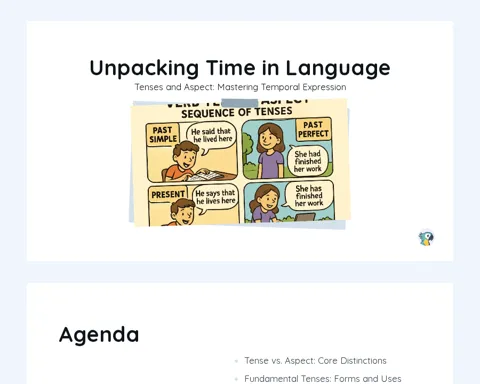
Unpacking Time in Language

عمر الدباغ
-

Presentation
Our Future with Will!

Putri Rahayu
-

Presentation
Mastering Public Speaking Confidence

Kimberly Clyne
-

Join a community of teachers directly on WhatsApp
Connect with other teachers, receive and share materials, tips, training, and much more!

Reinvent teaching


Resources
2026 - All rights reserved