Summary of Equation of a Straight Line
Understanding straight lines is fundamental in mathematics. This summary will cover how to determine the slope and equation of a line when given different pieces of information, such as the graph of the line, two points on the line, or the equation of the line itself. We will explore different forms of linear equations and practice applying these concepts.
Slope of a Line
- The slope of a line measures its steepness and direction. It is often referred to as "rise over run."
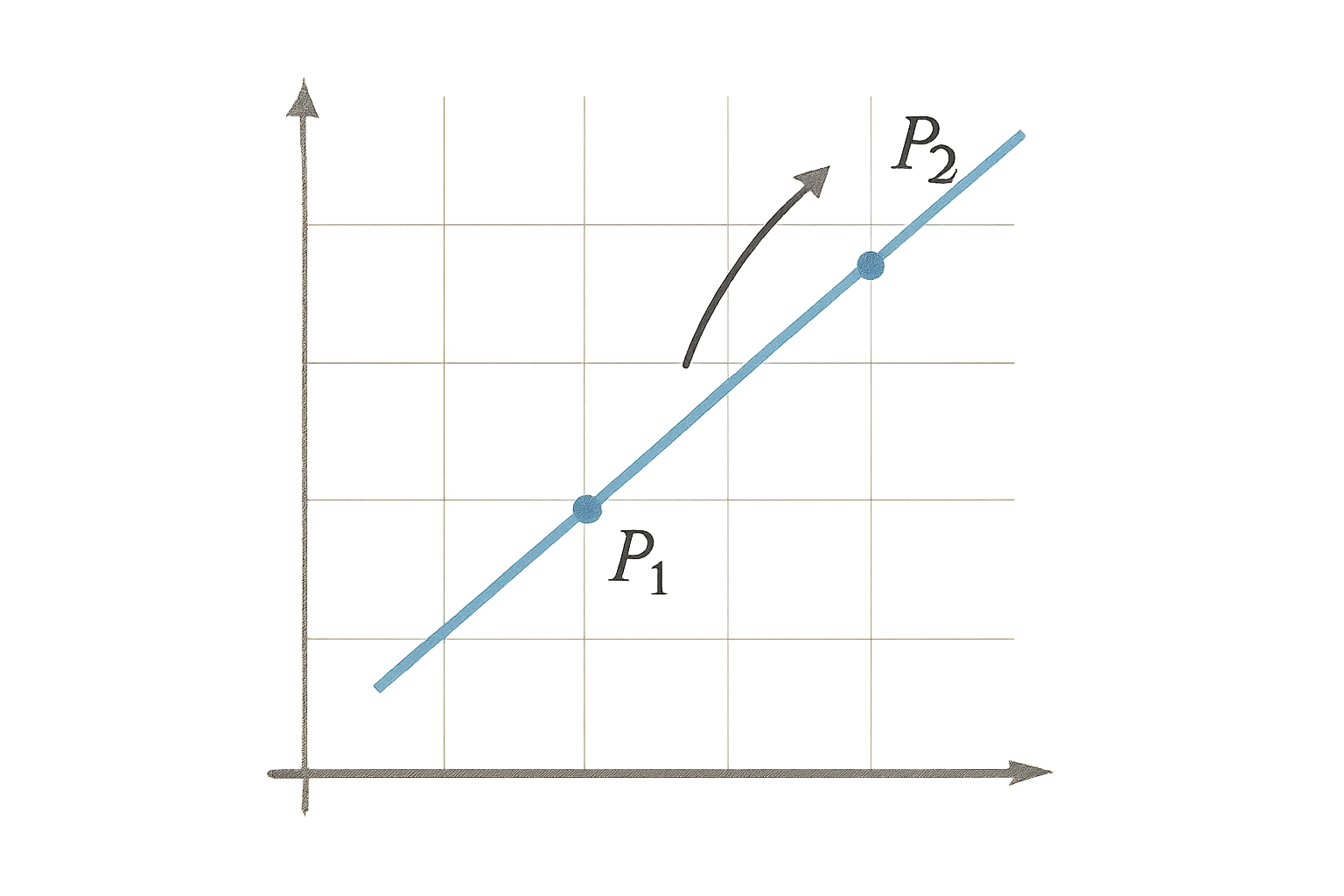
- Mathematically, the slope between two points and is calculated as:
- If the line rises from left to right, the slope is positive. If it falls, the slope is negative. A horizontal line has a slope of 0, and a vertical line has an undefined slope.
Forms of Linear Equations
- Slope-Intercept Form: This is one of the most common forms: where is the slope and is the y-intercept (the point where the line crosses the y-axis).
- Point-Slope Form: This form is useful when you know a point on the line and the slope :
- Standard Form: The standard form of a linear equation is: where , , and are constants. This form is less commonly used for direct calculations but is important for recognizing linear equations.
Determining the Equation of a Line
- From a Graph:
- Identify two points on the line.
- Calculate the slope using the formula .
- Find the y-intercept by observing where the line crosses the y-axis.
- Plug the slope and y-intercept into the slope-intercept form .
- From Two Points:
- Calculate the slope using the two given points and .
- Use the point-slope form with one of the points.
- Convert the equation to slope-intercept form or standard form if needed.
- From the Equation of the Line:
- If the equation is in slope-intercept form , the slope is and the y-intercept is .
- If the equation is in standard form , rearrange it to slope-intercept form to find the slope and y-intercept.
Examples
- Finding the Equation from a Graph:
- Suppose a line passes through the points (1, 2) and (3, 6).
- The slope is .
- Using the point-slope form with the point (1, 2):
- So, the equation of the line is .
- Finding the Equation from Two Points:
- Given points (-1, 4) and (2, -2):
- The slope is .
- Using the point-slope form with the point (-1, 4):
- The equation of the line is .
- Identifying Slope and Y-Intercept from an Equation:
- Given the equation :
- Rearrange to slope-intercept form:
- The slope is and the y-intercept is 2.
Activity: Line Detective
Objective: To practice finding the equation of a line from different given information.
Materials: Graph paper, rulers, worksheets with sets of points and equations.
Instructions:
- Graphing Lines:
- Provide students with equations in slope-intercept form (e.g., ).
- Have them plot the y-intercept and use the slope to find another point.
- Draw the line through these points.
- Finding Equations from Points:
- Give pairs of points (e.g., (2, 3) and (4, 7)).
- Students calculate the slope and use the point-slope form to find the equation.
- Convert to slope-intercept form.
- Matching Game:
- Create cards with graphs, points, and equations.
- Students match the correct equation to the corresponding graph and points.
- Real-World Applications:
- Present word problems where students need to create a linear equation to model a situation (e.g., the cost of renting a car based on miles driven).
Conclusion:
Understanding the equation of a straight line involves mastering the concepts of slope, different forms of linear equations, and the methods to determine these equations from graphs, points, or existing equations. By practicing these skills, you'll be well-equipped to tackle more complex mathematical problems involving linear relationships.