Summary of Experimental Techniques
Experimental techniques are fundamental to chemistry, enabling us to measure, separate, and purify substances to better understand their properties and behavior. Mastering these techniques is essential for conducting accurate and reliable experiments. In this summary, we will cover various essential laboratory apparatus, separation methods, and basic definitions to help you grasp the core concepts.
Measurement Apparatus
-
Time: Stopwatches are used to measure time intervals, especially in experiments involving reaction rates. Digital stopwatches can measure time to a hundredth of a second (0.01 s).
-
Temperature: Thermometers, often Celsius thermometers, are used to measure temperature. Digital temperature probes offer higher resolution than traditional liquid thermometers.
-
Mass: Balances are used to measure mass. Simple balances have lower resolution (e.g., 0.1 g), while complex balances offer higher resolution (e.g., 0.001 g).
-
Volume: Various apparatus are used to measure volume, including burettes, volumetric pipettes, measuring cylinders, and gas syringes. The choice of equipment depends on the required accuracy.
Volumetric Apparatus
-
Burettes: Used for accurate measurement of variable volumes, especially in titrations.
-
Volumetric Pipettes: Used for accurate measurement of fixed volumes (e.g., 10.0 cm³ or 25.0 cm³).
-
Measuring Cylinders: Provide sufficient accuracy for general use.
-
Gas Syringes: Used to measure the volume of gases produced in a reaction.

Basic Definitions
-
Solvent: A substance that dissolves a solute.
-
Solute: A substance that is dissolved in a solvent.
-
Solution: A homogeneous mixture of a solute dissolved in a solvent.
-
Saturated Solution: A solution that contains the maximum amount of solute that can dissolve in a given amount of solvent at a specific temperature.
-
Residue: The solid that remains on the filter paper after filtration.
-
Filtrate: The liquid that passes through the filter paper during filtration.
Acid-Base Titration
-
Acid-base titration is a technique used to determine the concentration of an acid or base.
-
A burette is used to add a known concentration of acid or base (the titrant) to a solution of unknown concentration.
-
A volumetric pipette is used to accurately measure a fixed volume of the solution being analyzed.
-
A suitable indicator is used to visually signal the endpoint of the titration.
Identifying the End-Point of a Titration
-
Indicators are substances that change color depending on the pH of the solution.
-
The end-point of a titration is reached when the indicator changes color, indicating that the acid and base have completely reacted.
-
The choice of indicator depends on the specific acid and base being used in the titration.
Introduction to Chromatography
-
Chromatography is a technique used to separate mixtures of soluble substances.
-
Paper chromatography is used to separate mixtures of soluble colored substances.
-
The substances separate based on their different solubilities in the solvent and their attraction to the paper.
Paper Chromatography
-
A drop of the mixture is placed on a pencil line (baseline) on chromatography paper.
-
The paper is placed in a solvent, ensuring the baseline is above the solvent level.
-
As the solvent moves up the paper, the substances separate.
-
The solvent front is the furthest point reached by the solvent.
Interpreting Chromatograms
-
Chromatograms can be used to identify unknown substances by comparing their separation patterns to those of known substances.
-
Pure substances will produce a single spot on the chromatogram.
-
Impure substances will produce multiple spots.
Value
-
The value is the ratio of the distance traveled by the substance to the distance traveled by the solvent front.
-
values are used to identify substances, as they are constant for a given substance and solvent.
Separation and Purification Techniques
-
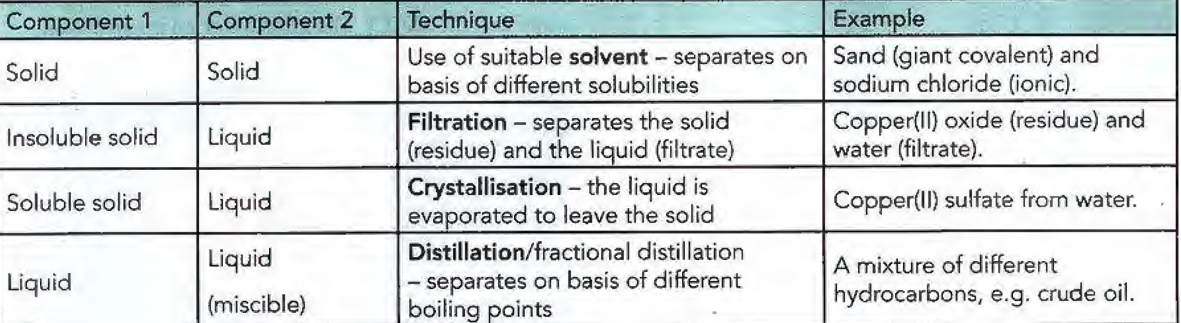
Suitable Solvent: Using a solvent to dissolve one component of a mixture while leaving others undissolved.
-
Filtration: Separating a solid from a liquid by passing the mixture through a filter paper.
-
Crystallization: Obtaining a pure solid from a solution by evaporating the solvent.
-
Simple Distillation: Separating a liquid from a solution based on differences in boiling points.
-
Fractional Distillation: Separating a mixture of liquids with close boiling points using a fractionating column.
Suggesting Suitable Techniques
-
The choice of separation technique depends on the properties of the substances being separated.
-
Consider factors such as solubility,
boiling point, and state of matter when selecting a technique.

Conclusion
Understanding experimental techniques is crucial for success in chemistry. By mastering the use of various apparatus, understanding key definitions, and applying separation and purification methods, you'll be well-equipped to conduct experiments and analyze results effectively. Remember to always prioritize safety and accuracy in the lab.