Summary of Ratio for IGCSE Foundation
Ratios are a fundamental concept in mathematics used to compare quantities relative to one another. Understanding ratios helps solve problems involving proportional relationships, which frequently appear in real-life scenarios such as recipes, maps, and financial calculations. This summary covers the essential aspects of ratios tailored for early high school learners preparing for the IGCSE Foundation level.
Understanding Ratios
- A ratio compares two or more quantities, showing how many times one value contains or is contained within the other.
- Ratios are expressed in the form or , where and are numbers representing quantities.
- Ratios can compare parts of a whole or different quantities entirely.
- Simplifying ratios involves dividing both terms by their greatest common divisor (GCD) to express the ratio in its simplest form.
Writing and Simplifying Ratios
- To write a ratio, identify the quantities to compare and express them using colons or fractions.
- Simplify the ratio by finding the GCD of the terms and dividing each term by that number.
- Example: The ratio 12:8 simplifies to 3:2 because the GCD of 12 and 8 is 4.
- Ratios can also be expressed as equivalent ratios by multiplying or dividing both terms by the same number.
Using Ratios in Problem Solving
- Ratios are used to determine unknown quantities when one part of the ratio is known.
- Cross-multiplication is a common method to solve ratio problems, especially when ratios are set equal to fractions.
- Problems often involve scaling quantities up or down while maintaining the same ratio.
- Real-world examples include splitting money, mixing ingredients, or converting units on maps.
Ratio and Proportion
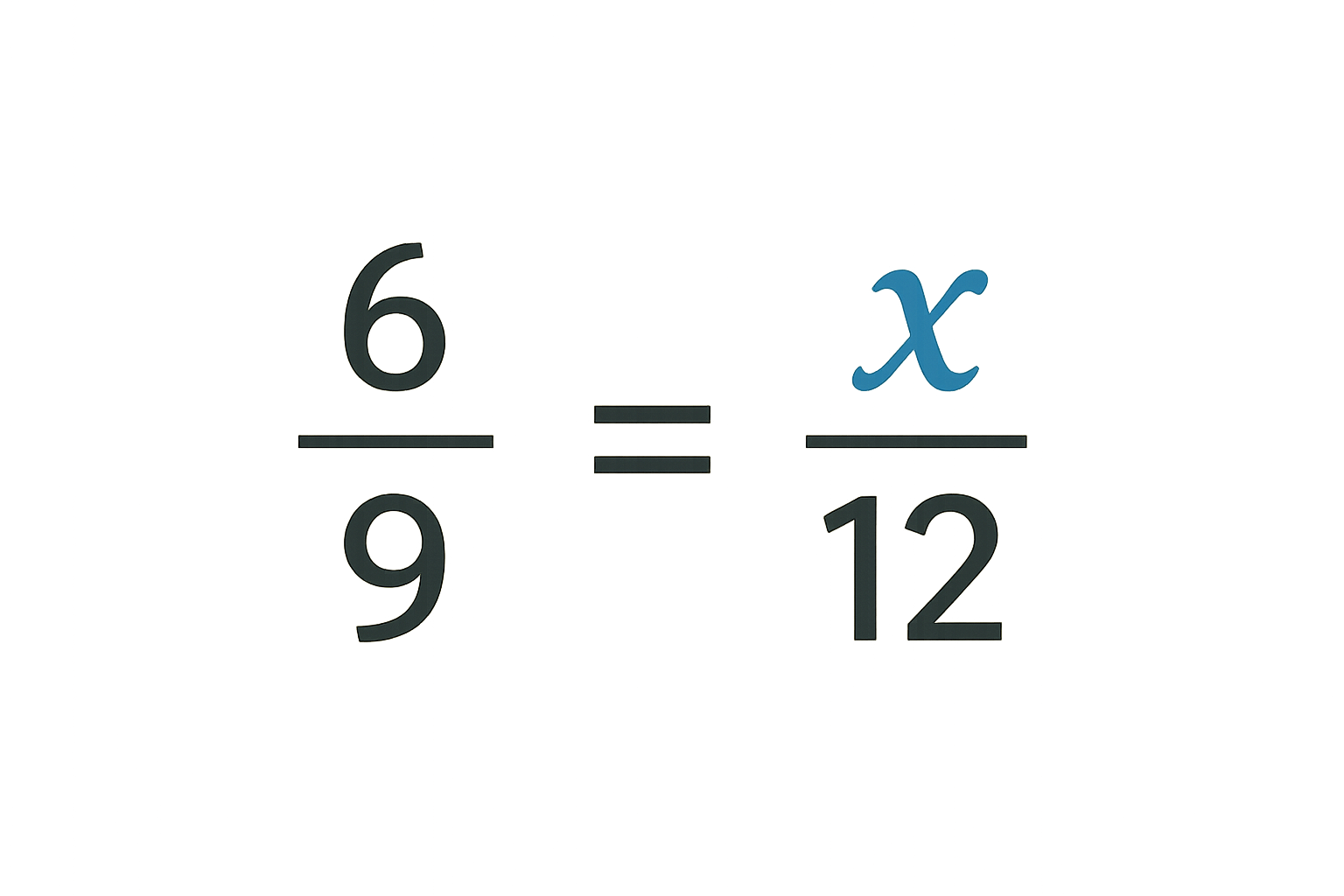
- Proportion states that two ratios are equal, written as .
- Proportions can be solved by cross-multiplying to find unknown values.
- Understanding proportions is key to working with similar figures in geometry and scaling in various contexts.
Practical Applications of Ratios
- Ratios appear in everyday life, such as recipes (e.g., 2 cups of flour to 1 cup of sugar), mixing paint colors, or calculating speed (miles per hour).
- In business, ratios help analyze financial statements, comparing assets to liabilities.
- Ratios are essential in science for expressing concentrations and rates.
Key Takeaways
- Ratios express the relative size of two or more quantities and can be written in various forms.
- Simplifying ratios and finding equivalent ratios are crucial skills for clarity and problem-solving.
- Ratios are widely applicable in real-life contexts, making their understanding essential for practical and academic purposes.
- Proportions extend the concept of ratios by equating two ratios and provide methods for solving unknown values efficiently.