Summary Tradisional | The Alphabet, Sounds and Syllabic Separation
Contextualization
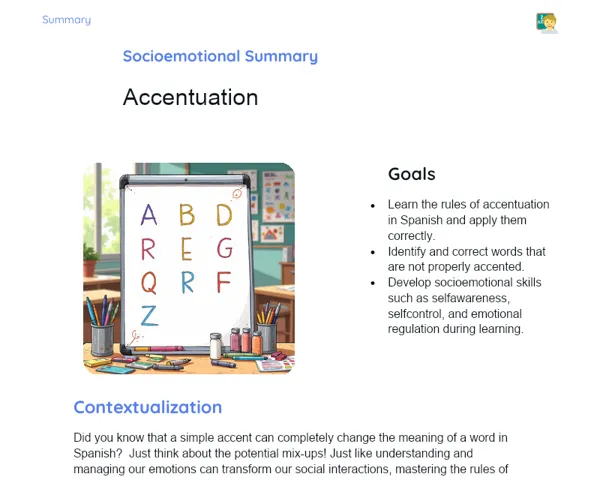
Spanish is one of the most widely spoken languages globally, boasting over 480 million native speakers. Mastering the Spanish alphabet is vital for correct pronunciation and a solid understanding right from the start. The Spanish alphabet comprises 27 letters, including all the Latin alphabet letters and the unique letter 'ñ'.
Beyond just knowing the alphabet, understanding the sounds of individual letters and combinations of letters – such as the digraphs 'll' and 'ch' and the double 'rr' – is crucial. The ability to split words into syllables is also key, as it aids in both reading and writing, laying a robust foundation for advanced Spanish studies.
To Remember!
Spanish Alphabet
The Spanish alphabet includes 27 letters, featuring the full set of Latin characters and the letter 'ñ'. The presence of 'ñ' makes the Spanish alphabet distinct from other Latin alphabets. Each letter has its own pronunciation, which is essential for mastering the Spanish language.
The letter 'ñ' is particularly relevant and appears in many common terms, including 'año' (year) and 'niño' (boy). Its inclusion signifies the importance of unique sounds in Spanish. Moreover, there's a special day for this letter, the DÍA de la Ñ, celebrated on April 23.
Learning the Spanish alphabet is a crucial step for any Spanish learner, as it establishes the groundwork for reading and writing. A solid grasp of the alphabet fosters a better understanding of both words and sentences, helping to prevent pronunciation errors.
-
The Spanish alphabet consists of 27 letters.
-
It includes the letters of the Latin alphabet plus the letter 'ñ'.
-
The letter 'ñ' is exclusive to Spanish.
-
Learning the alphabet is fundamental for accurate pronunciation.
Sounds of Letters
Each letter in the Spanish alphabet produces a specific sound that may not match the corresponding sounds in languages like English or Portuguese. For example, the letter 'a' in Spanish consistently sounds like /a/, as in 'casa' (house). It's important to become familiar with these sounds to pronounce words accurately and be understood by native speakers.
Certain letters, like 'b' and 'v', sound very similar in Spanish, which can be a bit confusing for beginners. Regular practice and immersion in the language help distinguish these sounds. Additionally, some letters, like 'g' and 'j', can sound different depending on their context, as seen in 'gente' (/xente/) and 'gato' (/gato/).
Spanish phonetics includes distinct sounds, such as that of 'ñ' (/ɲ/), which might not be present in many other languages. Listening to and mimicking Spanish words is a great way to internalize these sounds and refine pronunciation.
-
Each letter has a specific sound.
-
The sounds of 'b' and 'v' are similar.
-
The sound of letters can change depending on context.
-
The letter 'ñ' features a unique sound (/ɲ/).
Letter Combinations
In Spanish, certain digraphs and clusters of consonants affect word pronunciation. Digraphs consist of two letters that represent a single sound, like 'll' (/ʎ/ or /ʝ/) and 'ch' (/ʧ/). Mastering these combinations is essential for fluent speaking.
Consonant clusters, such as 'rr' (/r̄/), also have unique pronunciations that differ from their individual letters. For instance, 'perro' (dog) carries a strong, vibrant sound that isn't present in 'pero' (but). Understanding these sounds is critical for effective communication and to avoid misinterpretations.
Practising pronouncing digraphs and consonant clusters in Spanish helps improve fluency and listening skills. It's beneficial to listen to native speakers and repeat words and phrases to solidify these sounds.
-
Digraphs represent a single sound.
-
Examples of digraphs include 'll' and 'ch'.
-
Consonant clusters produce specific sounds.
-
Practising pronunciation enhances fluency.
Syllable Separation
Syllable separation involves breaking words down into syllables, each of which contains at least one vowel. In Spanish, the rules for syllable separation are well-defined, aiding in reading and writing. For instance, the word 'biblioteca' (library) splits into 'bi-bli-o-te-ca'. Knowing how to divide words into syllables supports accurate pronunciation and comprehension of lengthy words.
Typically, consonants situated between vowels will team up with the following vowel, as in 'amigo' (friend). However, there are exceptions, particularly in consonant clusters and digraphs. Understanding these rules and practicing with various terms can enhance the skill of syllable separation.
Being able to separate words into syllables is particularly helpful for reading aloud and ensuring correct writing. It also aids in grasping new vocabulary, allowing students to break down complex words into more digestible components.
-
Every syllable must have at least one vowel.
-
Consonants between vowels usually pair with the next vowel.
-
Syllable separation promotes better pronunciation and writing.
-
Practising with different words enhances this skill.
Key Terms
-
Spanish Alphabet: The collection of 27 letters, including the unique letter 'ñ'.
-
Sounds of Letters: The specific phonetics corresponding to each letter in Spanish.
-
Digraphs: Combinations of two letters that represent a single sound, like 'll' and 'ch'.
-
Consonant Clusters: Combinations of consonants that produce distinct sounds, such as 'rr'.
-
Syllable Separation: The division of words into syllables based on defined rules.
Important Conclusions
Throughout this lesson, we delved into the Spanish alphabet, drawing attention to the unique letter 'ñ' and the vital role of mastering each letter's pronunciation to facilitate reading and writing in Spanish. We also looked into the distinct sounds of letters, as well as consonant clusters like the digraphs 'll' and 'ch', and the consonant cluster 'rr', which are crucial for clear communication in Spanish.
Additionally, we examined the importance of syllable separation and the basic rules governing it, including that each syllable must contain at least one vowel. Practicing syllable separation enhances pronunciation and helps with understanding longer words, making reading and writing in Spanish smoother.
The insights gained regarding the alphabet, sounds, and syllable separation are foundational for any Spanish learner, serving as the bedrock for effective communication in the language. With these fundamentals in place, students are well-equipped to advance their Spanish studies, improving their reading, writing, and pronunciation skills.
Study Tips
-
Practice pronouncing each letter in the Spanish alphabet regularly, using example words to reinforce learning.
-
Listen to recordings of native speakers and imitate the words and phrases to boost listening skills and the pronunciation of digraphs and consonant clusters.
-
Break down words into syllables and practice reading aloud to enhance syllable separation skills and reading fluency.