Goals
1. Understand the importance of the kingdoms of Kush, Axum, and Ghana in African history.
2. Analyze the political, economic, and social structures of these kingdoms.
3. Explore the trade connections between these kingdoms and other civilizations.
4. Develop research and historical analysis skills.
5. Promote teamwork and problem-solving abilities.
Contextualization
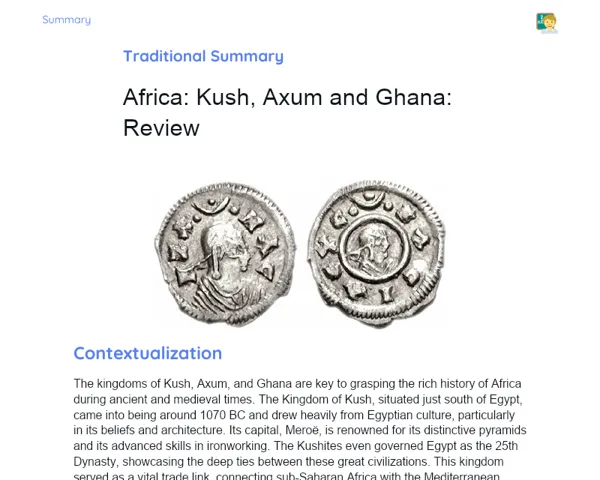
The kingdoms of Kush, Axum, and Ghana were significant and influential civilizations in ancient and medieval Africa. These kingdoms dominated extensive regions and created trade networks that spanned continents, exchanging gold, ivory, and other valuable resources with cultures as distant as Ancient Rome and India. They also developed sophisticated political and social systems that influenced governance and economic structures, which remain subjects of study and admiration today. For instance, the Kingdom of Ghana was referred to as the 'Land of Gold' because of its immense mineral wealth, positioning it as a vital trade hub.
Subject Relevance
To Remember!
Trade in the Kingdoms of Kush, Axum, and Ghana
These kingdoms established trade networks that interlinked various parts of Africa, Europe, and Asia. They traded precious resources like gold, ivory, and spices, which allowed them to amass wealth and influence. Trade not only fostered economic prosperity but also encouraged cultural and technological exchanges between differing civilizations.
-
Kush: Renowned for its gold mines and ivory trade.
-
Axum: Its strategic location facilitated trade with the Middle East and India.
-
Ghana: Known as the 'Land of Gold', it served as a crucial trade centre in West Africa.
Political and Social Structures
Kush, Axum, and Ghana developed intricate political and social systems that featured centralised monarchies, organised bureaucracies, and well-defined social hierarchies. These frameworks ensured effective governance and the maintenance of social order, while enabling the management of extensive territories and diverse populations.
-
Kush: Ruled by a monarchy with both political and religious functions.
-
Axum: Centralised political system where the king directly managed trade routes.
-
Ghana: A political system with a strong king and an aristocracy overseeing different regions.
Cultural and Technological Influences
Through trade and interaction with other societies, the kingdoms of Kush, Axum, and Ghana absorbed and shared a variety of cultural and technological influences. This included the introduction of innovations such as mining techniques, advanced architecture, and writing systems.
-
Kush: Cultural influences derived from Egypt, including architecture and hieroglyphics.
-
Axum: Adoption of Christianity along with the development of the Ge'ez script.
-
Ghana: Advances in mining and metallurgy techniques.
Practical Applications
-
Gold mining in West Africa today owes its roots to the practices established by the Kingdom of Ghana.
-
The trade negotiation strategies employed by ancient African traders are now studied in economics and international business courses.
-
Archaeological and historical research on the kingdoms of Kush, Axum, and Ghana continues to offer valuable insights for understanding social and economic dynamics in development and anthropology fields.
Key Terms
-
Kush: An ancient kingdom located south of Egypt, celebrated for its gold mines and ivory trade.
-
Axum: An ancient Ethiopian kingdom noted for its trading activities and the introduction of Christianity.
-
Ghana: A powerful kingdom in West Africa, renowned for its wealth in gold and its central role in trans-Saharan trade routes.
Questions for Reflections
-
How can we draw comparisons between the trade practices of ancient African kingdoms and today’s trade practices?
-
In what ways did the centralised political systems of Kush, Axum, and Ghana empower them to effectively manage their territories?
-
What insights on resource management can we glean from the mining and trading methods developed by these kingdoms?
Creating a Modern Trade Route
In this challenge, you will take on the role of a modern trader tasked with creating a trade route inspired by the practices of the kingdoms of Kush, Axum, and Ghana.
Instructions
-
Form groups of 3 to 4 students.
-
Research the main natural resources and trade products of a specific current African region.
-
Draw a map highlighting your modern trade route, indicating starting and ending points, as well as the products exchanged along the way.
-
Explain how the trade practices and negotiation techniques can be adapted to today's framework, comparing them to those of the ancient kingdoms.
-
Present your trade route to the class, highlighting the strategies employed and the economic and cultural benefits of the trades conducted.