Goals
1. Understand the concept of average scalar velocity.
2. Learn to calculate the average velocity of an object using the correct formula.
3. Solve practical problems involving the calculation of average velocity.
Contextualization
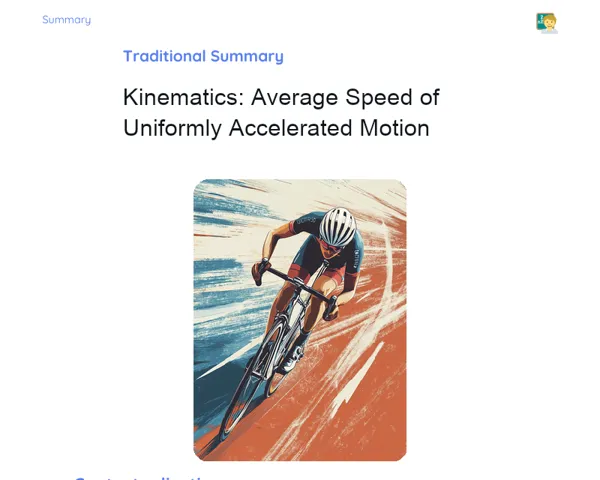
Average velocity is a fundamental concept in physics and is applicable in many areas of our daily lives. For instance, when you're planning a trip, you need to estimate how much time it will take to get to your destination. This is where average velocity becomes helpful, as it allows you to gauge this time based on the distance to be covered. Understanding this concept is vital not just for everyday tasks but also for many technical and scientific fields. In India, for example, transportation companies depend on average velocity calculations to streamline routes and cut down costs. Engineers utilize average velocity to design efficient roads and railways, ensuring that vehicles operate smoothly and safely. Additionally, pilots and ship captains rely on this concept to chart their journeys and ensure timely arrivals.
Subject Relevance
To Remember!
Definition of Average Scalar Velocity
Average scalar velocity is the ratio of the total distance travelled by an object to the total time taken for that journey. It measures how quickly an object moves, irrespective of the direction.
-
Average scalar velocity is computed by dividing the total distance travelled by the total time taken.
-
Its unit in the International System (SI) is meters per second (m/s), but it can also be given in kilometers per hour (km/h).
-
It's a scalar quantity, which means it doesn't take direction into account, only the numerical value.
Formula for Average Scalar Velocity
The formula to calculate average scalar velocity is straightforward: Average Velocity = Distance / Time. This formula is essential for resolving problems related to movement and time.
-
The formula is V = d / t, where V stands for average velocity, d is the distance travelled, and t is the time taken.
-
It's important that all units are in the same measurement system (like meters and seconds) to ensure accurate calculations.
-
The formula can be rearranged to find distance (d = V * t) or time (t = d / V) if the average velocity is given.
Units of Measure and Conversion
The most common units for measuring distance and time are meters (m) and seconds (s) in the International System, and kilometers (km) and hours (h) in day-to-day contexts. Converting between these units is key for accurate problem-solving.
-
1 km equals 1000 meters, and 1 hour equals 3600 seconds.
-
To convert km/h to m/s, divide the speed by 3.6; to convert m/s to km/h, multiply by 3.6.
-
Proper unit conversion ensures that average velocity calculations are accurate and relevant across various contexts.
Practical Applications
-
In logistics, calculating average velocity helps streamline delivery routes, resulting in cost savings.
-
In civil engineering, average velocity informs the design of roads and railways to promote efficient and safe transportation.
-
Aircraft pilots apply average velocity when planning flight paths to ensure timely arrivals at their destinations.
Key Terms
-
Average Scalar Velocity: The ratio of total distance travelled to total time spent.
-
Distance: The length covered by a moving object.
-
Time: The duration within which the movement takes place.
-
Unit of Measure: The standard used to quantify physical quantities, such as meters (m) and seconds (s).
Questions for Reflections
-
How can understanding average velocity help improve public transport efficiency in your city?
-
In what ways can knowledge of average velocity guide your decisions when planning a long-distance trip?
-
What potential issues could arise from errors in measuring average velocity in engineering projects?
Average Velocity Challenge in Everyday Life
This practical exercise aims to solidify understanding of the average velocity concept through application in a typical scenario.
Instructions
-
Choose a route that you frequently travel, like your commute from home to school.
-
Measure the total distance of this route using a mapping application or an odometer.
-
Utilize a stopwatch to measure the total time taken to travel this distance, whether you're walking, cycling, or driving.
-
Calculate the average velocity of your route using the formula: Average Velocity = Distance / Time.
-
Document your results in your notebook and compare the average velocities for different modes of transportation (such as walking, cycling, and driving).
-
Reflect on the variations in average velocities and how they might affect your transportation choices and time management.