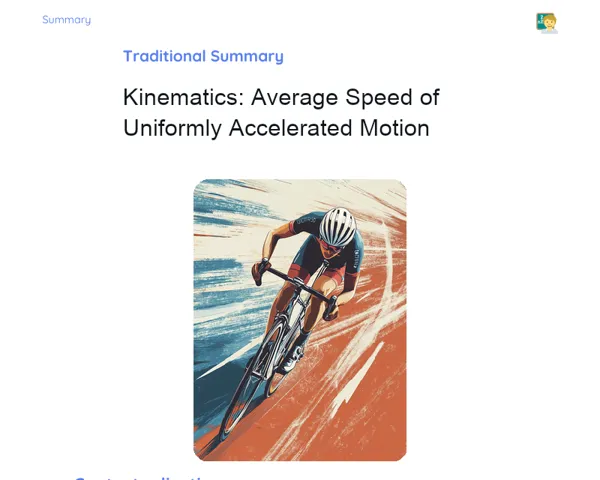
Summary Tradisional | Dynamics: Forces in Curvilinear Motion
Contextualization
Curvilinear motion is something we experience in our day-to-day life; be it when a car negotiates a bend on a busy street, a cyclist manoeuvres through winding lanes, or even when satellites orbit our planet. In each case, certain forces act to keep the object moving along a curved path. Without these forces, objects would simply continue in a straight line, straying from their intended routes.
At the heart of this phenomenon is the centripetal force – a force that always points towards the centre of the curve, ensuring that objects follow the curved path. For instance, on our roads, it is the friction between the tyres and the pavement that prevents vehicles from skidding off during a turn. Knowing how this force works and how to compute it is not only important for solving physics problems but also for designing safer roads, racetracks, and even ensuring amusement park rides are secure.
To Remember!
Definition of Curvilinear Motion
Curvilinear motion refers to movement along a path that is curved rather than straight. You can observe this in various everyday situations – a car taking a sharp bend in city traffic, the thrilling ride of a roller coaster, or even the elliptical orbit of the planets. In such motion, while the speed (a scalar quantity) may remain constant, the direction of the velocity vector is continuously changing. This means that a constant adjustment in the direction is necessary, which is provided by the acting forces.
When a car negotiates a turn, its curved path results from the combination of its tangential speed and an inward force that acts toward the centre of the bend. Without this force, inertia would take over, and the car would continue in a straight line.
Understanding curvilinear motion is essential as it lays the foundation for grasping how forces like centripetal force operate, which is vital while tackling practical problems in physics and engineering.
-
Curvilinear motion follows a curved rather than a straight path.
-
The direction of velocity keeps changing continuously.
-
Forces must constantly adjust the motion to keep the object on track.
Centripetal Force
Centripetal force is the key force that keeps an object on its curved path by always pointing towards the centre of the curve. This force is responsible for continuously changing the direction of the object's velocity. The formula used to calculate this force is F = m*v^2/r, where 'm' stands for the object's mass, 'v' its speed, and 'r' the radius of the curve.
Take the example of a car making a bend on one of our roads – the friction between the tyres and the road provides the necessary centripetal force. If this force is not sufficient, the car might lose grip and slide outward. Similarly, in the case of satellites, it is gravity that provides the centripetal force, keeping them in orbit.
A sound understanding of centripetal force is crucial for ensuring safety and efficiency, whether it's in everyday vehicle dynamics or in advanced applications like satellite navigation.
-
Centripetal force maintains an object’s motion along a curved path.
-
The calculation is done using F = m*v^2/r.
-
It is fundamental for the safety of vehicles in turns and for satellite orbits.
Difference between Centripetal and Centrifugal Force
It is common to mix up centripetal and centrifugal forces, but they are different. Centripetal force is the real force acting towards the centre of the curve, which is essential to keep an object in its curved path. On the other hand, centrifugal force is a fictitious force that appears in a non-inertial (accelerating) frame; for example, passengers may feel as though they are being pushed outwards when a car makes a turn.
This outward sensation is simply due to inertia – the tendency of the body to maintain its straight-line motion. While this feeling is real to observers inside the car, centrifugal force does not exist as a real force and should not be used for technical calculations.
Understanding the distinction between these forces is vital when solving problems in dynamics.
-
Centripetal force is a real force acting towards the centre.
-
Centrifugal force is a perceived force in non-inertial frames.
-
Recognising the difference is essential for accurately solving dynamic problems.
Solving Practical Problems
Applying the principles of forces in curvilinear motion to solve practical problems is an important part of physics. These problems often require the use of the centripetal force equation, F = m*v^2/r, and a careful identification of all forces acting on an object. For example, when analysing how a car negotiates a turn, you must consider the vehicle's mass, speed, and the radius of the bend, and then check if the frictional force is enough to provide the required centripetal force.
Moreover, real-life problems can be more complex, such as those involving satellite orbits or the dynamics of roller coasters. Here, applying the fundamentals of dynamics accurately helps ensure that all acting forces are properly accounted for, leading to effective predictions and safe designs.
-
Utilising the formula F = m*v^2/r is key to these problem solutions.
-
It is important to identify all forces at play in the scenario.
-
Practical problem-solving helps in understanding and controlling curvilinear motion.
Key Terms
-
Curvilinear Motion: A path that curves rather than proceeding in a straight line.
-
Centripetal Force: The force that acts towards the centre of a curve, keeping an object on its path.
-
Centrifugal Force: A fictitious force perceived in accelerating (non-inertial) frames, giving an impression of being pushed outwards.
-
Centripetal Force Formula: F = m*v^2/r, where m is the mass, v is the speed, and r is the radius of the curve.
-
Inertia: The natural tendency of an object to continue in its state of rest or uniform motion in a straight line.
Important Conclusions
In this lesson, we delved into the essentials of curvilinear motion and the forces that influence it, focusing mainly on centripetal force. We learnt that centripetal force, always directed towards the centre of the curve, is critical for keeping an object along its curved path, and its calculation is based on the formula F = m*v^2/r. We also clarified the difference between the real centripetal force and the perceived centrifugal force, which is merely an effect of inertia in a non-inertial frame.
Real-life examples – such as vehicles turning on our roads and satellites orbiting the Earth – illustrate how understanding these concepts is pivotal for both safety and efficiency in engineering and everyday applications. Solving practical problems further reinforces the importance of detailed analysis and precise calculations in dynamics.
Overall, mastering the concepts of forces in curvilinear motion is invaluable for explaining everyday phenomena and for designing systems that are both safe and efficient.
Study Tips
-
Review the fundamentals of centripetal and centrifugal forces, ensuring you understand their distinct roles.
-
Practice solving problems using the centripetal force formula (F = m*v^2/r) in diverse scenarios like road bends and satellite orbits.
-
Explore online videos and simulations which demonstrate curvilinear motion to better visualise the concepts discussed.