Goals
1. Understand the concept of uniformly varying circular motion.
2. Calculate angular acceleration and angular velocities in different situations.
3. Determine the period and angular displacements in circular motion.
4. Apply the concepts of circular kinematics to practical problems.
5. Relate uniformly varying circular motion to applications in the job market, such as in engines and rotational systems.
Contextualization
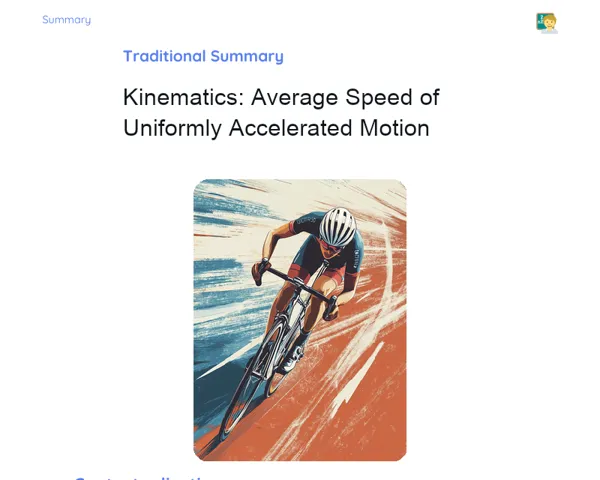
Uniformly varying circular motion is a fundamental concept in physics that illustrates how objects navigate circular paths with a consistent change in angular velocity. This understanding is vital for numerous applications, from vehicle engines to rotational mechanisms in factories. Picture the wheel of a bicycle that speeds up as you pedal – that's a perfect example of uniformly varying circular motion.
Subject Relevance
To Remember!
Uniformly Varying Circular Motion
Uniformly varying circular motion occurs when an object travels in a circular path with a steady change in its angular velocity. This implies that the angular acceleration remains constant, leading to a consistent change in angular velocity over time.
-
Constant Angular Acceleration: The angular acceleration stays the same over time.
-
Variable Angular Velocity: The angular velocity either increases or decreases uniformly.
-
Circular Path: The object follows a defined circular trajectory.
Angular Acceleration
Angular acceleration refers to the rate at which angular velocity changes over time. In uniformly varying circular motion, this acceleration remains constant, meaning the object's angular velocity varies at a steady rate.
-
Unit: Measured in radians per second squared (rad/s²).
-
Formula: Angular acceleration is calculated as the change in angular velocity divided by time.
-
Impact: Angular acceleration dictates how swiftly an object can alter its rotational speed.
Angular Velocity
Angular velocity is the rate at which the angle of rotation changes over time. In uniformly varying circular motion, angular velocity varies consistently due to the constant angular acceleration.
-
Unit: Measured in radians per second (rad/s).
-
Relation to Angular Acceleration: Angular velocity increases or decreases in line with angular acceleration.
-
Applications: Essential for grasping the rotation of objects in mechanical systems, like motors and turbines.
Period
The period is the time taken for an object to make one complete revolution along its circular path. In uniformly varying circular motion, the period might change if the angular velocity fluctuates.
-
Unit: Measured in seconds (s).
-
Calculation: The period is the inverse of the rotational frequency.
-
Importance: Knowing the period is critical for synchronizing movements in both mechanical and electronic systems.
Angular Displacement
Angular displacement measures the angle through which an object has rotated along a circular path. In uniformly varying circular motion, angular displacement increases non-linearly with time.
-
Unit: Measured in radians (rad).
-
Relation to Angular Velocity: Angular displacement is the integral of angular velocity over time.
-
Applications: Used for calculating the angular position of rotating objects.
Practical Applications
-
Wind Turbines: The varying speed of the blades exemplifies uniformly varying circular motion, critical for efficiently generating electrical energy.
-
Electric Motors: Consistent angular acceleration in motors enables precise control of rotational speed, essential for both efficiency and safety.
-
Bicycle Wheels: When pedaling, the bicycle wheel accelerates uniformly, showcasing uniformly varying circular motion.
Key Terms
-
Uniformly Varying Circular Motion: Motion along a circular path with a constant change in angular velocity.
-
Angular Acceleration: The rate of change of angular velocity over time, measured in rad/s².
-
Angular Velocity: The rate of change of the rotation angle, measured in rad/s.
-
Period: The time required to complete one full revolution along a circular path, measured in seconds.
-
Angular Displacement: The angle through which an object has rotated, measured in radians.
Questions for Reflections
-
How does constant angular acceleration affect the efficiency of an electric motor?
-
In what ways can knowledge of uniformly varying circular motion be applied in wind turbine engineering?
-
What other everyday situations can you identify that involve uniformly varying circular motion?
Practical Challenge: Measuring the Angular Acceleration of a Gyroscope
To reinforce our grasp of uniformly varying circular motion, you will conduct a practical experiment to measure the angular acceleration of a gyroscope created in the classroom.
Instructions
-
Using the gyroscope constructed during the lesson, employ a stopwatch to time how long it takes to reach a specific angular velocity.
-
Document both the initial and final angular velocities.
-
Compute the angular acceleration with the formula: angular acceleration = (final angular velocity - initial angular velocity) / time.
-
Contrast the obtained results with the theoretical values discussed in class.
-
Write a brief reflection on possible reasons for any discrepancies between your experimental results and the theoretical values.