Summary Tradisional | Work: Kinetic Energy and Work
Contextualization
Physics is the study of natural phenomena and helps us understand the workings of the universe. One of the basic ideas in this subject is energy, which touches every part of our lives – from the movement of vehicles on the road to the energy we use at home. Today, we will look at two important concepts: kinetic energy, which is the energy associated with motion, and work, which shows how energy is transferred or transformed by forces.
Kinetic energy is all about an object's motion and is determined by its mass and speed. On the other hand, work is the energy transferred when a force displaces an object. Grasping these ideas is vital for solving problems that involve forces, displacements, and speeds, and is also very useful in everyday situations such as driving a car or playing sports.
To Remember!
Kinetic Energy
Kinetic energy is the energy an object has due to its motion. It depends on both the mass of the object and its speed. To calculate the kinetic energy (Ec), we use the formula Ec = (1/2)mv², where 'm' is the mass and 'v' is the speed of the object. This means that if the speed of an object increases, its kinetic energy increases exponentially, while an increase in mass results in a linear rise in kinetic energy.
A clear example of kinetic energy is a car in motion. As the car speeds up, its kinetic energy increases. For instance, if the car doubles its speed, the kinetic energy becomes four times as much because of the square relation in the formula.
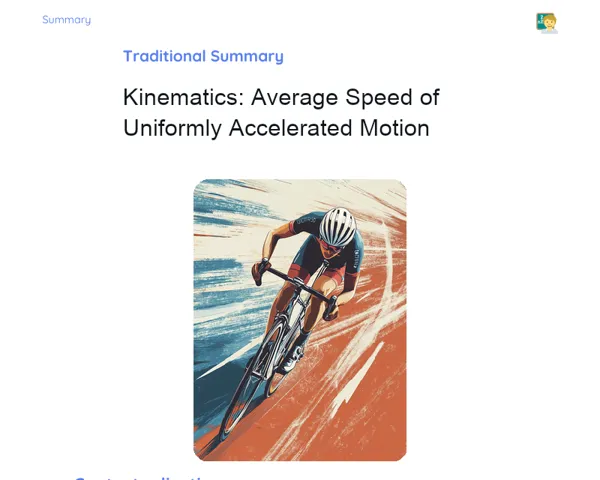
Kinetic energy is a type of mechanical energy and is directly linked to motion. In sports like running or cycling, the kinetic energy of the athlete plays a major role. Understanding how kinetic energy works helps in predicting movements in everyday life, as well as in industrial and technological scenarios.
-
Kinetic energy depends on the object’s mass and speed.
-
The kinetic energy formula is Ec = (1/2)mv².
-
Practical examples include moving cars and sports activities.
Work Done by a Force
In physics, work refers to the transfer of energy by means of a force that causes an object to move. The formula to calculate work (W) is W = Fd cosθ, where 'F' represents the applied force, 'd' is the displacement, and 'θ' is the angle between the force's direction and the direction of displacement. When the force is applied in the same direction as the movement, θ is zero, and cos 0 is 1, thus simplifying the formula to W = Fd.
The work done can be positive, negative, or zero, depending on the direction of the force relative to the displacement. If the force and displacement are in the same direction, the work is positive, indicating energy is being supplied to the object. If the force is applied in the opposite direction, the work is negative, showing energy is taken from the object. When the force is perpendicular to the displacement, no work is done.
An everyday example is when you push a shopping cart. As you apply force and the cart moves in the same direction, you are doing work. The work done is determined by both the force exerted and the distance the cart travels.
-
Work is the energy transferred by a force causing displacement.
-
The work formula is W = Fd cosθ.
-
Work can be positive, negative, or zero, based on the relative direction of force and displacement.
Work-Energy Theorem
The Work-Energy Theorem tells us that the work done by the net forces acting on an object is equal to the change in the object’s kinetic energy. In formula terms, W = ΔEc, where W is the total work done and ΔEc is the change in kinetic energy. This theorem is key in understanding how forces affect motion.
This theorem is very handy when solving real-world problems. For example, if we want to calculate the speed of an object after a force has been applied, knowing the work done and the object’s initial kinetic energy allows us to find its final kinetic energy, and hence its speed.
Understanding the Work-Energy Theorem is essential when dealing with problems involving motion and force, as it helps predict the impact of forces on an object's speed and energy.
-
The Work-Energy Theorem links the work done by forces to the change in kinetic energy.
-
Its formula is W = ΔEc.
-
This theorem is very useful for solving practical problems related to motion and forces.
Practical Applications
The ideas of kinetic energy and work have a wide range of practical applications in our daily lives as well as in various fields of engineering and technology. For example, in motorsports, the kinetic energy of vehicles is a key factor for both performance and safety. Car brakes, for instance, work by dissipating kinetic energy to slow the vehicle down.
In sports, understanding kinetic energy and work is essential for maximizing athletes' performance. Be it running, cycling, or swimming, an athlete’s speed and efficiency are directly linked to their kinetic energy. Consequently, training methods and sports equipment are often designed with these principles in mind to improve performance and reduce injury risks.
In engineering, principles of kinetic energy and work are integral to the design of machines and structures. Devices like motors and turbines are engineered to convert kinetic energy into useful work efficiently. These concepts also play a role in assessing the impact forces and material strength in construction, ensuring safety and durability.
-
Kinetic energy and work find applications in many fields.
-
In motorsports, brakes work by dissipating kinetic energy to slow down vehicles.
-
In sports, these concepts help in improving athletic performance.
Key Terms
-
Kinetic Energy: The energy an object has due to its motion, calculated using Ec = (1/2)mv².
-
Work: Energy transferred by a force causing displacement, given by W = Fd cosθ.
-
Work-Energy Theorem: A principle that links the work done by net forces to the change in kinetic energy, expressed as W = ΔEc.
-
Displacement: The distance moved by an object in a specific direction following the applied force.
-
Force: A push or pull that causes an object to move, measured in Newtons (N).
Important Conclusions
In today’s lesson, we looked at kinetic energy and work – two core concepts in physics. We saw that kinetic energy is the energy a moving object holds which follows the formula Ec = (1/2)mv², emphasising how both mass and speed affect this energy. Work, meanwhile, is defined as the energy transferred by a force that causes an object's displacement, calculated using W = Fd cosθ.
We also covered the Work-Energy Theorem, which tells us that the work done by forces equals the change in an object's kinetic energy, nicely summarised by W = ΔEc. This theorem is very useful in solving real-world problems involving motion and forces, helping us predict how an object’s speed and energy will change when forces act upon it.
Grasping these concepts is crucial not only for academic purposes but also for practical applications – from how our vehicles operate to enhancing performance in sports. A sound understanding of kinetic energy and work is essential for advancing technology and improving everyday practices.
Study Tips
-
Regularly revise the formulas and concepts behind kinetic energy and work.
-
Practice solving problems in different scenarios, which will help in better understanding these ideas.
-
Watch videos or go through additional reading materials on the practical applications of these concepts, especially in sports, engineering, and motorsports.