Summary Tradisional | Text Interpretation
Contextualization
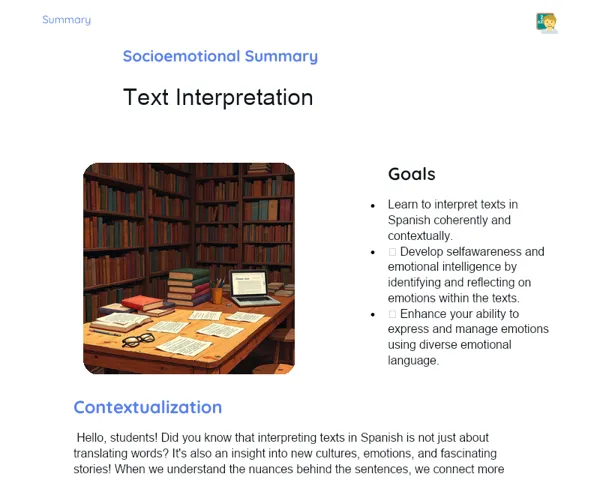
Interpreting texts is a vital skill that goes well beyond just reading. It requires a thorough understanding of both the obvious and subtle information within the text, alongside the ability to draw meanings from the context and pinpoint the main theme and key ideas. In the realm of learning Spanish, this competency holds particular significance, as it enables students not only to grasp the written content but also to appreciate the cultural and stylistic depth of the language.
By mastering text interpretation in Spanish, students acquire skills that are invaluable across various fields such as communication, critical thinking, and problem-solving. This ability is crucial for both academic and professional pursuits, especially in today's interconnected world where Spanish is among the most widely spoken languages. Additionally, understanding and analyzing texts in Spanish paves the way for exploring a wealth of diverse literatures, enriching the overall learning experience.
To Remember!
Identifying Explicit Information
Identifying explicit information is the foundational step in interpreting a text. This refers to information that is clearly stated in the text, requiring no further inference. Such information is essential for basic comprehension, as it provides concrete data that forms the backbone of the text.
To spot explicit information, readers must focus on clearly presented details, such as names, dates, and events. These elements usually appear in straightforward sentences that are direct and clear. Mastering this skill is key to building a solid understanding of the text.
For instance, a Spanish text discussing a historical event might include explicit details like the event's date, the key individuals involved, and the actions taken. Recognizing this information helps readers contextualize themselves in the narrative and achieve an initial grasp of the content before moving on to deeper analyses.
-
Explicit information is stated clearly in the text.
-
This includes essential details, such as names, dates, and events.
-
Finding explicit information is the first step to understanding the text.
Analyzing Implicit Information
Analyzing implicit information involves digging deeper than just reading the text as is. Implicit information is what isn't directly mentioned but can be understood from the context, tone, and clues provided by the author. This level of analysis requires a careful and critical reading approach, prompting readers to 'read between the lines' to uncover deeper meanings.
To pinpoint implicit information, readers should reflect on the broader context of the text, including cultural, historical, and social dimensions. Additionally, it’s crucial to pay close attention to figurative language, metaphors, and stylistic nuances that could point to additional meanings. The ability to analyze implicit information allows for a richer and more profound understanding of the text, grasping the subtleties and intentions of the author that may not be immediately obvious.
For example, in a literary piece in Spanish where metaphors are used to convey emotions or scenarios, understanding these figures of speech is essential to fully appreciate their meaning within the narrative context. This analysis greatly enhances the reader's comprehension and appreciation.
-
Implicit information is not directly stated within the text.
-
It can be inferred from the context, tone, and authorial cues.
-
Requires attentive, critical reading to uncover hidden meanings.
Contextualizing Unknown Words and Expressions
Contextualizing unknown words and expressions is a key strategy for interpreting texts in a foreign language. When readers encounter unfamiliar terms or phrases, they can draw on the surrounding context to infer their meanings. This method involves examining the sentences and paragraphs where the word or expression appears to find clues that help clarify its meaning.
To contextualize unknown words, readers should look for synonyms, antonyms, explanations, or examples within the text. Considering the overarching theme of the text and the author’s tone can also be beneficial. The ability to use context to decipher unknown words not only aids in reading but also enhances vocabulary and overall language understanding.
For instance, if a student comes across the word 'challenging' in a text and isn’t sure of its meaning, they might check adjacent sentences for hints. If the sentence reads, 'The exam was challenging, but I learned a lot,' the student can conclude that 'challenging' conveys a sense of difficulty when compared to the known term 'exam.'
-
Context can help deduce the meaning of unknown words.
-
Analyzing surrounding sentences and paragraphs offers valuable hints.
-
This technique enriches vocabulary and overall language comprehension.
Identifying Themes and Main Ideas
Identifying themes and main ideas is a critical skill in text interpretation. The theme represents the central subject or main message that the author intends to communicate. Meanwhile, the main ideas are the supporting points that help elaborate on the theme and develop the overall narrative or argument. Recognizing these components is essential for understanding the organization and intent of the text.
To determine the theme, readers should look out for recurring patterns or ideas throughout the text. The theme usually encompasses broader issues that the author approaches in various ways. Conversely, main ideas can often be found in topic sentences, summary lines, or concluding remarks of sections. These concepts act as the supporting backbone of the theme, helping to clarify the author’s message.
For example, in a Spanish essay focusing on environmental issues, the theme could revolve around environmental conservation, while the main ideas might touch on recycling, reducing pollution, and preserving natural habitats. Recognizing these elements enables readers to grasp the text's structure and the author's underlying message.
-
The theme represents the central subject or primary message of the text.
-
Main ideas are the crucial points that support the theme.
-
Recognizing these elements helps to comprehend the text's structure and purpose.
Key Terms
-
Explicit Information: Details clearly stated in the text.
-
Implicit Information: Underlying meanings inferred from the context.
-
Contextualization: Using context to interpret unknown words.
-
Themes: The central subject or principal message of the text.
-
Main Ideas: Key points that support the theme.
Important Conclusions
The lesson on interpreting texts in Spanish covered essential techniques for identifying both explicit and implicit information, utilizing context to make sense of unknown words, and spotting themes and main ideas. These skills are foundational for achieving a meaningful and critical understanding of texts, enabling students to grasp nuances and underlying meanings. Moreover, the analysis of figurative language and stylistic devices enhances the appreciation of literary works, fostering a richer and more authentic experience.
The insights gained are highly pertinent in our interconnected world, where the ability to interpret texts in diverse languages broadens academic and career opportunities. Text interpretation not only sharpens communication skills but also cultivates analytical and critical thinking—skills crucial across various domains.
We encourage students to keep exploring texts in Spanish, applying the techniques discussed in class to hone their interpretation skills. Engaging with works by esteemed authors and practicing critical text analysis will deepen their understanding and enrich their appreciation of the Spanish language and its culture.
Study Tips
-
Regularly read texts in Spanish, exploring a variety of genres and styles to practice identifying explicit and implicit information.
-
Utilize dictionaries and online resources to clarify unknown words, but always attempt to infer meanings from the context first.
-
Engage in discussions about the texts read with peers or teachers to share interpretations and amplify understanding through varied perspectives.