Summary Tradisional | Modern Neoclassicism
Contextualization
Modern Neoclassicism is an artistic movement that took shape between the late 18th and early 19th centuries, emerging as a reaction to the highly decorative Rococo and Baroque styles. This movement drew inspiration from the rich artistic heritage of Ancient Greece and Rome, emphasizing classic values such as simplicity, symmetry, and proportion. Neoclassical artworks are known for their clarity, discipline, and moral grandeur, standing in stark contrast to the ornate detail and emotional excess found in Baroque art. Understanding the historical and social backdrop of this era is essential, as Neoclassicism flourished amidst profound political and intellectual changes like the French Revolution and the Enlightenment, which left a lasting impact on artistic output.
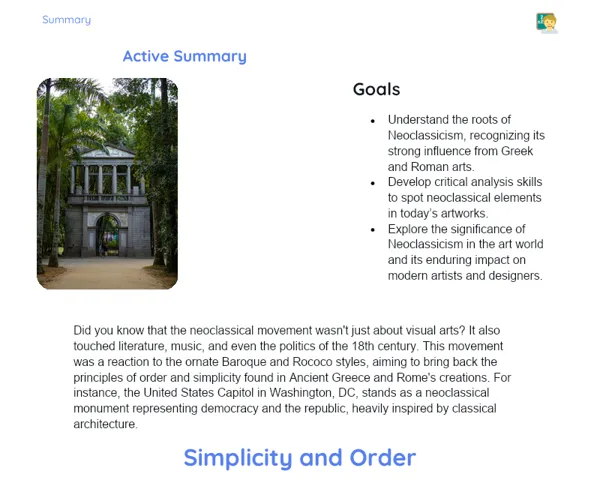
Interestingly, many government buildings and public monuments we see today, including the United States Capitol and Paris's Arc de Triomphe, were influenced by Neoclassicism. This style was particularly chosen for its link to democratic and republican values that gained prominence during the American and French revolutions. Additionally, neoclassical architecture can be discovered in different parts of the world, such as Brazil, where historic structures in cities like Rio de Janeiro and São Paulo proudly showcase neoclassical features.
To Remember!
Historical Context
Modern Neoclassicism emerged between the late 18th and early 19th centuries as a counter to Rococo and Baroque styles. These previous styles were noted for their excessive flair, emotional depth, and intricate complexity, which sparked a movement aimed at achieving simplicity and order. The movement was significantly shaped by Enlightenment ideals that championed clarity, rationality, and moral responsibility in both art and public life. The French Revolution played a pivotal role as well, stressing the importance of newfound republican and democratic values that sought expression in the artistic forms of the day. Consequently, Neoclassicism became a hallmark of discipline, proportion, and moral grandeur, providing a clear counterpoint to the extravagance of Baroque and Rococo. This era also witnessed a revival of interest in classical antiquity, with artists and architects taking direct inspiration from ancient Greek and Roman works. Archaeological discoveries in places like Pompeii and Herculaneum further fueled this revival, influencing the artistic and architectural pursuits of the time.
-
Reaction against Rococo and Baroque.
-
Influence of the Enlightenment and the French Revolution.
-
Renewed interest in classical antiquity.
Characteristics of Neoclassicism
Neoclassical works are distinguished by their clarity of form, offering a welcome contrast to the more ornate styles of Baroque and Rococo art. The emphasis on symmetry and proportion reflects the classical principles of harmony and equilibrium, with a disciplined approach to the composition of works. Additionally, moral grandeur is a prominent trait, with themes often drawn from ancient history and mythology, underscoring virtues like courage, honor, and patriotism. Rationality is also a crucial attribute, showcasing a more systematic and scientific method of artistic creation, which notably contrasts with the emotive qualities of earlier styles. The color palette tends to be more muted and restrained, emphasizing earthy and neutral tones akin to classical sculptures and architecture. Another defining quality is the straightforwardness of forms and lines, steering clear of excessive embellishment and concentrating on the structural integrity of the artworks.
-
Clarity of form and symmetry.
-
Moral grandeur and historical/mythological themes.
-
Rationality and simplicity in compositions.
Key Artists and Works
Jacques-Louis David stands out as one of the foremost artists of Neoclassicism, particularly known for works like 'The Oath of the Horatii,' which encapsulates ideals of discipline and sacrifice. Jean-Auguste-Dominique Ingres also holds a significant place, with pieces such as 'The Large Odalisque,' which melds neoclassical precision with a nuanced sensuality. Antonio Canova, celebrated as one of the eminent sculptors of the period, is recognized for his sculptures that express idealized beauty and classical serenity, including works like 'Psyche Revived by Love's Kiss.' These artists not only shaped the Neoclassical movement with their interpretations of classical values and exceptional technical prowess but also left a lasting influence on a subsequent generation of artists, shaping the aesthetics of public buildings and monuments of their era.
-
Jacques-Louis David and 'The Oath of the Horatii.'
-
Jean-Auguste-Dominique Ingres and 'The Large Odalisque.'
-
Antonio Canova and his classical sculptures.
Influence on Architecture
Neoclassicism made a profound mark on architecture, with numerous government buildings and public structures embodying the classical principles of simplicity, symmetry, and proportion. The United States Capitol serves as an iconic illustration of this movement, featuring its grand dome and columns that echo the design of ancient Roman temples. Similarly, the Arc de Triomphe in Paris exemplifies this grandeur, visually striking and celebrating military victories and republican ideals. In Brazil, historical architecture in cities like Rio de Janeiro and São Paulo also reflects neoclassical traits, mirroring European influences on local architecture. These buildings are not just testaments to the aesthetics of Neoclassicism but also represent the political and social ideals, such as democracy and republicanism, cherished during the periods of the American and French revolutions.
-
United States Capitol with classical dome and columns.
-
Arc de Triomphe in Paris as a symbol of grandeur and clarity.
-
Historic buildings in Brazil influenced by Neoclassicism.
Key Terms
-
Modern Neoclassicism: An artistic movement from the late 18th to early 19th centuries that drew inspiration from Ancient Greece and Rome.
-
Rococo: An artistic style preceding Neoclassicism, known for its elaborate ornamentation and emotional depth.
-
Baroque: An artistic style that preceded Neoclassicism, characterized by its complexity and dramatic flair.
-
Jacques-Louis David: Esteemed French painter recognized as a central figure of Neoclassicism.
-
Jean-Auguste-Dominique Ingres: Influential French painter celebrated for his neoclassical creations.
-
Antonio Canova: Renowned Italian sculptor famous for his neoclassical sculptures.
-
United States Capitol: A government structure influenced by Neoclassical design.
-
Arc de Triomphe: A monument in Paris that serves as an example of neoclassical architecture.
-
Enlightenment: An intellectual movement that informed Neoclassicism, advocating for rational thought and ethical governance.
-
French Revolution: A significant historical event that influenced the birth of Neoclassicism.
Important Conclusions
Modern Neoclassicism arose in reaction to Rococo and Baroque, heralding a return to the classic values rooted in Ancient Greece and Rome. This movement is noted for its clarity of form, disciplined approach, and moral grandeur—qualities that resonate with the Enlightenment ideals and the shifting political landscape brought on by the French Revolution. The impact of Neoclassicism is visible in various art forms and architectural styles, with remarkable illustrations such as the United States Capitol and the Arc de Triomphe in Paris.
Key artists of this movement, including Jacques-Louis David, Jean-Auguste-Dominique Ingres, and Antonio Canova, were instrumental in defining and propagating neoclassical values through their notable works. Neoclassical architecture, characterized by simplicity and proportion, not only reflects the aesthetic values of its time but also embodies political and social ideals such as democracy and republicanism.
Delving into Modern Neoclassicism is vital for a comprehensive understanding of the evolution of art and architecture, as well as acknowledging how historical and cultural values shape artistic endeavors. The relevance of this movement is underscored by its ongoing influence on contemporary art, highlighting the lasting significance of classical principles in current cultural and aesthetic traditions.
Study Tips
-
Review the main characteristics of Modern Neoclassicism and draw comparisons with earlier artistic styles such as Baroque and Rococo.
-
Conduct research on the pivotal artists of the movement, including Jacques-Louis David, Jean-Auguste-Dominique Ingres, and Antonio Canova, and analyze their masterpieces.
-
Investigate local examples of neoclassical architecture in your city or country, examining how these buildings embody the values reflected in Neoclassicism.