Summary Tradisional | Ancient Rome, Roman Empire: Review
Contextualization
Ancient Rome, which was established in 753 B.C., grew from a modest city-state into one of the largest empires of the ancient world. The imperial era began with Augustus in 27 B.C. following the fall of the Roman Republic and continued until the decline of the Western Roman Empire in 476 A.D. Throughout this period, Rome expanded dramatically, encompassing vast territories in Europe, North Africa, and the Middle East, while also developing political, social, and cultural frameworks that have significantly influenced modern Western society.
Understanding Imperial Rome is vital for grasping the legal, architectural, linguistic, and cultural underpinnings of contemporary Western civilization. The Romans made crucial advancements in architecture, notably the development of the arch and vault, facilitating the construction of robust and expansive structures. Furthermore, the Roman legal system, which encompassed principles like 'Ius Civile' and 'Ius Gentium,' has laid the groundwork for various modern legal systems. The Latin language, the progenitor of the Romance languages, has also left an enduring legacy, as has the spread of Christianity, which has markedly shaped Western culture and society.
To Remember!
Roman Architecture
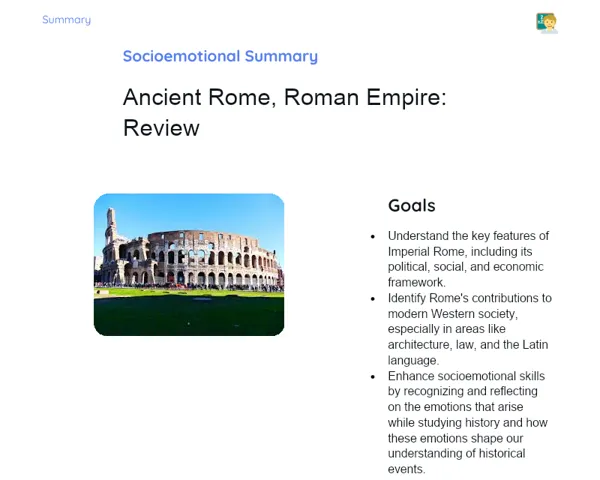
Roman architecture stands as one of the most significant and lasting legacies of ancient Rome. It is distinguished by the pioneering employment of the arch and vault, which facilitated the creation of sturdier and more spacious structures capable of bearing heavy loads. The Romans perfected concrete, a groundbreaking innovation that allowed for intricate and enduring designs. Landmark constructions like the Colosseum, an amphitheater that could seat thousands for public spectacles, and the Pantheon, famous for its grand dome and oculus, still remain among the world's largest unreinforced concrete domes.
Beyond public buildings, Roman aqueducts showcase the engineering brilliance of the Romans. These channels transported water from distant sources to urban areas, enhancing city life and illustrating their advanced hydraulic skills. The Appian Way, one of the earliest and strategically critical Roman roads, exemplifies the resilience and efficiency of Roman construction methods, remnants of which are still evident today.
The influence of Roman architecture on Western architectural practices is profound, with many principles and techniques being embraced and evolved over the centuries. Modern structures such as triumphal arches, bridges, and public buildings carry the legacy of Roman architectural expertise.
-
Innovative use of the arch and vault.
-
Advancements in concrete technology.
-
Construction of enduring aqueducts and roads.
-
Lasting impact on Western architectural styles.
Roman Law
Roman law is one of the key legacies bequeathed by ancient Rome, forming the basis for numerous modern legal systems. 'Ius Civile', or civil law, served as the regulatory framework for Roman citizens, while 'Ius Gentium', or law of nations, applied to all residents of the empire, irrespective of their citizenship status. This dual system facilitated adaptable and comprehensive governance, catering to the diverse cultures existing within the empire.
The 'Twelve Tables', established in the 5th century B.C., marked the first codified set of laws in Rome, paving the way for a more accessible and transparent legal framework. Later, the 'Corpus Juris Civilis', compiled by Emperor Justinian in the 6th century A.D., organized and consolidated Roman laws, becoming a key reference for civil law in many European nations and shaping the evolution of international law.
Roman law also introduced essential legal concepts such as private property, contracts, wills, and civil liability—fundamental principles that continue to underpin modern legal systems and reflect the lasting impact of Roman jurisprudence.
-
Two-tier legal system of 'Ius Civile' and 'Ius Gentium'.
-
Inception of the first legal code: 'Twelve Tables'.
-
Compilation and organization of laws in the 'Corpus Juris Civilis'.
-
Key legal concepts introduced that are still relevant.
Latin Language
Latin, the official tongue of the Roman Empire, has greatly shaped the development of modern languages. The Romance languages—Portuguese, Spanish, French, Italian, and Romanian—evolved from Latin and are spoken by millions globally. Additionally, Latin has had significant influence on scientific, legal, and ecclesiastical terminology, with many technical and religious words still utilized in their original Latin forms.
During the Middle Ages, Latin persisted as the language of learning and liturgy, acting as a conduit for the transmission of classical and medieval knowledge. Works in science, philosophy, and religion were penned in Latin, ensuring the flow of knowledge across generations. Its use as a common language among European scholars fostered communication and exchange of ideas across different cultures and regions.
The lasting impact of Latin extends not only to the Romance languages but also to English and other modern languages, which have integrated a plethora of Latin words. This linguistic heritage underlines the resilience and adaptability of Latin, illustrating the extensive cultural influence of the Roman Empire.
-
Fountainhead of Romance languages.
-
Influence on scientific, legal, and ecclesiastical language.
-
Continued use of Latin in scholarly circles during the Middle Ages.
-
Integration of Latin vocabulary into various contemporary languages.
Cultural and Social Influence
The culture and society of Rome have left a rich legacy on Western civilization. The rise of Christianity, which became the state religion of the Roman Empire in the 4th century A.D., had a transformative impact on Western culture, philosophy, and societal structures. Christianity shaped artistic expression, literary works, and moral frameworks, contributing significantly to the cultural fabric of Europe and regions influenced by Western ideals.
Public entertainments and spectacles, like those staged at the Colosseum, were integral to Roman social life, reflecting the centrality of amusement and community engagement. These events fostered social unity and served as tools for social management, engrossing the populace while showcasing the power and benevolence of the emperors.
The complex social and political architecture of Rome fundamentally shaped Western systems of governance. The concepts of a republic, citizenship rights, and citizen representation were all inherited and adjusted by many contemporary states, thus laying the groundwork for modern democratic principles.
Moreover, Roman art and literature have sustained influence, with countless Western authors, poets, and artists drawing inspiration from Roman classics. The philosophical writings of figures like Cicero, Seneca, and Marcus Aurelius have continued to shape Western thought, promoting ideals of virtue, ethics, and community responsibility.
-
Christianity’s establishment as the state religion.
-
Significance of public games and spectacles in society.
-
Influence on the organization of Western social and political frameworks.
-
Enduring contributions to art, literature, and philosophical thought.
Key Terms
-
Imperial Rome: This was the period of Roman history starting with Augustus in 27 B.C., lasting until the collapse of the Western Roman Empire in 476 A.D.
-
Roman Architecture: A blend of innovative strategies using arches, vaulting, and concrete to build long-lasting and expansive structures.
-
Roman Law: A pivotal legal system that shaped contemporary laws, characterized by 'Ius Civile' and 'Ius Gentium.'
-
Latin Language: The official language of the Roman Empire, it is the origin of Romance languages and significantly impacted scientific and legal terms.
-
Christianity: The religion that rose to prominence within the Roman Empire, leaving a profound mark on Western culture.
-
Twelve Tables: The first codified set of laws in Rome, established for a more open and transparent legal structure.
-
Corpus Juris Civilis: The organized compilation of Roman laws under Emperor Justinian, shaping civil law across many nations.
-
Aqueducts: Ingeniously designed Roman structures that transported water from distant sources to cities, enhancing urban living conditions.
-
Colosseum: A grand Roman amphitheater that hosted numerous public events, accommodating thousands of spectators.
Important Conclusions
Exploring Imperial Rome unveils the significance and longevity of Roman contributions to Western civilization, particularly through architectural advancements like the arch and vault, which facilitated the creation of sturdy and expansive buildings. Iconic structures such as the Colosseum and numerous aqueducts highlight the Romans' superior engineering skills, whose techniques still resonate in present-day construction practices.
The cornerstone of modern legal frameworks, established through the Roman legal system articulated in 'Ius Civile' and 'Ius Gentium', has been foundational for many contemporary judicial setups. The 'Twelve Tables' and the 'Corpus Juris Civilis' are landmark achievements that allowed for the continuity and adaptation of Roman laws over time.
Moreover, the Latin language has played a profound role in the development of the Romance languages, and Christianity, which became the state religion of the Roman Empire, has had a lasting effect on cultural, philosophical, and institutional aspects of Western life. The Roman influence is pervasive, reflecting the continued relevance and significance of studying Imperial Rome.
Study Tips
-
Review your class resources, including presentations and reading materials, to strengthen your grasp of Roman contributions in architecture and law.
-
Investigate further about the impact of the Latin language across various fields of knowledge and its prevalence in modern tongues.
-
Engage with documentaries and literature focusing on Imperial Rome for a richer and deeper understanding of its cultural and societal contributions.