Summary Tradisional | European Maritime Expansion: Review
Contextualization
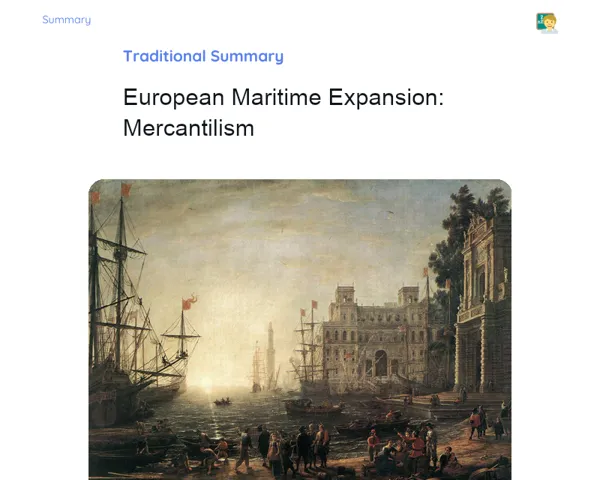
The European maritime expansion from the 15th to the 17th centuries was a landmark event during the Age of Discovery. Countries like Portugal and Spain spearheaded the exploration of new maritime routes, which led to the discovery of continents like the Americas and the establishment of extensive trade networks across the globe. This era was propelled by advancements in navigation technology, the quest for new sources of wealth, and the spread of European political and religious ideologies.
This maritime exploration not only reshaped the course of world history but also had significant impacts on geopolitics, the global economy, and cultural exchanges. The pursuit of spices, such as pepper and cinnamon, proved to be a major driving force for this expansion, as these commodities were highly sought after in Europe. This period facilitated the exchange of flora, fauna, and diseases between the interconnected continents, fundamentally changing societies on both sides of the Atlantic.
To Remember!
Key Players in Maritime Expansion
The maritime exploration was chiefly led by Portugal and Spain. Portugal’s journey began in the early 15th century under Prince Henry the Navigator, who set up the School of Sagres—an important institution for developing navigation and map-making techniques. Christopher Columbus, an Italian sailing for Spain, is well-known for his 1492 voyage that unveiled the Americas. Similarly, Vasco da Gama, navigating for Portugal, charted the sea route to India in 1498, marking a new phase in the spice trade. Another notable figure is Ferdinand Magellan, who, while sailing under the Spanish flag, orchestrated the first circumnavigation of the globe, highlighting the world’s vastness and connection.
-
Portugal and Spain were the main players in this expansion.
-
The School of Sagres was founded by Prince Henry the Navigator.
-
Christopher Columbus's voyage in 1492 led to the discovery of America.
-
Vasco da Gama discovered the route to India in 1498.
-
Ferdinand Magellan completed the first circumnavigation of the Earth.
Motivations for Maritime Expansion
Several factors spurred European maritime expansion, including economic, political, and religious motivations. Economically, there was a strong drive to find new trade routes that could directly access spices and other valuable goods from the East, thus bypassing the Muslim and Italian middlemen who dominated Eastern commerce. Politically, the nascent nation-states of Europe were eager to broaden their territories, enhancing their power and status. On the religious front, there was a fervent ambition to propagate Christianity and convert those who did not adhere to it. This blend of economic, political, and religious aspirations propelled European nations to invest significantly in exploration, resulting in the unveiling of new lands and trade paths.
-
The pursuit of new trade routes to eliminate middlemen.
-
An ambition to expand territories and bolster political clout.
-
A commitment to propagating Christianity and converting other communities.
Technological Advances in Navigation
Technological innovations played a vital role in the success of European maritime explorations. The compass, which originated in China, provided better navigation even in open waters, while the astrolabe, an instrument of Arab origin, enabled sailors to determine their latitude by observing the stars. The development of caravels by the Portuguese produced agile vessels that could sail against the wind due to their unique design. Additionally, with advancements in cartography, maps became increasingly accurate, allowing explorers to chart their courses with greater assurance and efficacy.
-
The compass facilitated precise open-sea navigation.
-
The astrolabe helped sailors determine latitude based on star observation.
-
Caravels were versatile ships capable of sailing upwind.
-
Improved accuracy of maps made route planning easier.
Impacts of Maritime Expansion
The impacts of European maritime expansion were significant and enduring, affecting the global economy, cultural interactions, and geopolitics. Economically, new trade routes and territories boosted international trade and wealth circulation, fostering the rise of a globalized economy. Culturally, a vibrant exchange transpired between continents, known as the Columbian Exchange, involving the movement of plants, animals, and diseases among the Americas, Europe, Africa, and Asia. Geopolitically, this expansion paved the way for the colonization of vast lands and the proliferation of European influence worldwide, drastically reshaping the global power dynamics.
-
An increase in international trade and wealth circulation.
-
Cultural exchanges flourished between continents.
-
Widespread colonization and dissemination of European ideologies.
Key Terms
-
European Maritime Expansion: The historical process of exploration and colonization driven by European nations.
-
Prince Henry the Navigator: Portuguese royal who established the School of Sagres.
-
Christopher Columbus: Navigator who discovered the Americas in 1492.
-
Vasco da Gama: Portuguese navigator who discovered the sea route to India.
-
Ferdinand Magellan: Navigator who led the first circumnavigation of the globe.
-
Columbian Exchange: The transfer of plants, animals, and diseases between the continents.
Important Conclusions
The European maritime expansion from the 15th to the 17th centuries marked a pivotal moment in human history. Spearheaded by Portugal and Spain, this movement was driven by various economic, political, and religious factors. Key technological advancements in navigation, including the compass, astrolabe, and the development of caravels, were instrumental in the success of these expeditions, enabling navigators to venture into uncharted territories with more accuracy and safety.
The repercussions of this maritime expansion are profound and multifaceted, ranging from boosted international trade and wealth circulation to vibrant cultural exchanges. This interaction not only introduced novel flora and fauna between continents but also facilitated the spread of diseases, leading to severe consequences for indigenous populations in the Americas. Furthermore, this period saw the colonization of extensive lands and the establishment of European influences globally, thereby shifting the global balance of power.
Understanding European maritime expansion is vital for grasping how the modern world was forged. It sheds light on the foundations of today's interconnected global economy, cultural exchanges among diverse populations, and the geopolitical dynamics influencing international relations even today. I encourage you to delve deeper into this intriguing topic and explore the historical details and outcomes of this critical era.
Study Tips
-
Review the key navigators and their contributions, such as Christopher Columbus, Vasco da Gama, and Ferdinand Magellan. Create mind maps to link their voyages and discoveries.
-
Investigate primary and secondary sources on the cultural exchanges between continents to comprehend the economic and social impacts of maritime expansion. Historical documents, ship logs, and contemporary narratives are excellent resources.
-
Explore the technological advancements in navigation—like the compass, astrolabe, and caravels—and understand how each instrument functioned and contributed to the success of sea expeditions.