Objectives
1. Examine the backdrop of the Russian Revolution, particularly focusing on how World War I and socioeconomic pressures spurred the revolutionary movement.
2. Contextualize and assess the significant events of the Russian Revolution, enabling students to grasp the various phases and the ensuing political, social, and economic transformations.
Contextualization
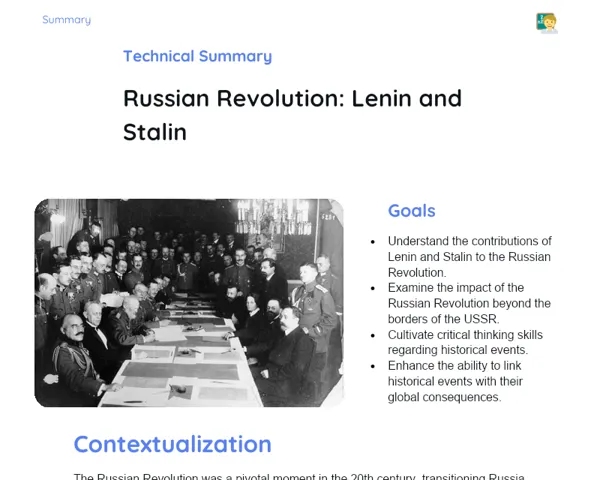
Did you know the Russian Revolution wasn't simply a historical event, but a monumental upheaval that altered the course of the 20th century? Sparked by severe social disparities, economic turmoil, and worsened by the devastation of World War I, the revolution not only led to the downfall of an empire but also heralded the rise of the Soviet Union, which became one of the major superpowers of the last century. This occurrence not only reshaped Russian politics and society but also had a significant ripple effect on social and political movements across the globe, influencing the dynamics of the Cold War and beyond.
Important Topics
Background of the Russian Revolution
The Russian Revolution emerged from a confluence of factors, including long-standing oppression under the Tsarist rule, disastrous involvement in World War I, which intensified social and economic unrest, and growing discontent among the populace. Russia was grappling with a severe crisis marked by a crumbled economy and a repressive political framework that left little room for meaningful reform.
-
Tsarist Regime: Defined by an absolute monarchy, the tsars suppressed any dissent and maintained a deeply unequal social structure.
-
Participation in World War I: The war's profound social and economic impacts led to widespread discontent and drained both the military and the economy.
-
Economic Crisis and Social Inequality: Mismanagement and famine worsened Russia's economic crisis, deepening the divide between the nobility, the emerging middle class, and the overwhelming majority of peasants.
Phases of the Russian Revolution
The Russian Revolution famously unfolded in two main stages: the February Revolution and the October Revolution. The February Revolution of 1917 forced Tsar Nicholas II to abdicate and resulted in the formation of a provisional government, while the October Revolution of that same year, led by the Bolsheviks, established a communist regime, marking the start of radical changes in Russia.
-
February Revolution: Initially a rebellion against the monarchy, it led to a provisional government but failed to address urgent demands for peace and social reforms.
-
October Revolution: Under Lenin's leadership, this phase saw the overthrow of the provisional government and the establishment of a communist regime that promised peace, land, and bread, radically reshaping Russia's political and economic landscape.
Impacts of the Russian Revolution
The ramifications of the Russian Revolution were tremendous, not just domestically but also on a global scale. The establishment of the Soviet Union as the first socialist state, the subsequent Russian Civil War, and revolutionary policies transformed Russian society and economy while inspiring revolutionary movements worldwide.
-
Creation of the Soviet Union: The Revolution birthed the world's first socialist state, creating a counterpoint to Western capitalism and ideologically influencing numerous nations.
-
Civil War: The internal strife that followed the revolution involved various factions and was brutally destructive, resulting in millions of deaths and widespread devastation.
-
Domestic Policies: Initiatives like land reforms, nationalization of industries, and the imposition of a centralized planning system had profound and lasting effects on Russia's economy and society.
Key Terms
-
February Revolution: Often referred to as the March Revolution, it was the first stage of the Russian Revolution, culminating in Nicholas II's abdication and a provisional government taking charge.
-
October Revolution: The subsequent phase following the February Revolution, spearheaded by the Bolsheviks, leading to a power shift and establishment of a communist regime.
-
Bolsheviks: A political faction led by Lenin, playing a crucial role in the Russian Revolution and the formation of the Soviet government.
-
Soviet Union: A socialist state that emerged from the Russian Empire post-revolution, encompassing several socialist Soviet republics.
For Reflection
-
How did the socioeconomic and political landscape of pre-revolutionary Russia contribute to the onset of the Russian Revolution?
-
In what ways did Russia’s involvement in World War I shape the trajectory of revolutionary events?
-
What were the most significant challenges faced by revolutionary leaders in solidifying their power and communist ideology in post-revolutionary Russia?
Important Conclusions
-
The Russian Revolution represented a pivotal moment in history that not only dismantled an imperial government but also laid the groundwork for the world’s first socialist state, the Soviet Union.
-
The revolution's antecedents, including involvement in World War I and socioeconomic inequalities, illuminated the conditions that precipitated the upheaval and enhanced our understanding of the era's social and political dynamics.
-
The evolution of the revolution, from the February to the October Revolution, illustrates the shifts in power that not only defined Russia but also had far-reaching implications for international events.
To Exercise Knowledge
Compose a diary entry from the perspective of a character involved in the Russian Revolution. You may choose to portray a peasant, a soldier, or a member of the bourgeoisie, detailing their experiences during the revolution. Create a concept map linking the root causes of the revolution to its political, social, and economic ramifications. Research Lenin’s life and legacy and write an essay discussing his influence in the revolution and his vision for post-revolutionary Russia.
Challenge
Produce a multimedia presentation illustrating how the Russian Revolution inspired revolutionary movements in other nations, such as China and Cuba. Include specific examples and highlight the similarities and differences between the contexts and outcomes.
Study Tips
-
Employ chronological maps to understand the sequence of events of the Russian Revolution and their connections to global developments at the time.
-
Watch documentaries and films on the Russian Revolution for a visual and emotional grasp of the events and the people involved.
-
Engage in online discussions or study groups to debate and exchange perspectives with fellow students regarding the complexities and impacts of the Russian Revolution.