Socioemotional Summary Conclusion
Goals
1. Get to know the major optical instruments and their workings.
2. Learn to calculate distances and focal lengths of key optical devices.
Contextualization
🌟✨ Geometric optics is a captivating field of physics that looks into how light travels. Think about telescopes that help us see far-off stars and galaxies, or microscopes that uncover the unseen world of cells! These tools are pivotal for scientific inquiry as well as our everyday lives. So, let’s plunge into this fascinating realm and see how it all operates! 😉🔭🔬
Exercising Your Knowledge
Lenses
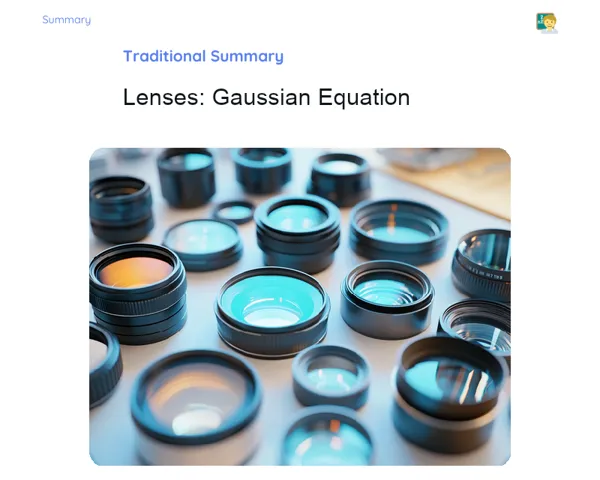
Lenses are clear materials shaped by two surfaces, at least one of which is curved. They are crucial for correcting vision issues (like myopia and hyperopia) and appear in various optical instruments, such as spectacles, microscopes, and telescopes. Lenses can be converging (convex) or diverging (concave), depending on their effect on light.
-
Convex Lenses: They converge light rays, forming real or virtual images based on the object's distance from the lens.
-
Concave Lenses: They diverge light rays, consistently producing virtual images that are smaller than the object.
-
Applications: Used in spectacles to enhance vision, in magnifying glasses to enlarge images, and are vital components in cameras, microscopes, and telescopes.
Mirrors
Mirrors are reflective surfaces that can be flat or curved (concave and convex). They reflect light predictably and are commonly found in our homes and in various optical devices, such as telescopes and periscopes. Concave mirrors gather light, while convex mirrors spread it.
-
Flat Mirrors: Produce virtual images that are the same size as the object and appear at the same distance from the mirror.
-
Concave Mirrors: Gather light, potentially forming real and enlarged images or virtual and smaller images based on the object's position.
-
Convex Mirrors: Spread light rays, consistently forming virtual images that are smaller and appear farther away than the object, widening the field of view.
Microscopes
Microscopes are instruments that use multiple lenses to magnify images of tiny objects, revealing details that are invisible to the naked eye. They come in optical and electronic types, each serving specific purposes.
-
Optical Microscopes: They utilize lenses to enlarge images of small entities, such as cells and microorganisms, and are commonly used in biology and medical labs.
-
Electronic Microscopes: They employ electron beams to create highly enlarged images of minuscule samples, such as cellular structures and viruses.
-
Importance: Essential for advances in biology, medicine, and materials science, they aid in research and medical diagnostics.
Telescopes
Telescopes are designed to observe far-off celestial bodies, like stars and planets. They can be refractors, which use lenses, or reflectors, which use mirrors. Telescopes are indispensable for astronomy, enabling the exploration and understanding of the universe.
-
Refracting Telescopes: They use convex lenses to gather light and form images. They are simpler but can suffer from colour distortions.
-
Reflecting Telescopes: They utilize mirrors to converge light and form images, removing chromatic aberrations and allowing for the construction of larger telescopes.
-
Contributions: Facilitate the observation of galaxies, stars, planets, and more, expanding our knowledge of the cosmos.
Cameras
Cameras employ a lens system to focus light onto a film or digital sensor, capturing images of the surroundings. From traditional cameras to modern digital and smartphone models, these devices are key for preserving memories and recording events.
-
Lenses: Focus light to create sharp images on film or digital sensors.
-
Shutter: Controls how long the sensor or film is exposed to light, influencing the brightness and details of the image.
-
Aperture: Regulates the amount of light entering the camera, affecting the depth of field and overall exposure of the image.
Glasses
Glasses employ specific lenses to rectify visual impairments like myopia, hyperopia, and astigmatism. Tailored to individual needs, glasses enhance quality of life by providing clear and comfortable vision.
-
Diverging Lenses: Help correct myopia by aiding in focusing distant images on the retina.
-
Converging Lenses: Assist in correcting hyperopia by helping focus nearby images on the retina.
-
Adaptability: Glasses can be customized with various lens types and frames to meet personal visual and style preferences.
Projectors
Projectors use a lens system to enlarge images and project them onto a screen, making them visible to a big audience. They are widely used in educational settings, cinemas, and corporate presentations.
-
Projection Lens: Expands the image to project onto a large screen.
-
Light Source: Ensures adequate brightness for the image to be seen under different lighting conditions.
-
Applications: Utilized in classrooms, theatres, conferences, and events, aiding visual communication for larger crowds.
Key Terms
-
Geometric Optics: A branch of physics examining light propagation and its behaviors.
-
Converging Lenses: Lenses that converge light rays to a focal point.
-
Diverging Lenses: Lenses that spread light rays from a focal point.
-
Concave Mirrors: Mirrors that converge light, resulting in real and virtual images.
-
Convex Mirrors: Mirrors that spread light, creating virtual and smaller images.
-
Optical Microscope: An instrument utilizing lenses to enlarge images of small objects.
-
Electronic Microscope: A device using electron beams to create enlarged images of tiny samples.
-
Refracting Telescope: A telescope using lenses to image distant objects.
-
Reflecting Telescope: A telescope using mirrors to form images of far-out objects.
-
Camera: An apparatus that captures images by focusing light on film or a digital sensor.
-
Shutter: A part of the camera that regulates the exposure time of the sensor to light.
-
Aperture: A camera component managing the light entering it, influencing depth of field.
-
Glasses: A device employing lenses to correct visual impairments.
For Reflection
-
How do the optical instruments you interact with daily affect your emotional well-being?
-
In what ways could understanding geometric optics shape your future decisions in careers or hobbies?
-
What techniques have you used to navigate frustration or challenges encountered while building a pinhole camera, and how might those apply in other life situations?
Important Conclusions
-
Optical instruments are crucial for scientific investigation and our daily activities, enabling everything from viewing microorganisms to gazing at stars and galaxies.
-
Grasping how these instruments work and how to compute their properties, including lenses, mirrors, microscopes, telescopes, and cameras, is vital across various fields.
-
Geometric Optics broadens our comprehension of how light interacts with different materials and surfaces, enriching our understanding of both the natural and technological worlds.
Impacts on Society
Understanding Geometric Optics has profound implications for society. In medicine, technologies like optical and electronic microscopes are vital for precise diagnoses and innovative research, directly impacting individuals' health and wellness. In terms of communication, cameras and projectors play a significant role in capturing and sharing visual information, with implications for everything from media to entertainment.
Additionally, telescopes are essential in astronomy, facilitating our exploration of the universe and enhancing our understanding of our place within it. This connection to the cosmos nurtures scientific curiosity and inspires deep reflections on our existence and role in the vast universe. Just imagine being able to observe distant stars and entire galaxies; that experience not only heightens our scientific knowledge but also instills a sense of wonder and humility in the face of the universe's vastness.
Dealing with Emotions
To implement the RULER approach, I recommend taking a few moments at home to reflect on how you felt while learning about optical instruments. Jot down these emotions in a diary and try to understand the triggers behind them. For instance, if you felt frustrated while calculating a focal length, pinpoint what triggered that frustration. Accurately label your emotions, like 'curiosity,' 'excitement,' or 'frustration.' Clearly articulate these emotions, whether it's by having a chat with a friend or penning thoughts in your diary, and consider ways to manage those emotions constructively, such as practicing more calculations or seeking help when necessary.
Remember: recognizing and managing emotions well is an invaluable skill, not just for studying but for life overall.
Study Tips
-
Craft a study timetable by breaking content into manageable segments and regularly revisiting each for a thorough understanding.
-
Employ online videos and animations to visualize the functioning of optical instruments, aiding the comprehension of theoretical concepts.
-
Form study groups with peers to discuss topics covered, share insights, and clarify doubts, making the learning process more interactive and cooperative.