Objectives
1. Identify and analyze the optical interference patterns formed by Newton's rings and understand their connection to waves and light.
2. Develop the ability to calculate wavelengths and the thickness of transparent materials using the interference phenomenon of Newton's rings.
3. Encourage critical thinking and analytical reasoning by applying physics concepts in real-life situations, thereby enhancing our grasp of optical physics.
Contextualization
Did you know that Isaac Newton, the renowned physicist, mathematician, and astronomer, not only laid down the laws of motion and gravity but also made significant contributions to optics? The Newton's rings we will explore are not merely an intriguing phenomenon; they also have practical applications, such as aiding in the production of high-precision lenses and measuring the thickness of transparent materials. This understanding is crucial in diverse fields like technology and medicine. This illustrates how science continues to foster innovation and enhance our daily lives, even centuries later.
Important Topics
Wave Interference
Newton's rings exemplify wave interference. Interference happens when two or more waves converge at a point, leading to a pattern of light enhancement or reduction. For Newton's rings, light reflecting between a flat surface and a spherical lens produces a series of concentric rings that differ in color and intensity, observable when light is cast on them.
-
Newton's rings demonstrate key properties of light, such as its wave behavior and its capacity to change intensity through interference.
-
Analyzing these rings provides insights into the optical properties of materials, including the thickness of thin films and the quality of lenses.
-
This phenomenon is not only of theoretical interest but also holds practical applications in the production of optical instruments and surface analysis.
Spherical Lenses
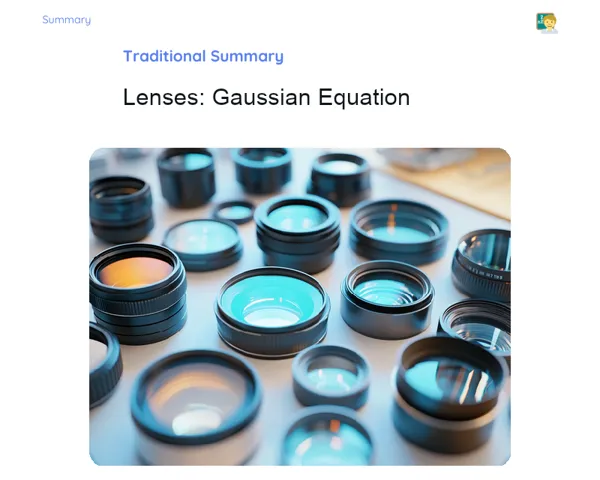
The spherical lens is central to the formation of Newton's rings. The lens modifies the properties of light waves, leading to a particular interference pattern. The distance between the lens and the reflecting surface (flat) influences the characteristics of the rings, such as their size and the sequence of colors, which is vital for comprehending and utilizing the phenomenon.
-
Spherical lenses are commonly used in optics due to their focusing and magnifying traits, thus helping decode intricate optical phenomena like Newton's rings.
-
Modifying the focal distance of the lens can significantly change the interference pattern, which is crucial for applications requiring precise light manipulation.
-
Grasping how lenses impact light is foundational for many technologies, spanning from cameras and microscopes to various scientific and medical instruments.
Light Sources
The light source used to project Newton's rings is vital for observing this phenomenon. Different types of light sources (like lasers, LEDs, and incandescent bulbs) emit light with distinctive properties that influence the formation and clarity of the rings. The coherence and intensity of the light are crucial for observing and analyzing the rings, making the choice of the light source significant.
-
Coherent light sources, such as lasers, are optimal for generating sharp and well-defined interference patterns, essential for high-precision applications of Newton's rings.
-
The quality of the light source directly affects the resolution and clarity of the rings observed, particularly crucial for accurate measurements, as seen in industries like semiconductors.
-
Investigating the properties of various light sources aids in a better understanding of the principles of interference and diffraction, which are fundamental to modern optics.
Key Terms
-
Wave Interference: The phenomenon that happens when two or more waves overlap at the same location, resulting in a pattern of intensifications and reductions.
-
Newton's Rings: An interference pattern produced by light reflected between a flat surface and a spherical lens, displaying varying colors and intensity in concentric circles.
-
Spherical Lens: A lens whose surfaces are parts of a sphere. These lenses are crucial in various optical applications due to their focusing properties.
-
Coherent Light Source: A light source that emits waves at the same frequency and phase, resulting in sharply defined interference patterns.
For Reflection
-
How might altering the distance between the lens and the reflecting surface change the observed pattern of Newton's rings?
-
What is the importance of utilizing a coherent light source for studying Newton's rings in precise measurement contexts?
-
In what ways can the study of Newton's rings enhance advancements in imaging technologies and the production of optical devices?
Important Conclusions
-
We delved into the captivating world of Newton's rings, an optical phenomenon that enriches our understanding of light wave interference and has crucial applications in lens manufacturing and measurement technologies.
-
We learned that the creation of Newton's rings hinges on the interaction between a spherical lens and a flat surface, and how careful adjustments in these setups allow for measuring the thickness of transparent materials.
-
We discussed the significance of coherent light sources in obtaining accurate and clear interference patterns, which are vital for high-precision applications, particularly in the semiconductor sector.
To Exercise Knowledge
- Create a model of Newton's rings using a magnifying lens and a piece of aluminum foil. 🔄 2. Attempt to observe Newton's rings on different surfaces such as plastic and glass, and document the variations. 🌈 3. Prepare a brief report on how Newton's rings are utilized in industries today and their impact.
Challenge
Ring Detective Challenge: Use a spherical lens and a small flashlight to measure the thickness of a strand of hair! Keep a record of your process and findings, seeking innovative methods to improve the accuracy of your measurement.
Study Tips
-
Regularly revise interference and diffraction concepts to solidify your understanding of Newton's rings and comparable optical phenomena.
-
Experiment with different types of lenses and light sources at home to see how they influence patterns of interference and light bending.
-
Watch documentaries or videos on the evolution of optics to gain a broader perspective on the context and importance of Newton's rings.