Current Periodic Table | Traditional Summary
Contextualization
The periodic table is one of the most essential and fundamental tools in chemistry. It organizes all known elements systematically, allowing scientists to predict the properties of elements and their chemical reactions. Originally created by Dmitri Mendeleev in 1869, the table has undergone various modifications over the years, culminating in the modern version we use today. This evolution reflects the advancement of scientific knowledge and the discovery of new elements.
The structure of the current periodic table is based on the increasing atomic number of the elements, organized in periods (horizontal rows) and groups or families (vertical columns). Each element in the periodic table has a specific position that reveals much about its chemical and physical properties. In addition to being a theoretical tool, the periodic table has significant practical applications in our daily lives. For example, silicon (Si) is crucial in the manufacturing of electronics, such as computers and smartphones, while aluminum (Al) is widely used in the production of cans and packaging.
Structure of the Periodic Table
The structure of the periodic table is based on the increasing atomic number of the elements, which is the number of protons in the nucleus of each atom. The table is organized into periods (horizontal rows) and groups or families (vertical columns). Each period corresponds to a shell of electrons around the nucleus of an atom, and the elements in the same group have similar chemical properties because they have the same number of electrons in their valence shell.
The periods of the periodic table range from 1 to 7, and the higher the period number, the greater the number of electron shells in the atoms of the elements that compose it. The groups are numbered from 1 to 18 and represent families of elements with similar chemical properties. For example, the elements in group 1 are known as alkali metals and are highly reactive.
The table is also divided into blocks (s, p, d, f) that indicate the electron subshell where the last electron of an element is located. The blocks help identify common characteristics among the elements, such as reactivity and physical state at room temperature.
-
Organization based on increasing atomic number.
-
Division into periods (horizontal rows) and groups or families (vertical columns).
-
Existence of s, p, d, and f blocks that indicate the subshell of the last electron.
Classification of Elements
The chemical elements in the periodic table are classified into three main categories: metals, nonmetals, and transition metals. Each of these categories has distinct physical and chemical properties that influence the behavior of the elements in chemical reactions.
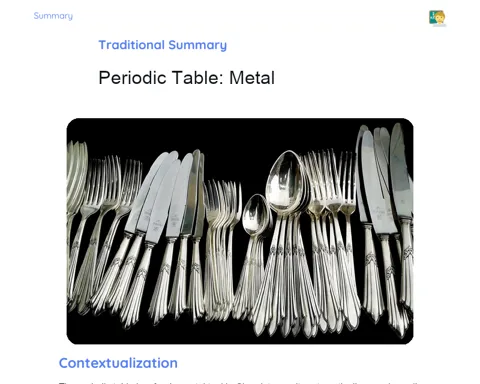
Metals, which occupy the largest part of the periodic table, are characterized by their high electrical and thermal conductivity, malleability, and ductility. They tend to lose electrons in chemical reactions, forming cations. Examples of metals include iron (Fe), copper (Cu), and aluminum (Al).
Nonmetals, on the other hand, have low electrical and thermal conductivity and are generally brittle when solid. They tend to gain electrons in chemical reactions, forming anions. Examples of nonmetals include oxygen (O), sulfur (S), and chlorine (Cl). Transition metals are a special group of metals that have intermediate properties and are known for their ability to form stable complexes.
-
Classification into metals, nonmetals, and transition metals.
-
Metals: high conductivity, malleable, and tendency to form cations.
-
Nonmetals: low conductivity, brittle, and tendency to form anions.
Families of Elements
The families of elements in the periodic table are groups of elements that have similar chemical properties. Each family occupies a specific column in the table and is designated by a group number. The main families include alkali metals (group 1), alkaline earth metals (group 2), halogens (group 17), and noble gases (group 18).
Alkali metals, like sodium (Na) and potassium (K), are highly reactive and have one electron in the valence shell. This reactivity increases as you move down the group. Alkaline earth metals, like calcium (Ca) and magnesium (Mg), are also reactive but less so than alkali metals, and have two electrons in the valence shell.
Halogens, like fluorine (F) and chlorine (Cl), are highly reactive nonmetals with seven electrons in their valence shell, tending to gain one electron to complete their shell. Noble gases, like helium (He) and argon (Ar), are chemically inert due to their complete valence shell, making them very stable.
-
Families occupy specific columns in the table.
-
Alkali metals (group 1): highly reactive, one electron in the valence shell.
-
Halogens (group 17): reactive nonmetals, seven electrons in the valence shell.
-
Noble gases (group 18): chemically inert, complete valence shell.
Periodic Trends
Periodic trends are observable patterns in the properties of elements that occur across periods and groups of the periodic table. These trends help predict the chemical behavior of elements and are essential for understanding the chemistry of elements.
Electronegativity is the tendency of an atom to attract electrons in a chemical bond. It increases across a period from left to right and decreases down a group. The most electronegative elements are found in the upper right corner of the table, such as fluorine (F).
Ionization energy is the amount of energy required to remove an electron from an atom in the gaseous state. This energy increases across a period and decreases down a group. The atomic radius is the distance between the nucleus of an atom and the outermost layer of electrons. It decreases across a period due to increasing nuclear attraction and increases down a group due to the increase in the number of electron shells.
-
Electronegativity: tendency to attract electrons, increases from left to right and decreases down a group.
-
Ionization energy: energy needed to remove an electron, increases across a period and decreases down a group.
-
Atomic radius: distance from the nucleus to the outermost layer of electrons, decreases across a period and increases down a group.
To Remember
-
Periodic Table: Systematic organization of chemical elements based on atomic number.
-
Period: Horizontal row in the periodic table.
-
Group/Family: Vertical column in the periodic table.
-
Metals: Elements with high electrical and thermal conductivity, malleable and ductile.
-
Nonmetals: Elements with low electrical and thermal conductivity, generally brittle.
-
Transition Metals: Elements that have intermediate properties between metals and nonmetals.
-
Electronegativity: Tendency of an atom to attract electrons in a chemical bond.
-
Ionization Energy: Energy required to remove an electron from an atom in the gaseous state.
-
Atomic Radius: Distance between the nucleus of an atom and the outermost layer of electrons.
-
Alkali Metals: Elements in group 1, highly reactive.
-
Alkaline Earth Metals: Elements in group 2, reactive.
-
Halogens: Elements in group 17, highly reactive nonmetals.
-
Noble Gases: Elements in group 18, chemically inert.
Conclusion
The periodic table is a central tool in chemistry, systematically organizing the elements based on increasing atomic number. Its structure in periods and groups allows the prediction of the properties and reactivities of the elements, being essential for the understanding of basic and applied chemistry.
The classification of elements into metals, nonmetals, and transition metals, as well as the identification of main families such as alkali metals, halogens, and noble gases, facilitates the understanding of the chemical and physical properties of the elements. This organization reveals patterns and trends that are fundamental for science and technology.
Periodic trends, such as electronegativity, ionization energy, and atomic radius, stand out for their predictable variations across the table. These concepts are crucial for understanding how elements interact and form compounds, directly influencing various practical applications, from electronics manufacturing to the production of industrial materials.
Study Tips
-
Regularly review the periodic table, focusing on the positions of the elements and their classifications into metals, nonmetals, and transition metals.
-
Study each family of elements, such as alkali metals, halogens, and noble gases, and their characteristic properties to facilitate memorization.
-
Practice solving questions about periodic trends, such as electronegativity and ionization energy, to reinforce understanding of variations across the table.