Statics: Levers | Socioemotional Summary
Objectives
1. 🎯 Understand that levers are simple machines that help amplify a force.
2. 🌟 Comprehend how the different types of levers work: Class 1, Class 2, and Class 3.
3. 🛠️ Develop skills to apply these concepts to practical everyday problems.
4. 💡 Relate the concept of levers to the development of socioemotional skills, such as self-control and cooperation.
Contextualization
🔍 Have you ever wondered how a simple bottle opener can make the task of opening a bottle so much easier? Or how a seesaw works? Levers are present in our daily lives in ways we don't always notice. They are incredible tools that allow us to perform tasks with less effort, thanks to the principle of force amplification. But levers are not just physical; they teach us valuable lessons about how small actions can produce significant results, both in our daily activities and in our social interactions. Let's discover how levers work and how we can use them to become more effective and emotionally intelligent!
Important Topics
Introduction to Levers
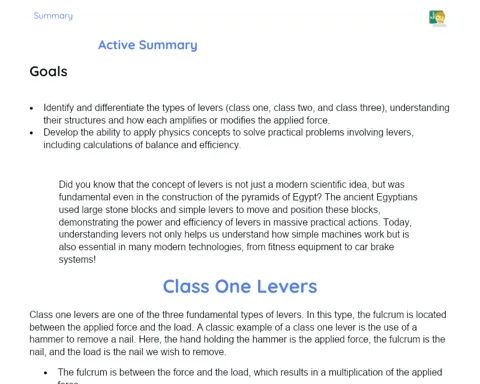
A lever is a simple machine consisting of a rigid bar that rotates around a pivot point, known as the fulcrum. They are used to amplify the force applied at one end, making work easier to accomplish at the other end. Levers can be found in many tools and machines we use in daily life, such as scissors, tweezers, and seesaws. Besides their practical application, the study of levers teaches us the importance of small changes and actions in achieving great results.
-
🎚️ Main Components: A lever has three main components: the force (effort), the load (resistance), and the pivot point (fulcrum).
-
⚖️ Lever Principle: The relationship between force, resistance, and the distances from the fulcrum is fundamental. Use the formula: Force x Distance from Force to Fulcrum = Resistance x Distance from Resistance to Fulcrum.
-
🛠️ Everyday Applications: Common examples include seesaws, scissors, and tweezers, which demonstrate how levers facilitate our daily work.
Types of Levers
There are three main types of levers, classified by the position of the fulcrum, the force, and the resistance. Each type has unique characteristics that influence how the force is applied and amplified. Understanding these types helps not only in Physics but also in developing skills like problem-solving and critical thinking.
-
⚙️ Class 1 Levers: The fulcrum is located between the force and the resistance. Example: seesaw. This type of lever can change the direction of the applied force.
-
🛒 Class 2 Levers: The resistance is between the force and the fulcrum. Example: wheelbarrow. This type maximizes the applied force, making it easier to lift heavy objects.
-
🔧 Class 3 Levers: The force is between the resistance and the fulcrum. Example: tweezers. This type allows for greater control and precision, although it requires more applied force.
RULER Method and Socioemotional Skills
The RULER method is a tool for developing socioemotional skills, essential for dealing with the challenges of practical activities. It involves recognizing, understanding, naming, expressing, and regulating emotions, promoting a more collaborative and effective learning environment.
-
👀 Recognize: Identify the emotions felt during challenging activities, such as building levers.
-
🧠 Understand: Comprehend the causes of these emotions and how they affect performance and collaboration.
-
🗣️ Express: Share emotions constructively and respectfully, encouraging a supportive environment.
-
💪 Regulate: Develop strategies to deal with difficult emotions, such as taking breaks or asking for help, improving resilience and self-control.
Key Terms
-
⚙️ Lever: A simple machine that amplifies the applied force through a rigid bar and a pivot point.
-
⚖️ Fulcrum: The pivot point around which the lever's bar rotates.
-
🔧 Force (Effort): Energy applied to move the resistance.
-
🛒 Resistance (Load): The object or load that one wants to move using the lever.
-
🔄 Class 1 Lever: A type of lever where the fulcrum is between the force and the resistance.
-
📦 Class 2 Lever: A type of lever where the resistance is between the force and the fulcrum.
-
✂️ Class 3 Lever: A type of lever where the force is between the resistance and the fulcrum.
To Reflect
-
🤔 Reflection 1: How can you use the concept of levers in your daily life to perform tasks more efficiently? Think of a specific example and describe how the lever facilitates the task.
-
📚 Reflection 2: Relate the principle of levers to a situation where a small action of yours had a significant positive impact on a group or an activity. How did you feel when you realized this amplification of effort?
-
💬 Reflection 3: During the practical activity of building levers, what emotions did you experience? How did you use emotional regulation strategies to deal with these emotions and collaborate effectively with your peers?
Important Conclusions
-
🔧 Levers are simple machines that help amplify a force, making physical tasks easier.
-
💡 There are three main types of levers: Class 1, Class 2, and Class 3, each with distinct characteristics.
-
🌟 Understanding the principle of levers allows us to apply them in various everyday situations, making our lives easier.
-
🧠 The application of socioemotional concepts, such as the RULER method, helps improve our collaboration and resilience in practical activities and daily challenges.
Impact on Society
Levers have a significant impact on our daily lives, simplifying tasks that would be much more difficult without them. Whether using scissors, a bottle opener, or even a wheelbarrow, levers help us accomplish work with less effort. This shows how physics is present in our everyday life, often in ways we don't notice.
Moreover, the study of levers also has an important emotional connection. We learn that small actions can lead to significant changes, both physically and emotionally and socially. This encourages us to be more aware of our actions and to collaborate more effectively with others, knowing that our contributions can have a significant impact.
Dealing with Emotions
To help manage your emotions while studying levers and their applications, I propose the following exercise based on the RULER method: Take a quiet moment at home and reflect on a situation where you faced a challenge similar to understanding a new concept. Acknowledge the emotions you felt, such as frustration or excitement. Then, try to understand why you felt that way and correctly name those emotions. Express your feelings by writing about the experience, and finally, think of strategies you used or could use to regulate those emotions, such as deep breathing or asking someone for help. This exercise will help develop self-control and resilience.
Study Tips
-
📚 Create visual analogies: Draw or build simple models of levers using household materials to visualize how they work.
-
📝 Write short summaries: Write brief summaries about each type of lever and their applications, helping to fix the content practically.
-
🤝 Group study: Discuss the topic with peers, exchange ideas, and clarify doubts together, promoting a collaborative and enriching learning experience.