Unraveling Solutions: Chemistry in Practice
Objectives
1. Understand that a solution is a homogeneous mixture.
2. Differentiate between solute (dissolved substance) and solvent (substance that dissolves the solute).
Contextualization
Solutions play a fundamental role in our daily lives and in various industries. From the coffee we drink in the morning to the medications we use to treat diseases, solutions are present in many aspects of our daily routine. For example, in the pharmaceutical industry, many medications are liquid solutions that need to be precisely formulated to be effective and safe. In the food industry, drinks, syrups, and condiments are products that rely on well-prepared solutions to ensure flavor, texture, and preservation. Additionally, in the cosmetics industry, perfumes and lotions are solutions where the solute (fragrances, moisturizers) is dissolved in solvents (alcohol, water).
Relevance of the Theme
Understanding how solutions are formed and how they work is essential for various professions, especially in the pharmaceutical, food, and cosmetics industries. This knowledge is not only crucial for the precise formulation and manipulation of products but also fundamental for ensuring their quality and effectiveness. Therefore, mastering these concepts prepares students for the challenges of the job market and for solving practical problems.
Solutions
A solution is a homogeneous mixture of two or more substances. In a solution, the dissolved substance is called the solute and the substance that dissolves the solute is called the solvent. Solutions can be found in different physical states: solid, liquid, and gas.
-
Homogeneous mixture: the particles of the solute are evenly distributed in the solvent.
-
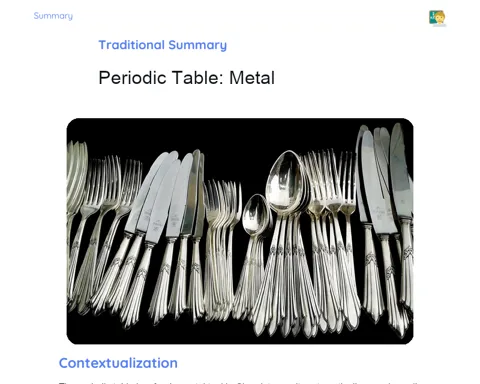
Physical states: a solution can be solid (metallic alloys), liquid (water with sugar), or gaseous (atmospheric air).
-
Everyday examples: coffee, saltwater, soft drinks.
Solute
The solute is the substance that is dissolved in a solvent to form a solution. The amount of solute present in a solution determines its concentration. The solute can be solid, liquid, or gas.
-
Dissolved substance: it is the substance that disperses in another.
-
Influence on concentration: the amount of solute directly affects the concentration of the solution.
-
Examples: sugar in water, salt in water, carbon dioxide in soft drinks.
Solvent
The solvent is the substance that dissolves the solute to form a solution. The solvent is usually present in larger quantity in the solution. Water is known as the 'universal solvent' due to its ability to dissolve many substances.
-
Substance that dissolves: it is the substance that disperses the solute.
-
Presence in larger quantity: generally, the solvent is in larger quantity in the solution.
-
Examples: water, ethanol, acetone.
Practical Applications
- In the pharmaceutical industry, the preparation of liquid medications requires precision in the formulation of solutions to ensure efficacy and safety.
- In the food industry, the production of beverages and syrups depends on the correct preparation of solutions to maintain flavor and preservation.
- In the cosmetics industry, the formulation of perfumes and lotions involves the dissolution of fragrances and other components in suitable solvents.
Key Terms
-
Solutions: Homogeneous mixtures of two or more substances.
-
Solute: Substance dissolved in a solvent to form a solution.
-
Solvent: Substance that dissolves the solute to form a solution.
-
Concentration: Amount of solute present in a specific amount of solvent or solution.
-
Homogeneous mixture: Mixture in which the components are evenly distributed.
Questions
-
What would our life be like without solutions? Which everyday products would cease to exist?
-
Why is it important to understand the difference between solute and solvent when preparing solutions?
-
How can knowledge about solutions be useful in future careers in the pharmaceutical, food, or cosmetics industry?
Conclusion
To Reflect
Throughout this lesson, we explored the fascinating world of chemical solutions and their importance in our daily lives and various industries. Understanding how solutions are formed and how they work is essential for many professions and daily activities. Solutions are fundamental to the production of medicines, foods, and cosmetics, highlighting the need for precision and understanding in the preparation and manipulation of these products. Reflect on how today's learning can be applied to your future career and everyday life, recognizing the importance of each concept addressed.
Mini Challenge - Practical Challenge: Preparing a Homemade Solution
This challenge aims to consolidate your understanding of solution formation, allowing you to apply the concepts learned in a simple and practical activity at home.
- Choose a common solute (like salt or sugar) and a solvent (water).
- Measure a specific amount of solute (e.g., 10g of salt or sugar).
- Dissolve the solute in a measured amount of solvent (e.g., 100mL of water) in a transparent container.
- Stir the mixture until the solute is completely dissolved, forming a homogeneous solution.
- Observe and record how long it took for the solute to fully dissolve.
- Calculate the concentration of the solution (mass/volume) and note the results.
- Compare your observations with solutions prepared by colleagues or family members, discussing possible differences.