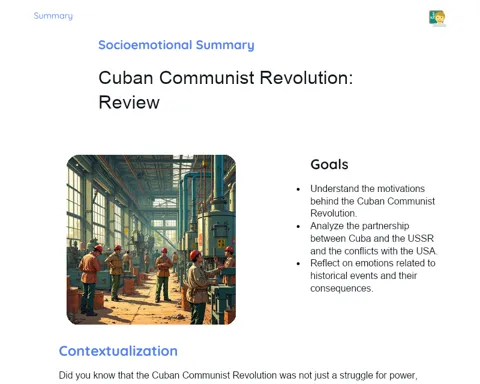
Illustration | Active Summary
Objectives
1. Explore the importance of the Enlightenment in shaping the modern world and its impact on the fields of science, philosophy, and revolutionary movements.
2. Understand how Enlightenment principles of reason, liberty, and equality shaped new perspectives and transformed the social and political structures of the time.
Contextualization
Did you know that the Enlightenment, also known as the 'Age of Reason,' was crucial not only for questioning traditions and the power of the church but also as one of the engines for the first discussions on human rights? The ideas of liberty and equality popularized during the Enlightenment inspired the Declaration of Independence of the United States and were fundamental to the French Revolution. This movement not only reshaped Europe but also laid the foundations for modern democratic and scientific thought.
Important Topics
Rationalism
Rationalism was a central pillar of the Enlightenment, emphasizing reason as the primary source of knowledge and authority. This component challenged the traditional bases of knowledge, which often depended on religious dogmas or monarchy. Philosophers like René Descartes and Immanuel Kant explored and promoted the idea that knowledge and answers to human problems should be sought through analytical and empirical reason, not just through faith or tradition.
-
Descartes coined the famous axiom 'I think, therefore I am,' which became a mantra for rational and critical thought.
-
Rationalism stimulated the development of the scientific method, fundamental for the advancement of modern science.
-
This focus on reason helped to question and eventually change social and political structures, paving the way for more democratic and just systems.
Liberty and Equality
The Enlightenment was also marked by a strong appeal to liberty and equality, principles that became slogans in the American and French Revolutions. Thinkers like Jean-Jacques Rousseau and John Locke argued that all human beings are born free and equal in rights, opposing the feudal structures of power and absolute monarchy. These ideas directly influenced the drafting of important documents such as the U.S. Declaration of Independence and the Declaration of the Rights of Man and of the Citizen in France.
-
Locke developed the theory of the 'social contract,' which suggests that government should be formed with the consent of the governed.
-
The ideas of liberty and equality challenged the established order and encouraged debates about civil and human rights, influencing social movements to this day.
-
These principles were fundamental to the decline of absolutism and the advent of republican and democratic governments.
Empiricism
Empiricism, advocated by philosophers like John Locke and David Hume, is another crucial component of the Enlightenment. This principle asserts that all knowledge comes from sensory experience. Empiricism was essential for the development of the natural sciences, as it promoted observation and experimentation as methods for understanding the world, contrasting with explanations based on sacred texts or unquestionable authority.
-
Empiricism led to the questioning of many 'facts' that were accepted based on traditions or religious interpretations, paving the way for evidence-based science.
-
This approach directly influenced the development of technologies and scientific theories that transformed the world, such as Newtonian physics.
-
It promoted a culture of questioning and verification that is the foundation of modern critical thinking.
Key Terms
-
Enlightenment: An intellectual movement of the 18th century advocating the use of reason and critical thinking to reform society and knowledge.
-
Reason: The human capacity to form logical thought, fundamental to the Enlightenment movement as a tool for knowledge and critique.
-
Liberty: One of the ideals of the Enlightenment, referring to the individuals' ability to act according to their own will, without arbitrary restrictions.
-
Equality: An Enlightenment principle proposing that all men are inherently equal in rights and dignity.
-
Empiricism: A philosophical doctrine emphasizing the importance of sensory experience and observation in the formation of knowledge.
To Reflect
-
How can the ideas of reason and critique from the Enlightenment be applied to solve contemporary challenges in politics or society?
-
In what ways do the principles of liberty and equality influence current discussions about human rights and social justice?
-
Reflecting on empiricism: How can the empirical approach aid in our understanding and response to current environmental issues?
Important Conclusions
-
We explored how the Enlightenment, the famous 'Age of Reason,' was fundamental in shaping the modern world, influencing areas such as science, philosophy, and revolutionary politics.
-
We discussed how the principles of reason, liberty, and equality proposed by Enlightenment thinkers shaped new social and political perspectives, challenging old structures and promoting an environment of critique and questioning.
-
We saw how these ideas remain relevant, inspiring movements for human rights and the establishment of fairer and more democratic governments in the contemporary world.
To Exercise Knowledge
Create a diary of an Enlightenment philosopher: Choose one of the great Enlightenment thinkers and, based on the ideas discussed, write diary entries as if you were that philosopher, reflecting on the challenges of the time and how your ideas could solve them.
Challenge
Creative Enlightenment Challenge: Using recyclable materials, build a 'time machine' that represents an invention that could have been conceived during the Enlightenment. Explain how it would work and what problem it would solve, based on the Enlightenment principles of reason and empiricism.
Study Tips
-
Review your classmates' presentations on different Enlightenment philosophers and note key points that you found interesting or that provoked questions.
-
Watch documentaries or read additional articles about how the Enlightenment influenced other parts of the world, such as the Americas and Asia, to gain a global perspective.
-
Discuss with friends or family how Enlightenment principles, such as liberty and equality, apply (or do not apply) in today's society.