Asia: Socialism: Review | Socioemotional Summary
Objectives
1. Understand how the Cold War influenced the establishment of socialism in Asian countries.
2. Analyze the influence of the USSR in the areas of influence on the Asian continent.
3. Develop self-awareness and self-control skills by reflecting on complex historical contexts.
4. Apply emotional regulation strategies learned during the class.
Contextualization
Have you ever imagined what it would be like to live in a country where political ideologies influence every aspect of your life, from the economy to personal relationships? 🌏 During the Cold War, countries like China, Vietnam, and North Korea underwent radical transformations under the influence of socialism, led by the USSR. By studying this period, you not only understand history but also develop empathy and gain a better understanding of the emotions that shaped the modern world.
Important Topics
Historical Contextualization
The Cold War was a period of intense ideological and geopolitical disputes between the United States and the Soviet Union, lasting from 1947 to 1991. One of the main battles of this confrontation was the spread of socialism in various parts of the world, including Asia. The USSR sought to expand its influence by supporting the establishment of socialist regimes in countries like China, Vietnam, and North Korea.
-
🌍 Division of the World: The world was divided into two blocs, the capitalist led by the US, and the socialist led by the USSR.
-
🛠 Interventions: Many countries became arenas for direct and indirect interventions, resulting in radical political changes.
-
🔄 Alliances and Confrontations: The alliances formed shaped global politics, with important social and economic consequences.
Establishment of Socialism in China
The Chinese Revolution of 1949 marked the beginning of the communist government led by Mao Zedong. Under Mao's leadership, China underwent profound transformations, including land collectivization and the Cultural Revolution. These changes not only altered the country's economic and political structure but also profoundly affected people's daily lives.
-
🚩 Revolution of 1949: Mao Zedong led the revolution that established communism in China.
-
🌾 Land Collectivization: Lands were collectivized, resulting in significant impacts on the agricultural economy.
-
🎨 Cultural Revolution: A period of great turmoil where culture and traditions were radically transformed.
Vietnam War
The Vietnam War (1955-1975) became an emblematic conflict of the Cold War. North Vietnam, supported by the USSR and China, fought against South Vietnam, supported by the US. The leadership of Ho Chi Minh was crucial for the North's victory, which unified the country under a socialist regime. The war had deep social and emotional consequences for the Vietnamese people.
-
⚔️ Prolonged Conflict: Lasted 20 years, causing widespread destruction and suffering.
-
🌐 External Influences: The USSR and China supported the North, while the US supported the South.
-
🏴 Victory of the North: Ho Chi Minh's leadership was essential for the unification of the country under socialism.
Division and Socialism in North Korea
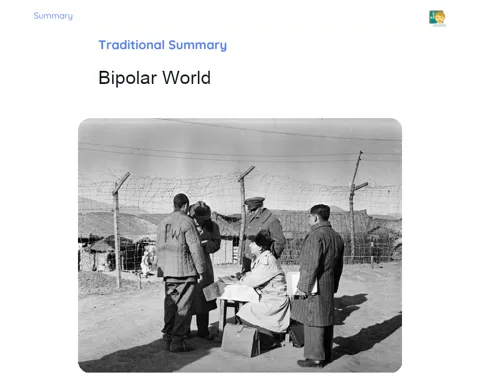
After World War II, Korea was divided into two: the North, under Soviet influence, and the South, under American influence. Kim Il-sung led North Korea and implemented a rigid socialist regime, aligned with the USSR. The division resulted in the Korean War (1950-1953), which further solidified the ideological and political differences between the two Koreas.
-
🌀 Division of Korea: The country was divided into two spheres of influence after World War II.
-
🔒 Rigid Regime: Kim Il-sung established a rigid socialist regime, with strong state control.
-
⚔️ Korean War: Armed conflict that solidified the division and ideological differences between the North and the South.
Key Terms
-
Cold War: Period of geopolitical tension between the United States and the Soviet Union post-World War II.
-
Socialism: Political and economic system where the means of production are collective or state-owned.
-
USSR (Soviet Union): Socialist state, leader of the communist bloc during the Cold War.
-
Chinese Revolution: Movement that resulted in the establishment of communism in China in 1949.
-
Vietnam War: Conflict between North Vietnam (socialist) and South Vietnam (capitalist) supported by the US.
-
Korean War: Conflict between North Korea (socialist) and South Korea (capitalist) from 1950 to 1953.
To Reflect
-
☯️ How do you think living under a socialist regime would have affected your emotions and social interactions?
-
🤔 What could be the emotional impacts of living in a war-torn country or under intense ideological influence?
-
💭 In what ways does the history of socialism in Asia help to understand current political and social issues?
Important Conclusions
-
The Cold War was a period of intense ideological disputes between the US and the USSR, impacting various regions of the world, including Asia.
-
The establishment of socialism in China, Vietnam, and North Korea was strongly influenced by the USSR and resulted in profound political, social, and economic transformations.
-
The Chinese Revolution of 1949, the Vietnam War, and the formation of North Korea under a socialist regime are striking examples of how socialist ideology shaped the history and geopolitics of Asia.
-
Studying this period helps to develop empathy and understand the emotions that shaped political decisions and the daily lives of people at that time.
Impact on Society
Currently, the legacy of socialism in Asia is still visible. China and Vietnam, for example, maintain a socialist political structure, although they have adopted economic reforms that open their economies to the global market. North Korea, on the other hand, continues to be one of the world's most closed and rigid regimes, with economic and social policies that significantly impact the lives of its citizens. Understanding these historical contexts helps to interpret current political dynamics and international relations involving these countries.
Emotionally, studying the establishment of socialism in Asia can awaken feelings of curiosity, empathy, and reflection. By understanding how ideologies influenced the lives of millions, it is possible to develop a more human and conscious perspective on the difficulties and hopes of these populations. This emotional connection turns learning into not just an academic activity but an enriching experience that promotes a more sensitive and critical view of the current world.
Dealing with Emotions
To help you deal with your emotions while studying this complex topic, I suggest practicing the RULER method. First, recognize the emotions you feel while learning about the political and social transformations in Asia. Next, try to understand the causes of those emotions: why does this topic affect you? Name these emotions, whether it's sadness, curiosity, or empathy. Express them healthily, like discussing with a peer or writing about what you felt. Finally, regulate those emotions by finding ways to cope with them, such as breathing techniques or guided meditation. This practice will help you develop greater emotional intelligence and apply those skills in other areas of your life.
Study Tips
-
Create a study schedule that includes additional readings on the Chinese Revolution, the Vietnam War, and the division of Korea. Dedicate specific time to each topic and note your reflections.
-
Participate in group discussions or online forums about the Cold War and the influence of socialism in Asia. Sharing ideas and hearing different perspectives can enrich your understanding.
-
Take advantage of multimedia resources like documentaries and podcasts about the history of socialism in Asia. These materials can provide a more dynamic and engaging view of the topic.