Summary Tradisional | Ancient Rome: Introduction
Contextualization
Ancient Rome stands as one of the most significant civilizations in global history, with its founding traced back to 753 BC and a legacy that endured for over a millennium. The journey of Rome can be categorized into three crucial phases: Monarchy, Republic, and Empire. The Monarchical period was overseen by seven kings, beginning with Romulus and concluding with the downfall of Tarquin the Proud. This initial era was essential in laying the groundwork for Rome's social, political, and cultural framework that supported its expansion.
In 509 BC, the emergence of the Republic ushered in a more inclusive political framework, marked by the establishment of key institutions such as the Senate, Consuls, and the Assembly. This era was characterized by Rome's territorial growth through military victories, notably the Punic Wars against Carthage, securing Roman dominance over the Mediterranean. The Empire phase kicked off with Augustus, heralding the peak of Roman influence. During this time, Rome attained its largest territorial expanse and enjoyed the Pax Romana, a significant period of peace and prosperity. The impact of Roman contributions in areas like law, architecture, language, and religion continues to resonate in the modern Western world.
To Remember!
Foundation of Rome
The origins of Rome are wrapped in intriguing myths and legends. According to tradition, Rome was established in 753 BC by twin brothers Romulus and Remus, who were left to fend for themselves along the Tiber River and nurtured by a she-wolf. After a fateful conflict, Romulus killed Remus and became the inaugural king, thus giving his name to the city. While the tale of Rome's foundation captivates, it also highlights the significance the Romans attributed to their beginnings and divine ancestry. The city evolved from a modest village into a powerful entity, primarily due to its strategic location and the military prowess of its leaders. The actual foundation story is more intricate, involving the amalgamation of diverse tribes such as the Latins, Etruscans, and Sabines. This blending of cultures fostered a resilient society, adept at adapting and thriving.
-
Founded in 753 BC by Romulus and Remus.
-
Legend of the she-wolf that nurtured the twins.
-
Merging of Latin, Etruscan, and Sabine tribes.
The Roman Monarchy
During the monarchical era of Rome, there were seven kings, starting from Romulus and concluding with Tarquin the Proud. In this time, Rome functioned as a small city-state, with its social structure still evolving. The kings wielded political, military, and religious authority, guiding the city during both peaceful and turbulent times. Among these rulers, Numa Pompilius is famed for introducing numerous religious institutions, establishing the religious calendar, and reforming the legal framework, thus laying the foundation for future laws. Another notable figure was Tarquin the Elder, who initiated significant public infrastructure projects, including the Circus Maximus. The monarchy came to an end in 509 BC when Tarquin the Proud was deposed due to his despotic rule, leading to the formation of the Republic—an evolving political system that was more inclusive and decentralized.
-
Governed by seven kings.
-
Numa Pompilius and his religious reforms.
-
Overthrow of Tarquin the Proud in 509 BC.
The Roman Republic
The Roman Republic was instituted in 509 BC following the fall of the last king. This new governance model was characterized by the distribution of power across various institutions such as the Senate, Consuls, and the Assembly. The Senate, made up of aristocrats, advised magistrates and played a crucial role in shaping foreign policy and legislative matters. The Consuls, two magistrates elected annually, shared executive powers, preventing the concentration of authority in one individual. Additional roles included praetors and censors, each with distinct responsibilities in managing the city's affairs. This period was also marked by social strife between the patricians (the elite) and plebeians (the common folk), leading to reforms like the establishment of the Tribunes of the Plebs, granting them the power to veto laws that adversely affected plebeians.
-
Established in 509 BC.
-
Power divided among the Senate, Consuls, and Assembly.
-
Social tensions between patricians and plebeians.
The Roman Empire
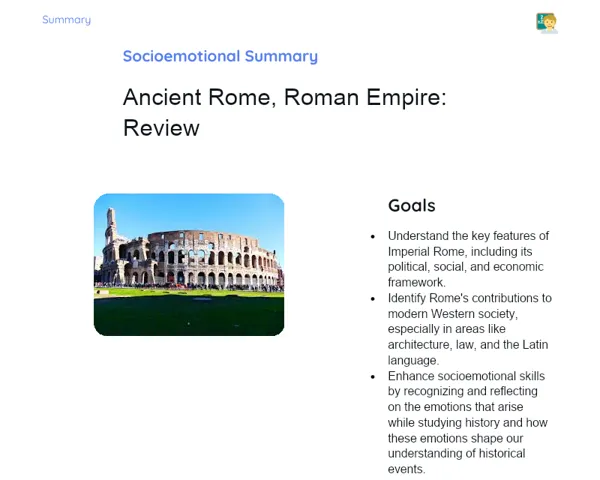
The transition from the Republic to the Empire was initiated by Julius Caesar, who, after declaring himself dictator for life, was assassinated in 44 BC. Augustus, his heir, solidified power and became the first emperor of Rome in 27 BC, marking the apex of Roman territorial and cultural dominance. Augustus introduced several administrative and military reforms that rejuvenated the empire. He ushered in the Pax Romana, a prolonged period of peace and prosperity spanning about 200 years. During this era, Rome expanded its territories and welcomed various cultures within a centralized governance structure. The Empire also witnessed substantial progress in engineering and architecture, exemplified by the construction of aqueducts, roads, and iconic monuments. It was also a time of significant religious transformation with the spread of Christianity, initially a persecuted faith that eventually gained official status.
-
Commenced with Augustus in 27 BC.
-
Era of Pax Romana and territorial growth.
-
Major advances in engineering and architecture.
Key Terms
-
Monarchy: The initial phase of Roman history, governed by kings.
-
Republic: A more inclusive political structure with entities like the Senate and Consuls.
-
Empire: The height of Rome's territorial growth and cultural prominence, initiated with Augustus.
-
Senate: The advisory council of aristocrats in the Roman Republic.
-
Consuls: Two annual magistrates sharing executive authority.
-
Pax Romana: A peaceful and prosperous era during the Roman Empire.
-
Roman Law: The legal framework established by Rome, forming the basis for many contemporary laws.
-
Roman Architecture: Innovations in architecture, including aqueducts, roads, and monuments.
-
Latin Language: The tongue spoken by the Romans, which evolved into the Romance languages.
-
Christianity: The faith that flourished during the Roman Empire, eventually becoming officially acknowledged.
Important Conclusions
Understanding the history of Ancient Rome is vital to comprehending the foundations of the modern Western world. From its origin in 753 BC, Rome traversed three significant phases: Monarchy, Republic, and Empire, each bringing considerable shifts in politics, society, and culture. The transitions between these phases were underscored by pivotal moments such as the overthrow of monarchs, the establishment of republican frameworks, and the ascension of emperors.
During the Republic, Rome fostered a complex political environment encompassing the Senate, the Consuls, and the Assembly, effectively sidestepping the centralization of power in one person. This era also saw considerable territorial expansion through military victories, notably during the Punic Wars. The Empire phase, initiated by Augustus, represented the zenith of Roman authority, characterized by advancements in engineering, architecture, and the spread of Christianity, which emerged as a major world religion.
The influences of Ancient Rome—such as Roman Law, architectural breakthroughs, and the Latin language—continue to shape our society today. Engaging with this remarkable civilization allows for a deeper appreciation of the cultural and legal foundations that persist in our lives. I encourage every student to delve further into this enthralling historical epoch, as its rich legacy is vast and profoundly inspiring.
Study Tips
-
Read books and articles about Ancient Roman history for a more comprehensive understanding of the events and figures discussed.
-
Watch documentaries and historical series that depict Roman civilization; they'll help you visualize and grasp the historical context.
-
Explore museums and exhibitions showcasing Roman artifacts or attend classes and lectures on the topic to enhance your knowledge.